The Martinez family had the idea that using vertical tanks would save them space when they installed their second fuel station in Houston. Their contractors quickly put an end to that idea. “You would probably need a 25-foot excavation pit, which would need special foundation work, and your maintenance costs would be increased threefold.” It took three weeks and a revised engineering plan before standard underground, horizontal tanks were installed.
The wrong choice could cause massive additional installation costs, regulatory headaches, and maintenance into the tens of thousands of dollars. Yet, the vast majority of gas station owners decide based on what people tell them about horizontal tanks rather than on engineering reality.
In this guide: “When and why your goals need to use horizontal tanks (Hint: almost always for retail stations). When you want to consider vertical tanks.” The chapter will examine how most commercial sites can be assessed. At the end of the manual, you will have before you a guide for making the right choice.
What we’ll cover:
- The engineering differences between vertical and horizontal tank orientations
- Why 95% of gas stations choose horizontal tanks for underground storage
- EPA, UL, and international regulatory requirements by tank type
- Complete cost breakdown, including hidden installation factors
- A practical decision framework for your specific project
What Are Vertical and Horizontal Fuel Tanks?
Understanding Vertical Storage Tanks
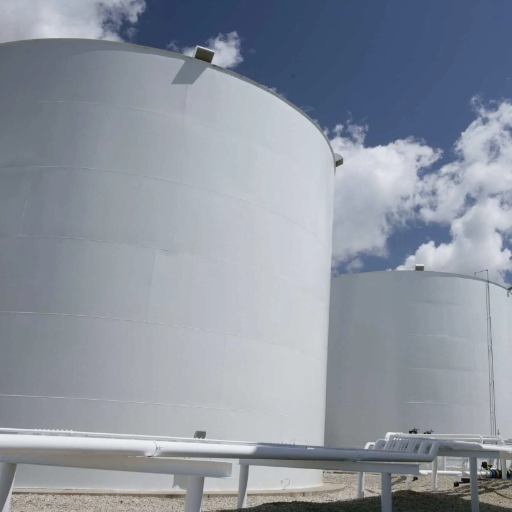
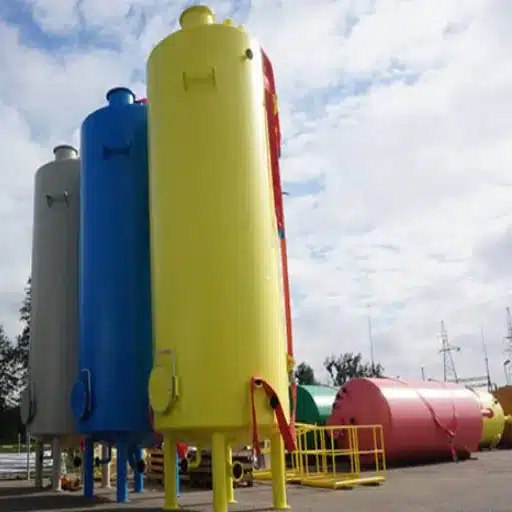
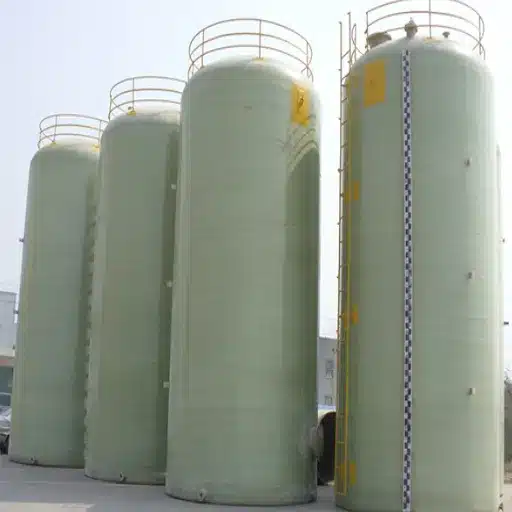
The design of vertical fuel tanks uses cylindrical vessels that stand vertically because their height exceeds their diameter. Imagine a standing drum or silo that exists either underground or above ground, with its circular face directed toward the sky.
Typical specifications:
- The height range for industrial applications extends from 15 feet to 40 feet.
- The diameter range extends from 8 feet to 15 feet.
- The capacity usually exceeds 20,000 gallons.
- The system requires top-mounted manways, which need ladders or lifts for access.
Vertical tanks enable facilities to achieve maximum storage capacity while needing only a small area of ground space. A 30,000-gallon vertical tank might occupy only a 12-foot diameter circle at ground level. The engineering design of this space solution requires multiple engineering design decisions.
The vertical tank design creates a different pressure distribution in the tank system. The tank base needs thick steel or reinforced construction because all fuel weight reaches the tank bottom plate. The tall, narrow profile generates head pressure, which supports gravity-fed systems but makes underground installation more difficult.
Understanding Horizontal Fuel Tanks
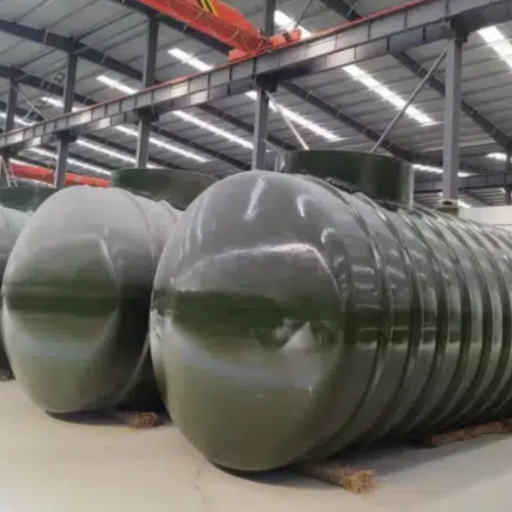
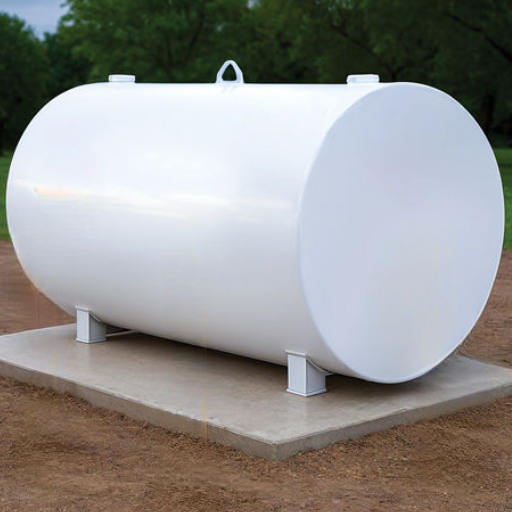
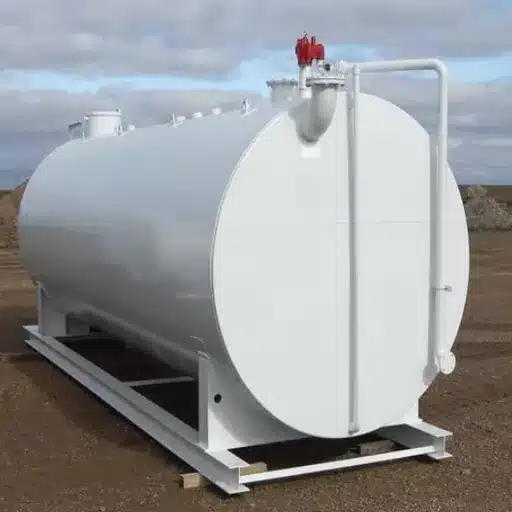
Horizontal fuel tanks lie on their sides, cylindrical bodies parallel to the ground. Picture a large pipe resting in a cradle or buried beneath the surface, with domed ends facing outward.
Typical specifications:
- Length range 15 to 40 feet
- Diameter range 6 to 10 feet
- Capacity 5,000 to 20,000 gallons for retail stations
- Access points, side-mounted manways at ground or near-ground level
Horizontal tanks distribute fuel weight across their entire length, which results in decreased point-loading stress. Their typical height range of 8 to 10 feet enables them to handle soil pressure better when they are underground. This makes them the industry standard for underground fuel storage at retail gas stations.
The orientation also simplifies practical operations. Technicians can inspect, clean, and maintain tanks through side-mounted manways, which require no climbing equipment. The valves, gauges, and connections are positioned at reachable heights, which eliminates the need for ladders or lifts.
The Gas Station Standard: Why Horizontal Tanks Dominate
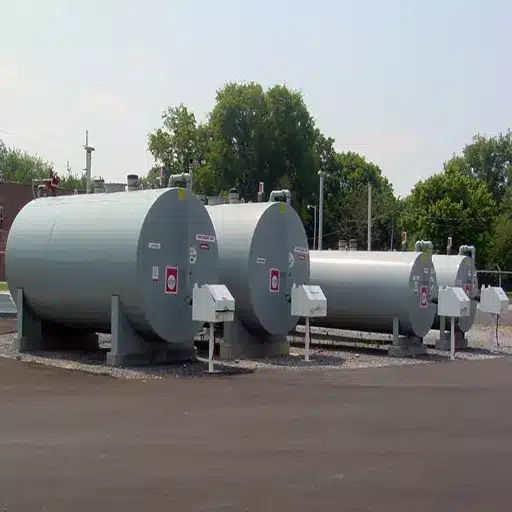
Horizontal tanks power approximately 95% of underground fuel storage installations at retail gas stations across the United States. The result occurs because engineering experts established it through many years of practical testing.
Superior Underground Performance
The tank’s underground movement results in soil becoming its primary adversary. The combination of earth weight, water pressure, and ground movement generates unending pressure on tank structures. Tanks perform better at dealing with force by using a horizontal design.
The domed ends of horizontal tanks distribute external pressure evenly across curved surfaces. Vertical tanks, which have flat or slightly curved bottom plates, direct soil weight to a single horizontal plane. This requires significantly thicker base construction or additional reinforcement.
Pressure distribution comparison:
- Horizontal tanks: The curved cylindrical shell, together with the domed ends, distributes pressure throughout the system
- Vertical tanks: The bottom plate receives pressure while the side walls undergo hoop stress
Maria Chen, a civil engineer who designs fuel systems for a Midwest petroleum contractor, explains: “Vertical tanks at high water table sites need double-thickness bottom plates according to our findings. The process results in higher material expenses together with complicated installation procedures. Horizontal tanks handle the same conditions with standard construction.”
Soil and Excavation Reality
The process of installing underground tanks requires extensive excavation work. The process requires the excavation of more than 10 feet of earth. The depth of horizontal tank trenches needs to be 12 feet while their width needs to be 10 feet, with these measurements varying based on the tank’s size and the area’s frost levels. Equipment operators dig trenches using standard excavators, place the tank on a prepared bedding layer, and backfill around it.
Vertical tanks require the construction of a shaft. The process requires workers to create a cylindrical pit that extends 20 to 40 feet in depth and has enough width to permit vertical tank installation. Specialized drilling equipment replaces standard excavators. The excavation itself becomes a major project component.
Excavation comparison for equivalent 15,000-gallon capacity:
- Horizontal tank: Standard trench, ~1,200 cubic yards of material moved
- Vertical tank: Deep shaft excavation, ~800 cubic yards, but requiring specialized equipment and shoring
The vertical shaft also introduces safety complications. Workers enter deep excavations during installation. OSHA confined space regulations apply. Shoring systems prevent cave-ins. The implementation of each requirement increases both time and expenses and makes the work more difficult.
Maintenance Accessibility
Fuel storage tanks require periodic inspection, cleaning, and maintenance. Someone needs to get inside that tank.
Horizontal tanks place manway openings at the side, typically 3 to 4 feet above the tank bottom for buried installations. Technicians open the manway, set up ventilation and safety equipment, and enter through a standard opening at workable height.
Vertical tanks create a vertical shaft scenario. Maintenance personnel must descend from the top, often using ladder systems or lifts. Fall protection becomes critical. Equipment hoisting adds complexity. Simple tasks require more time, more people, and more safety protocols.
A tank cleaning contractor based in Florida notes, “A routine horizontal tank cleaning takes our crew four hours. We’ve quoted vertical tank jobs at triple that time because of access issues. Those costs get passed to the station owner.”
When Vertical Fuel Tanks Make Sense
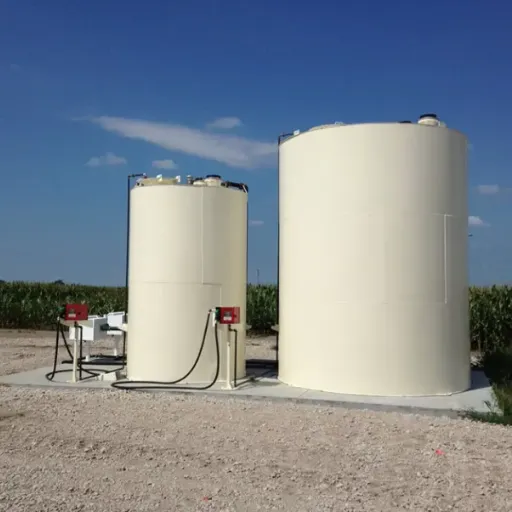
Despite horizontal dominance, vertical tanks serve specific niches where their characteristics provide genuine advantages.
Severe Space Constraints with Available Height
Dense downtown areas create extreme lot restrictions for urban gas stations that operate their business from these locations. The measurement of horizontal footprint in feet establishes the possibility of vertical building design.
The evaluation needs to assess the complete set of benefits and drawbacks that exist between the two options. A 15,000-gallon vertical tank needs roughly 113 square feet of surface area (12-foot diameter circle). The horizontal tank occupies about 240 square feet (8-foot diameter by 30-foot length). The land-value assessment shows that a 127-square-foot difference between the two options requires vertical installation because it has complex installation requirements.
The calculation process for this study undergoes a complete transformation because the containment area has become a new element for consideration. Aboveground vertical tanks require secondary containment systems sized to hold 110% of tank capacity. The containment structure often eliminates the footprint advantage.
Aboveground Applications
Vertical tanks become appropriate for aboveground setups whenever sites lack height limitations and require smaller area usage. Facilities that operate industrial activities and fleet refueling stations and bulk storage terminals use vertical tank systems on occasion.
Aboveground vertical tanks eliminate excavation difficulties, which lead to high costs for installing underground vertical tanks. The system enables maintenance access while wind-load factors remain under control through ground-level tank accessibility.
Very Large Capacity Requirements
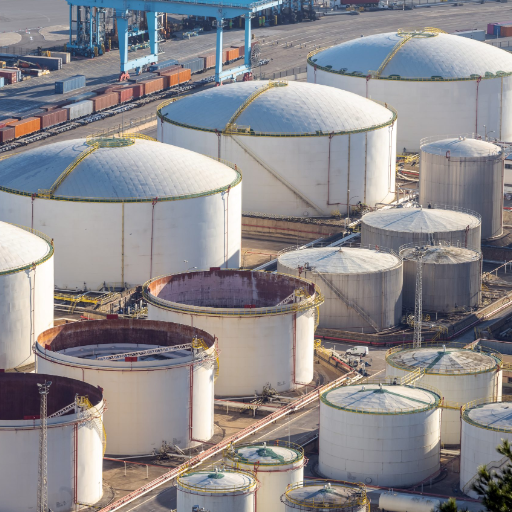
Bulk fuel terminals and distribution centers storing 50,000 gallons or more sometimes use vertical tanks. At extreme capacities, the footprint efficiency becomes meaningful. Multiple horizontal tanks would sprawl across acres; vertical tanks concentrate storage.
These applications represent industrial-scale operations, not retail gas stations. The engineering and maintenance considerations remain significant but become proportionally less impactful at a massive scale.
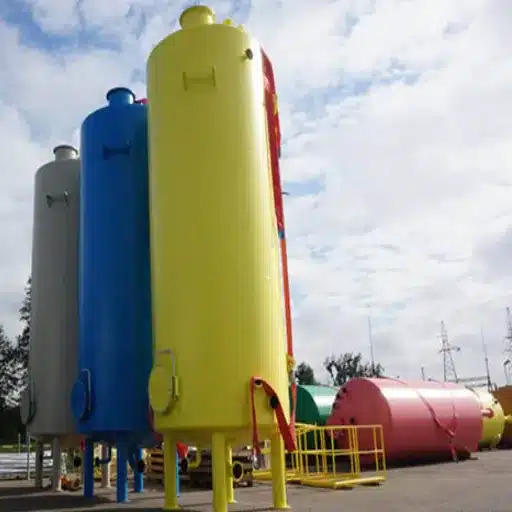
Head-to-Head Comparison: Vertical vs Horizontal Fuel Tanks
| Factor | Horizontal Tanks | Vertical Tanks |
|---|---|---|
| Underground installation | Industry standard, excellent soil load distribution | Complex, requires deep shaft excavation |
| Surface footprint | Moderate (length-based) | Minimal (diameter-based only) |
| Maintenance access | Side manways at workable height | Top-mounted, requires climbing equipment |
| Capacity range | 5,000-20,000 gallons typical | 20,000+ gallons typical |
| Seismic stability | Lower center of gravity | A higher center of gravity requires anchoring |
| Installation cost | Standard | 30-50% higher underground |
| Pressure distribution | Even across a cylindrical shell | Concentrated on the bottom plate |
Space Requirements: The Myth of Vertical Efficiency
Many buyers assume vertical tanks automatically save space. This assumption holds only for the tank structure itself, not the total installation footprint.
Aboveground scenario: A vertical tank requires secondary containment, which must have the capacity to contain its entire liquid volume. A 15,000-gallon tank needs a containment area that measures 16,500 gallons. The containment structure usually needs extra space, which extends beyond the tank’s width. This results in greater land requirements than what a horizontal tank with equivalent containment would need.
Underground scenario: Horizontal tanks actually reduce the amount of surface area that they disturb. The trench gets backfilled. The surface area above becomes usable for dispensers, canopy supports, or traffic. Vertical shafts create disruption to the environment, but they do not decrease the actual amount of disruption.
Cost Analysis: Beyond Purchase Price
Tank purchase price represents only part of the total cost. Installation, maintenance, and compliance expenses often dwarf the initial equipment investment.
Installation cost factors:
- Horizontal tank: Standard excavation (1,500-3,000), standard bedding materials, conventional backfill
- Vertical tank: Shaft excavation with shoring (5,000-10,000+), specialized foundation work, potential dewatering in high water table areas
Maintenance cost factors:
- Horizontal tank: Ground-level access, standard cleaning procedures, routine inspection without specialized equipment
- Vertical tank: Elevated work platforms or lifts for top access, extended cleaning time, confined space procedures
A 2023 analysis by the National Institute for Storage Tank Management found that vertical underground installations cost 35% more than equivalent horizontal installations over a 20-year lifecycle, primarily due to maintenance access complications.
Safety and Stability Considerations
Aboveground vertical tanks face wind-load challenges. A 30-foot-tall cylinder acts like a sail. Engineers must design anchoring systems to prevent overturning in high winds or seismic events. This adds foundation complexity and ongoing inspection requirements.
Horizontal tanks sit low to the ground. Their center of gravity remains close to the foundation, providing inherent stability. Wind passes over rather than pushing against the profile.
Underground, both orientations benefit from soil support. However, horizontal tanks still maintain an advantage in seismic zones. Their lower profile and distributed mass resist ground movement forces better than tall, concentrated vertical structures.
Regulatory Requirements by Tank Type
Fuel storage operates under strict regulatory oversight. Understanding requirements helps avoid costly compliance failures.
EPA Underground Storage Tank (UST) Regulations
The Environmental Protection Agency has established 40 CFR Part 280 as the governing regulation for underground storage tanks, which applies to all storage tanks across the United States. The regulations need to be followed for all tank types, but different procedures exist for their actual application.
Secondary containment requirements: All USTs installed after April 11, 2016, must include secondary containment with interstitial monitoring. The construction of horizontal tanks requires a double-wall design, which establishes an annular space that separates the inner shell from the outer shell. Vertical tanks require similar double-wall systems, but the vertical orientation complicates leak detection sensor placement.
Leak detection: Federal regulations require facilities to conduct monthly leak detection assessments. Horizontal tanks accommodate standard automatic tank gauge systems with probes inserted through top fittings. Specialized probe configurations are necessary for vertical tanks to achieve monitoring of their entire height dimension.
Installation standards: EPA delegates UST program implementation to states, which may impose additional requirements. California, for example, requires enhanced corrosion protection for vertical tanks in coastal areas where saltwater intrusion accelerates metal degradation.
UL Standards and Certification
Underwriters Laboratories (UL) establishes standards that direct the design and safety protocols for fuel tank construction. The main standards that govern this area of work include the following:
UL 142 – Steel Aboveground Tanks for Flammable and Combustible Liquids
- The standard establishes specifications for steel thickness, welding methods, and pressure testing procedures
- The standard requires tanks that hold up to 660 gallons to use 10-gauge (0.123-inch) steel for construction
- The standard requires tanks that hold between 661 and 5,000 gallons to use 8-gauge (0.167 inch) steel for construction
- The regulation applies to all types of aboveground tanks, which include both horizontal and vertical designs
UL 2085 – Protected Aboveground Tanks for Flammable and Combustible Liquids
- The system uses fire-rated materials to create a safer environment, which protects against fire hazards
- The system conducts a two-hour fire test, which reaches 2,000°F
- The system allows shorter distance requirements between tanks than UL 142 tanks
UL 58 – Steel Underground Tanks for Flammable and Combustible Liquids
- The system establishes requirements for both corrosion protection and structural elements, which must be maintained
- The system requires steel tanks to use cathodic protection systems
- The system specifies required steel thicknesses, which depend on different tank size requirements
Tanks that want UL certification must complete additional structural tests that assess their vertical design. Engineers use height-to-diameter ratios to determine wind load effects and anchoring design requirements. The process requires engineering review time and costs, but it does not stop certification.
International Standards
Global projects must navigate multiple regulatory frameworks:
EN 12285-1 (Europe) – Workshop fabricated steel tanks
- Specifies horizontal tanks for underground use at gas stations
- Requires double-wall construction for environmental protection
- Mandates specific leak detection capabilities
GB50156-2012 (China) – Code for design and construction of filling stations
- Specifically designates horizontal tanks for gas station underground storage
- Requires buried depth minimums and setback distances
- Governs tank materials, corrosion protection, and testing
The convergence of international standards on horizontal tanks for retail fuel applications reflects global engineering consensus. When regulatory bodies across North America, Europe, and Asia independently reach the same conclusion, that signals a robust technical foundation.
Choosing the Right Tank for Your Gas Station
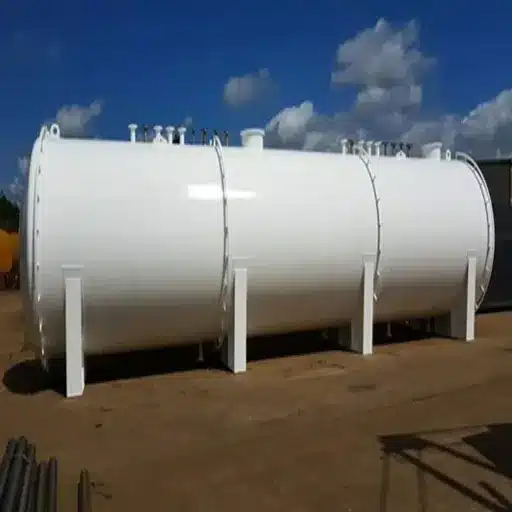
Select Horizontal If:
You’re planning an underground installation. Horizontal orientation handles soil pressure, simplifies excavation, and provides accessible maintenance points. Unless you have extraordinary site constraints, horizontal tanks optimize underground performance.
Your capacity needs fall within 5,000 to 20,000 gallons. This range covers standard retail gas stations. Horizontal tanks are manufactured efficiently at these sizes and installed using conventional equipment.
Your site experiences high winds or seismic activity. Lower center of gravity and distributed mass provide inherent stability without complex anchoring systems.
You expect regular maintenance or inspection. Side-mounted manways at ground level simplify technician access and reduce maintenance costs over the tank lifecycle.
You want standardized regulatory compliance. Horizontal tanks align with EPA, UL, and international standards without special engineering considerations.
Consider Vertical If:
Your aboveground installation faces severe space constraints, and height restrictions don’t apply. Industrial facilities with limited pad space sometimes accept vertical orientation trade-offs.
You’re storing extremely large volumes (50,000+ gallons) at an industrial scale. Bulk terminals occasionally use vertical tanks to concentrate massive storage capacity.
You specifically need gravity-fed dispensing without pump systems. Vertical tanks create natural head pressure that can drive fuel flow in specific applications.
You’re installing aboveground with specialized containment already in place. Existing containment structures sized for vertical tanks might make orientation change uneconomical.
Site Assessment Checklist
Before finalizing tank selection, evaluate these factors:
Soil conditions:
- Soil type and bearing capacity
- Groundwater table depth
- Presence of bedrock or obstructions
- Frost line depth (affects burial requirements)
Space and access:
- Available surface area for excavation or pad
- Overhead clearance (power lines, structures)
- Equipment access for installation
- Future maintenance access routes
Regulatory environment:
- Local UST program requirements
- Setback distances from buildings and property lines
- Fire code requirements (NFPA 30, 30A)
- Environmental sensitivity of the surrounding area
Operational requirements:
- Expected fuel throughput
- Number of product types stored
- Maintenance and inspection schedule
- Long-term site plans (potential relocation?)
Installation Best Practices
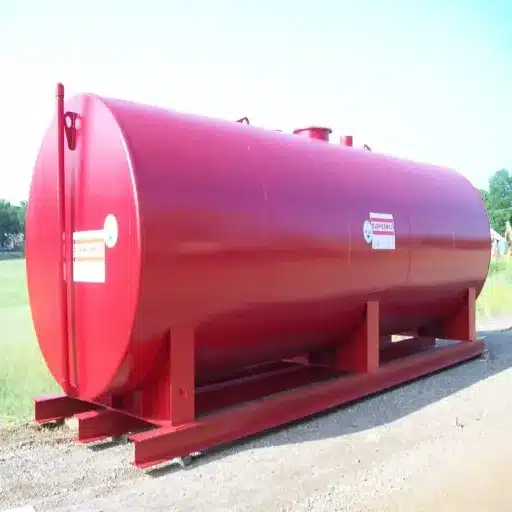
Underground Horizontal Tank Installation
Excavation and bedding: Dig trenches to the specified depth plus bedding thickness. The work requires the complete removal of rock debris and organic material. The installation requires a bedding layer that consists of 6 to 12 inches of compact sand or pea gravel. The crew must achieve a level surface that stretches across the entire length of the tank.
Tank placement: Lower tanks using slings at manufacturer-specified lifting points. Pipes and fittings must never serve as designated lifting points. The team needs to position tanks on bedding material without using dragging or rolling methods across rough surfaces.
Backfill requirements: The project requires backfilling with clean flowing material that contains no rocks that exceed 1 inch in size. The team needs to place material in 12-inch lifts while they use hand shoveling methods to tamp material under tank sides and ends. The team must compact each lift before proceeding to add the next layer. The project requires a minimum tank top cover that needs to maintain a 30-inch distance from the ground.
Corrosion protection: The installation needs to follow UL 58 standards for both impressed current and sacrificial anode cathodic protection system installations. The team must conduct tests on all systems right after their installation while they record their initial system measurements.
Leak detection integration: The project requires the installation of interstitial monitoring equipment for the double-wall tank system. The system needs to position sensors that will identify leaks in both annular spaces and containment sumps. The team needs to test all detection systems before proceeding to cover the tanks.
Aboveground Installation Considerations
Foundation design: The concrete pads need to support both the tank weight and the fuel load. The project needs to include containment walls, which will be constructed to 110% of the largest tank capacity. The containment floor requires a 1% slope, which directs water to the collection point.
Wind anchoring: The tanks need to be secured using hold-down straps or bolts, which must meet local wind load requirements. The calculations need to be verified against ASCE 7 wind load standards, which apply to your specific region.
Spill containment: The aboveground tanks need to have secondary containment systems, which must comply with EPA SPCC regulations. The inspection of containment systems should occur at regular intervals to check for cracks and deterioration, and drainage blockages.
Real-World Decision Examples
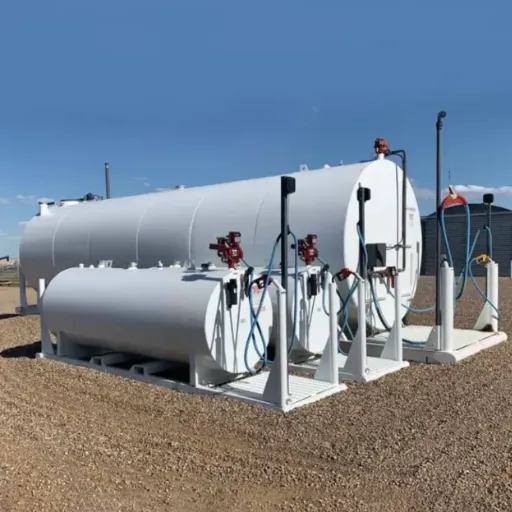
Highway Fuel Plaza: Horizontal Underground
The Thompson Group developed a six-pump highway fuel station along Interstate 35. Their engineering team evaluated both orientations before selecting horizontal double-wall tanks.
“We initially considered vertical tanks to minimize excavation near the highway embankment,” recalls project manager David Thompson. “But when we ran the numbers, vertical installation would have required specialized shoring near the roadway and extended our timeline by three weeks.”
The horizontal installation proceeded using standard excavation equipment. Three 12,000-gallon tanks (gasoline, diesel, premium) went in during one week. Total installed cost came in 18% below the vertical tank estimate.
Key factors: Standard installation procedures, accessible maintenance, and regulatory simplicity.
Urban Fleet Operation: Aboveground Horizontal
Metro Delivery Services operates a 40-vehicle fleet in downtown Chicago. They needed on-site diesel storage but lacked space for underground installation.
Their solution: Two 5,000-gallon horizontal tanks installed aboveground on a compact concrete pad with integrated containment. The horizontal orientation kept tank height below 10 feet, avoiding visibility issues with neighboring buildings and meeting local zoning requirements.
“Vertical tanks would have stuck out like sore thumbs,” notes facilities director Jennifer Walsh. Horizontal kept everything low-profile and manageable. Our maintenance team can walk up and check gauges without ladders.”
Key factors: Height restrictions, zoning compliance, and maintenance accessibility.
Industrial Bulk Terminal: Vertical Aboveground
Portland Industrial Fuels stores 250,000 gallons of diesel for marine and rail customers. At this scale, vertical tanks made engineering sense.
Four 65,000-gallon vertical tanks occupy a compact 80-foot by 120-foot pad. Equivalent horizontal storage would sprawl across multiple acres. The facility uses the natural head pressure from vertical tanks to feed loading systems without pumps.
“This is industrial scale, not retail,” emphasizes chief engineer Robert Kim. “Vertical orientation works here because we’re not dealing with underground complications, and the footprint concentration actually matters. But I wouldn’t recommend this for a neighborhood gas station.”
Key factors: Massive capacity requirements, aboveground installation, gravity-fed distribution.
Conclusion: Making the Right Choice
Horizontal tanks are used at gas stations because they provide better sound engineering solutions. The system shows operational advantages because it distributes soil loads better than others, its installation process is less complex, its maintenance procedures are more straightforward, and it complies with all applicable regulations. The underground fuel storage system at gas stations uses horizontal tanks, which are installed under the fuel pumps.
Vertical tanks serve specific niches: extreme aboveground capacity requirements, severe space constraints with available height, and specialized industrial applications. These scenarios represent exceptions, not standard practice.
Your decision framework is straightforward:
- Planning underground storage at retail scale? Choose horizontal.
- Need aboveground storage with height restrictions? Consider horizontal first.
- Facing extreme capacity or space constraints? Evaluate vertically with eyes open to trade-offs.
The Martinez family from our opening example learned this lesson the expensive way. Their revised horizontal installation opened on schedule, passed all inspections without complications, and continues operating with routine maintenance fifteen years later.
Ready to specify fuel storage for your gas station project? Contact Shandong Shengrui Intelligent Equipment for certified horizontal tanks, expert installation guidance, and comprehensive compliance documentation.