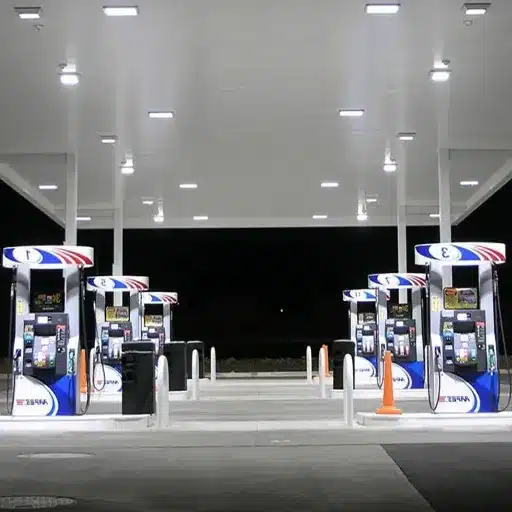
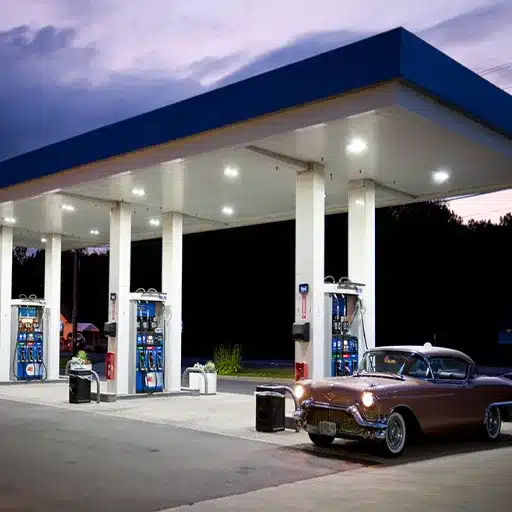
Tuesday morning at Saddle Brook, the regional manager for one of the nation’s largest major-brand fuel chains in Texas burst into the quarterly review session with a number that changed everything. Stations with their canopy lights replaced by LEDs are garnering 23% higher gas sales volumes than those still running MH fixtures. It was about energy saving, all right-it was generating revenue.
If you own or are constructing a fuelling station, you appreciate the value of first impressions. Even before reading your fuel prices or catching sight of your signage, your customers first see your lighting. Whether it is dim, flickering, or old décor canopy lighting, it sends a signal that impacts just about everything – from safety perceptions to purchase decisions.
This guide contains everything you need to know to make a scientifically informed decision about canopy lighting for your fuel station. The guide includes the value of LED technology, design standards that enforce these concepts, cost calculus that justifies the investment, and incentives that earn you the utility rebate. By the end, you would understand why your neighbors have already upgraded, and how you can plan the upgrade, as surely thousands of other station owners have moved on to better products, too.
What Is Canopy Lighting for Gas Stations?
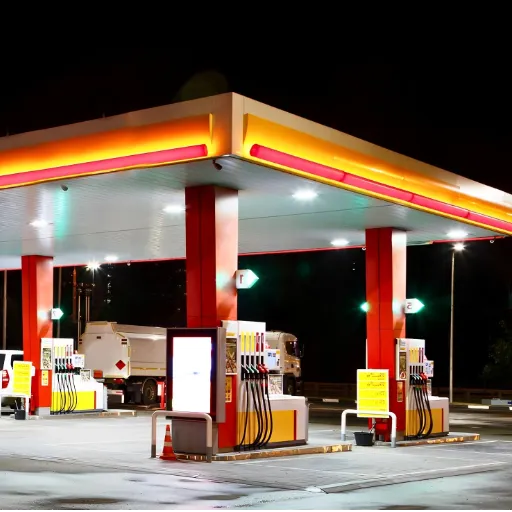
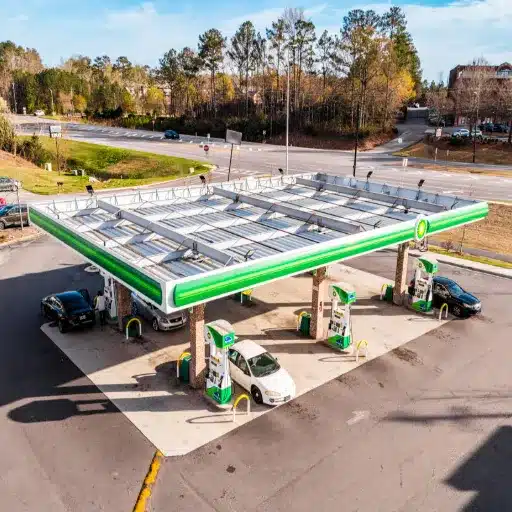
Canopy lighting is an illumination system installed under the canopy of a filling station to give effective and safe lighting for fueling operations. It is very beyond normal outdoor lighting, thereby needing certain standards for light output, uniformity, and safety because of the presence of explosive vapors.
Purpose and Function
Canopy lighting has three main functions. They add value to a product by providing safe fueling, even in the dark, and visibility for customers handling dangerous liquids. Secondly, it is guaranteed by its function so that it can secure areas where criminal activities may be performed because security can get hampered on account of shadowy areas, and thirdly, it serves as a very sharp marketing tool. Brightly lit stations are able to attract drivers from as far as hundreds of meters away, especially during the most dazzling evening hours.
Types of Canopy Light Fixtures
There are numerous ways of mounting fixtures that, unlike canopy lighting, are possible today at contemporary fuel stations. Fixture styles are recessed mounting, which sits the fixture flush with the canopy ceiling, offering a clean, streamlined appearance. Surface mounting allows fixtures to be installed directly to the canopy underside and to access them much more easily in terms of installation and maintenance. Retrofit kits make it possible to fit LED modules into existing fixture housings without destroying canopy aesthetics while upgrading performance.
Key Performance Metrics
Canopy lighting is read before evaluating; while at the same time, there are lumens, lumens have a total light output, and on average, 13,000-15,000 lumens are produced in a 100 W LED canopy fixture. Simply: Efficacy is lumens per watt yield on efficiency: most high-quality LED fixtures achieve anywhere from 130 to 165 lm/W. This is because the color temperature affects the light feature, and 4000K-5000K would be a rather white, clear light, good for refilling areas. Regarding the CRI (Color Rendering Index), it measures how accurately the color is seen. Your refueling areas might have good light for reading fuel grades and payment displays-CRI 80.
Ingress protection marks are IP, and an IP of 65 and 66 is the standard for canopy applications. IK (impact resistance) ratings inform the degree of protection from assault that is provided, and an LED light can be described according to these ratings as either IK08-IK10, covering against any loss and vandalism.
LED vs Traditional Canopy Lighting: The Comparison
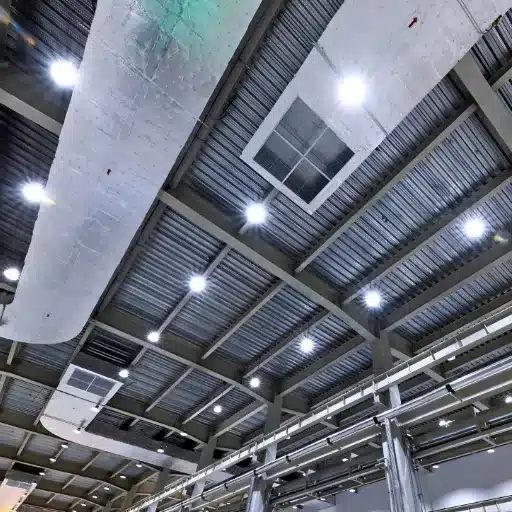
The lighting technology you choose affects energy costs, maintenance schedules, and safety performance for decades. Understanding the differences between LED and traditional options makes the decision clear.
LED Canopy Lights: The 2025 Standard
The advent of LED technology eventually came to be the purest standard for light-emitting fuel station canopies. The most publicized benefit today is energy: LED fixtures use 75-80% less energy than their incumbent competitors, Metal Halide and High-Pressure Sodium, offering equal or superior light output. This converts into money saved in operating expenses that would normally cover the installation cost within 18-36 months after commissioning.
There is so much more that makes life easier: life, for example. Good LED fixtures usually last for at least 50,000 or even 100,000 hours, amounting to 12-20 years of average use by canopy lighting. In comparison, metal halide lamps burn out when they run for only 10,000-20,000 hours, in say, two or four years. So even if the energy savings are minimal for a service station with a high canopy accessibility problem, the elimination of relamping cycles is similarly highlighted because it reduces maintenance expenditure.
Instant-on safety features are more often taken for granted until one finds the need for them. These particular bulbs light up instantly only after charging is applied to them. If contrasted with sodium or metal halide bulbs, those versions were required to heat up for several minutes. Integrating LEDs, which light up almost instantly, is meant to protect their occupants against interruption of power, bringing light to a dim warehouse in a matter of seconds.
A smart control system will age-proof your investment. Modern fixtures with LEDs are equipped with occupancy sensors, daylight harvesting systems, and remote monitoring platforms. This allows more savings in energy through dimming the lights during low-traffic hours and setting an automatic schedule based on the time of sunset and sunrise.
Metal Halide and HPS: Legacy Systems
Old fuel stations are lit by metal halide and high-pressure sodium fixtures. On the downside, such systems consume massive energy, leading to very high maintenance costs; a 400W metal halide fixture can consume 450W, depending on how ballast losses are calculated, while a 100W LED can provide the same amount of illumination.
They expose a safety risk through their extended warm-up times. Metal halide fixtures need five to 15 minutes to reach their full brightness after the power is turned on following a power outage. During such periods, the responsibility of stations increases if any accident were to occur due to the substandard lighting conditions.
An eyesore to the customer is the poor color rendering quality of lighting products. High-pressure sodium LEDs produce a warm yellow-orange light, distorting colors. Metal-halide lamps give better quality to the CRI, but edge out LEDs even though lamps deteriorate quickly.
Fluorescent Canopy Lights: Phasing Out
Fluorescent is generally a more energy-efficient alternative to HID lighting and is a similar choice for many fuel stations. However, most people are not using it due to the simpler overhead costs associated with the solution. One of the primary problems with the fluorescent is that mercury contained in the lighting not only hinders disposal but also produces environmental challenges. Most often, when lamps fail, they have mercury, which needs special handling, so much so that it is not known how much ventilation they should have. The cold performance of the fluorescent can have asset-undermining effects in many environments; there will be a tendency for it to glow at a reduced level below higher temperatures; in extreme cases, there will be no light at all. There is an inability to provide dimming, limited to little energy saving, in controlling system projects that can be effective with LED systems.
Side-by-Side Comparison
| Specification | LED Canopy | Metal Halide | Fluorescent |
|---|---|---|---|
| Energy Use | 60-150W | 175-400W | 100-200W |
| Lifespan | 50,000-100,000 hrs | 10,000-20,000 hrs | 15,000-20,000 hrs |
| Warm-up Time | Instant | 5-15 minutes | Instant but reduced cold performance |
| CRI | 80+ | 65-70 | 80+ |
| Maintenance | Minimal | High (relamping) | Medium (tube replacement) |
| Mercury Content | None | Present | Present |
| Dimming Capability | Excellent | Limited | Limited |
Design Standards and Requirements
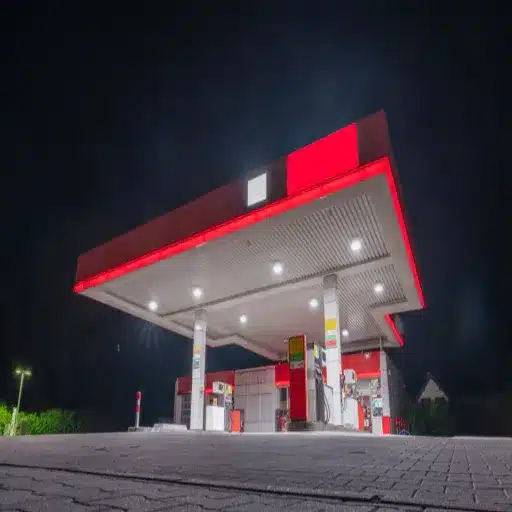
Proper canopy lighting design ensures safety, compliance, and optimal performance. Understanding the standards that govern fuel station illumination helps you plan installations that meet regulatory requirements and operational needs.
IES Lighting Standards
The first point of reference for service station lighting design is the publication of the Illuminating Engineering Society RP-33. This document sets minimum levels at which to light, uniformity values for the same, and acceptable glare-control standards. The fueling-area minimums from IES are 10 foot-candles at the pump island level. Nowadays, stations usually aim for 20 or 30 foot-candles over the same area for safety, security, and customer comfort.
Uniformity is as important as brightness itself. It is recommended in the RP-33 that the ratio of uniformity be about 4:1, so that the brightest area (richness) should not exceed four times the illumination of the darkest area (poor). Poorly uniform lit areas are noisy with shadows and dark spots that would compromise safety and aesthetics.
Photometric Design Guidelines
A good canopy lighting design involves balancing many technical factors involved. In general, heights for mounting range from 14 – 17 ft. above the island surface. A lower mounting point may decrease glare from those studying the canopy at higher heights; however, spacing for illumination is critically important to retain a holistic, uniform saddle-type appearance.
Spacing the calculations of the fixtures is dependent upon fixture-to-mounting height ratio, fixture’s light distribution, and target illumination levels. The simplest rule of thumb that can be applied is to equally space the fixtures at a 1.0-1.2 ratio to the mounting height. This means that for a 16-ft mounting height, the spacing between the fixtures will be ideally 16-19 ft.
Canopies and their patterns are unique, and so are the layout patterns. A single row pattern might work for the narrow canopy with just two pumps on an island. Double lines give a more uniform appearance for a larger canopy with several islands or exit lanes. Edge zones can utilize more fittings with asymmetric optics to minimize shadow lines at canopy drip edges.
Municipal and Environmental Regulations
Be aware that local rules are not the same as the International Energy Society quantifications. Full cut-off fixtures are demanded in dark sky regulations throughout many jurisdictions to point the light entirely downward and keep it from entering the sky. Some areas town light spillage control illumination under canopies to not exceed 20 to 22 foot candles – an effort to protect against neighborhood glare and reduce light pollution.
Building energy codes require installing outdoor fixtures using automatic lighting controls in IECC and ASHRAE 90.1 compliance. All these require a requirement to switch off or decrease canopy lighting’s brightness during sufficiently different illumination, requiring the use of time clocks or astronomical time clocks, motion sensors, or daylight harvesting.
Explosion-Proof and Safety Requirements
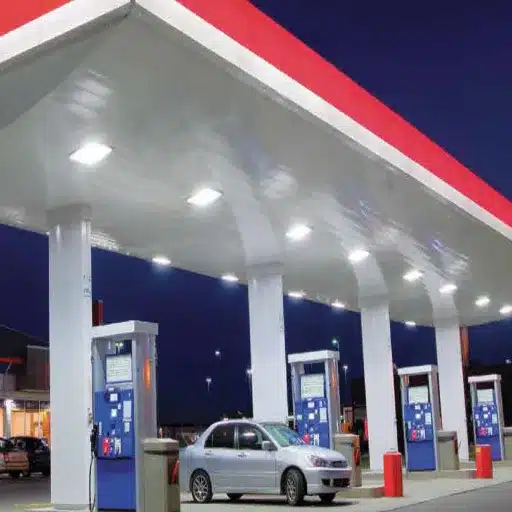
Fuel station environments require careful attention to electrical safety. Understanding when explosion-proof fixtures are necessary and when standard wet-location fixtures suffice can save significant cost while maintaining safety.
When Explosion-Proof Is Required
The National Electrical Code Article 514 defines hazardous location classifications for motor fuel dispensing facilities. Class I Division 2 zones extend up to 18 inches above grade within 20 feet horizontally of fuel dispensers. Fixtures installed within this zone must carry Class I Division 2 ratings per UL 844.
Standard canopy lighting mounted at 14 to 17 feet operates in unclassified space and requires only wet-location ratings per UL 1598. This distinction is important; many suppliers market explosion-proof fixtures for all canopy applications when standard wet-location LED fixtures provide adequate safety at standard mounting heights.
Low-mounted fixtures, including bollard lights, under-canopy wall packs, and dispenser-mounted lighting within 18 inches of the ground and within 20 feet of dispensers, must carry hazardous location ratings. These applications represent the minority of canopy lighting but require careful specification.
Certification Standards
These are the requirements for the stringent certifications of explosion-proof lighting for fuel stations. It is, after all, UL 844 that looks at hazards coming from electric lighting fixtures in North America. In the European markets, the ATEX 2014/34/EU applies to equipment rated as suitable for atmospheres where flammable gases can enter. IECEx approval of equipment covers many countries.
The temperature classification, also known as the T-code, refers to the maximum temperature a lantern is likely to reach on the exterior. In circumstances where the light shares the surrounding gas vapors as fuel, the highest safety margin can be achieved with the rating of T6 (highest surface temperature of 85°C). Depending on the fuel type and how it is installed, the ratings are also adjustable to T5 (100°C) and T4 (135°C).
Safety Benefits of LED Canopy Lighting
Fulfilling the mandate, quality canopy lighting facilitates dramatic improvements vis-à-vis safety. The surveillance cameras manage clear images, and other security details can form incident records, thus preventing the impacts. One retailer recently recorded a tremendous 40% drop in safety incidents after the completion of LED retrofit projects at all the locations.
Environmentally designed crime evasion is highly advocated. The very thing is done by lighting up very bright open areas with tall shadows, where the scope for any kind of criminal activity reduces greatly. Keeping fewer shadows would help accident prevention: The most tired-out persons would tend to fall less often, and nighttime fuelling operations would occur less often, leading to fewer frequent vehicle collisions.
Cost Analysis and ROI
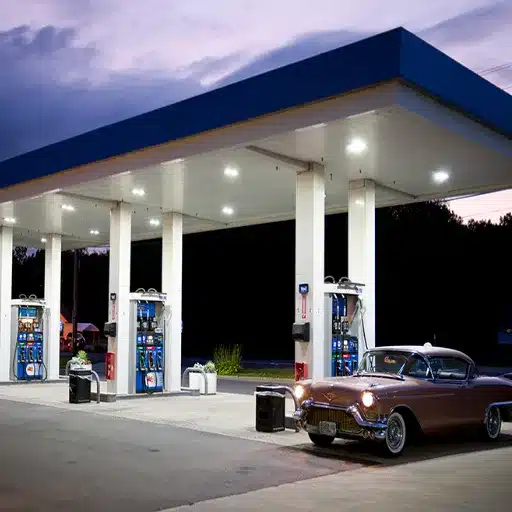
Understanding the true cost of canopy lighting requires examining fixture pricing, installation expenses, energy consumption, and long-term maintenance. The economics overwhelmingly favor LED technology when viewed over the system lifecycle.
Fixture Pricing
LED canopy fixture pricing varies by specification and certification level. For standard wet-location LED fixtures for standard canopy heights, prices range from 60 to 200 units, depending on metal wattage, lumen output, and brand, and the premium fixtures emerging in the marketplace with higher efficacy, better warranties, and smart control capabilities can be as high as 200 to 400 units.
Explosion-proof LED fixtures certainly cost a premium because they come with specialty housings for the most demanding environments, plus certifications and testing. Similar to ATEX and IECEx, UL 844 Class I Division 2 fixtures range from 300 to 800 per unit. Retrofit kits are meant to be installed; they usually come equipped with an LED module, which can be fastened inside the housing of an existing fixture, saving quite a little when the right applications come into play.
Kit prices vary; some may be much cheaper, running from 30 to 30 to100 on a per fixture basis, but overall project costs are a function of existing housing condition and installation conditions rather than initial costs.
Installation Costs
Installation expenses depend on project scope and site conditions. Simple LED retrofits using existing mounting points and wiring may cost 30 to 75 per fixture in labor. Full fixture replacement requiring new mounting hardware, wiring modifications, or conduit work increases costs to $100 to 250 per fixture.
Elevated canopy access requirements significantly affect installation economics. Ground-level canopies accessible with standard ladders keep labor costs manageable. High-clearance canopies requiring lifts or specialized equipment increase per-fixture installation costs substantially.
Energy Savings Calculation
Energy savings calculations demonstrate the LED upgrade value clearly. A typical fuel station might operate 12 canopy fixtures for approximately 4,100 hours annually (11 hours per day average).
Example: 12-fixture station retrofit
| Metric | Metal Halide (250W) | LED (80W) | Annual Savings |
|---|---|---|---|
| Fixture count | 12 | 12 | – |
| Watts per fixture | 287 (incl. ballast) | 80 | 207W |
| Total system watts | 3,444W | 960W | 2,484W |
| Annual kWh | 14,120 kWh | 3,936 kWh | 10,184 kWh |
| Annual cost (@ $0.12/kWh) | $1,694 | $472 | $1,222 |
At 0.12 perkilowatt−hour, this station saves 0.12 perkilowatt−hour, this station saves 1,222 annually in electricity costs alone. Maintenance savings from eliminated relamping add another 400 to 800 annually for most locations.
Payback Period
LED canopy retrofits produce paybacks that are simple, averaging 18 to 36 months and are affected by electricity cost, probability of projected failure, and utility incentives. Faster returns are achieved in high-cost utility regions; payback can occur within 12 to 18 months in California establishments if the electricity rates are more than $0.20 per kWh.
Even without the financial incentives, LED still brings higher benefits in relation to life cycle costs, mostly because one LED system matched to a metal halide system can save an astounding 60-70 percent within 15 years from energy, maintenance, and replacement costs.
Utility Rebates and Incentives
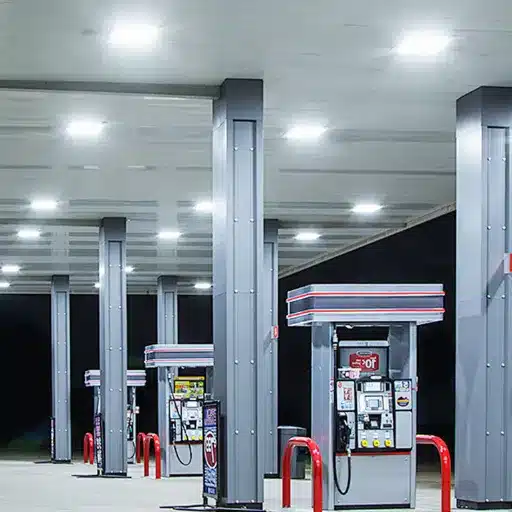
Utility rebate programs can substantially reduce LED upgrade costs. Understanding available programs and qualification requirements helps you maximize financial incentives.
2025 Rebate Programs Overview
Most of the rebate programs available for consumers do have a specified requirement of being DLC (DesignLights Consortium) certified. For these incentives, utilities refer to a qualified product list, which is maintained by DLC. Standard qualification serves as the fundamental eligibility for a lower level of rebate, while the Premium one adds 25-50% extra incentives.
Utility programs are complemented by federal tax incentives. It is such that Section 179D of the Internal Revenue Code affords up to per square foot of deduction for energy-efficient building improvement, including upgrades involving lighting. Preferably, tax professionals would be consulted to assist in comprehending the present deduction limitations and the particular criteria for eligibility.
Regional Program Examples
Texas Programs
Austin Energy Power Saver program offers 15 to 75 per canopy fixture, depending on wattage and specification. CenterPoint Energy provides performance-based incentives through its CSOP program covering both retrofit and new installation projects.
Oklahoma and Arkansas
Public Service Company of Oklahoma (PSO) offers exit sign incentives at 6 perfixture,interiorlightingat 6 perfixture, interior lighting at 6 to 20, and HID replacements at 20, and HID replacements at 30 to $75 per fixture. Entergy Arkansas provides small business incentives covering up to 67 percent of project costs for qualifying upgrades.
California
Title 24 compliance requirements drive significant rebate activity. Many California utilities offer enhanced incentives for controls, including occupancy sensors and daylight harvesting systems that exceed baseline efficiency requirements.
Maximizing Rebate Capture
The successful rebate capture will require that the details of the program be studied well. Pre-approval is necessary for most programs; submission should be done before the purchase of the equipment to confirm qualification. Documents needed include fixture specifications, energy savings calculations, and installation photographs.
One way to maximize the total benefit of combining various incentive sources is to use utility rebates, federal tax deductions, and manufacturer promotions, which can sometimes cover 50 to 75 percent of an upgrade’s total project cost if it is done well.
Installation Best Practices
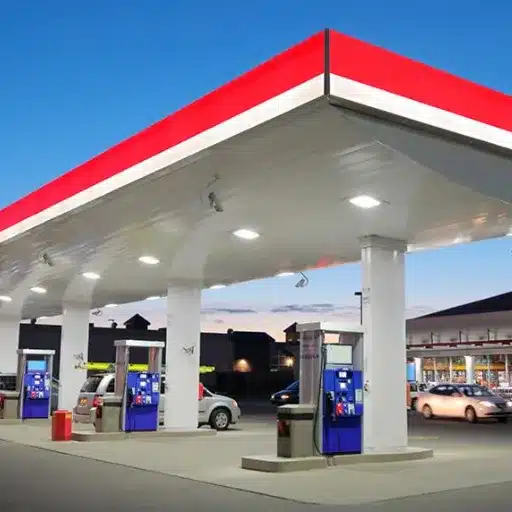
Quality installation ensures canopy lighting performance, safety, and longevity. Following established best practices prevents common problems and optimizes system operation.
Pre-Installation Planning
Evaluation of existing power infrastructure, condition of overhead structure, and exact points for entry should go into the site assessment. Photometric analysis helps conclude the most appropriate placements for the kind, quantity, and specs of the optimal device with respect to lighting requirements.
Through gauging existing fixtures, one can exactly establish whether or not replacement or retrofit would be called for from project to project. In some cases, the inner workings within the canister are greatly scarred or corroded, while entire units may have been knocked around or have physically taken a beating. However, cleaner and those that are aesthetically pleasing replacements would be a flashlight or LED set/hardwire retrofit.
Electric load calculators can be really helpful in ensuring current circuits would allow new fixtures, thus upgrade of LED models brings about lowering electric load, although verification is required to avoid any circumstance of an overloaded circuit; suitable margins should be provided as per panel capacity and breaker ratings that would underpin the existing setup and support a project’s future configuration.
Installation Process
Overall, retrofit installation procedures fluctuate heavily; however, similar following steps are observed. Disconnecting the power source at the panel certainly contributes to safety during work. Remove the existing lamps and ballasts from housings. Install LED modules using the mounting brackets and hardware given by the manufacturers. Wire connections should strictly follow normal electrical wiring practices with the use of appropriate wire nuts or terminal blocks.
New light installation demands mounting hardware attachment to the canopy structure, the electrical box installation, if not existing, running of conduit and wire routing, attachment of the light fixtures and leveling, and wiring connections. Testing after installation ensures that all will work just fine, integrity in grounding, and illumination function.
Common Installation Mistakes
According to manufacturer specifications or design calculations, incorrect spacing of fixtures leads to uniformity issues and, consequently, underlighted areas. It also leaves fixtures defenseless against injury produced by a sudden surge in electric power. Surge-protecting devices of good quality can be plugged in panel areas or in fixtures, shielding them from external dangers in the end.
Not having a good grounding can lead to reliability issues that might make the fixture unusable, and without the proper undertaking, all canopy fixtures ought to have the necessary grounding element to meet NEC requirements. Entry of moisture through a bad gasket installation or from mishandled household items causes it to fail faster; thus, proper assembly and careful inspection will help prevent water from entering it.
Smart Controls and Future Technology
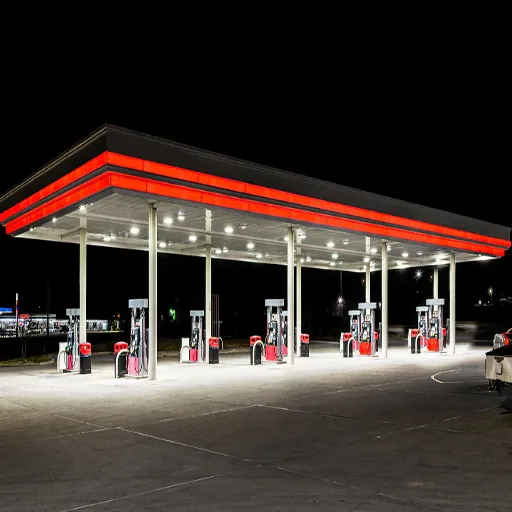
Advanced control capabilities extend LED canopy lighting value beyond basic illumination. Understanding available technologies helps you plan future-ready installations.
Motion Sensors and Dimming
During a period of low traffic, occupancy-based dimming is a way to diminish energy consumption. Once motion sensors detect movement by vehicles or pedestrians, the lamp is led to full output. Even when people are not moving, light illuminates at about 20 – 50% of the full output. It provides a first-line defense in the event of a security breach, yet at the same time consumes 30% to 50% less energy in the off-peak hours of the evening.
The Daylight Harvesting System adjusts control output whenever ambient light levels change. During the dusk-to-dawn transition periods, reduced values of output can be seen during lighter hours, including sunrise and sunset, protecting minimum illumination levels in the area secured. Simple installation to provide dusk-to-dawn control without adding light expenses.
IoT Integration
Networked lighting systems enable a centralized facility that enables monitoring and control over multiple station locations, while realizing remote monitoring capabilities that provide real-time visibility over fixture statuses, energy usages, and maintenance requirements. Also, maintenance alerts provided are alerts for predictive maintenance, which means that there is a fixture that is reaching end-of-life or operating abnormally before it might break down.
Energy usage analytics assist in further fine-tuning scheduling and control strategies. Data on occupancy patterns, energy consumption trends, and performance metrics lead to further improvements in lighting efficiency and effectiveness.
Future-Proofing
The installation of an EV charging station as a future contingency will obviously need to be studied in the planned lighting system of the canopy. EV-charging stations typically involve extending fueling area coverage that requires additional lighting. Establishing additional zones within the first LED upgrade saves retrofitting when the charging infrastructure gets expanded.
Consistent digital advertising and media linkage open opportunities for united canopy and pylon lighting management. Such kind of a unitary management platform controls lighting and advertisement boards to save energy with restricted light content display for achieving perfect brand visibility.
Maintenance and Troubleshooting
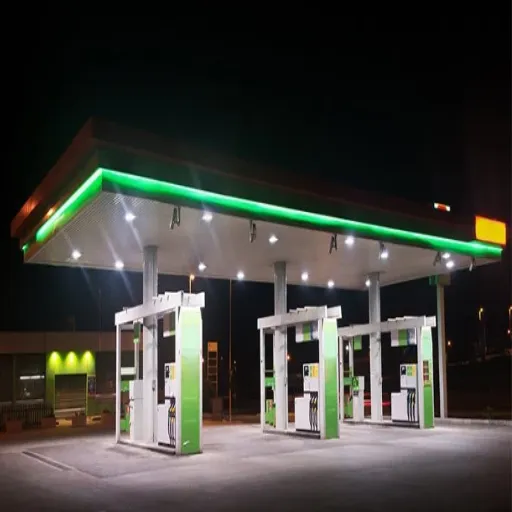
LED canopy lighting requires minimal maintenance compared to traditional technologies, but understanding proper care extends system life and ensures consistent performance.
Routine Maintenance
Cleaning schedules are environmental-specific. Stations in dusty, industrial, or coastal environments are clear examples of locations requiring more frequent cleaning. While locations in cleaner climates get by with annual cleaning, tough environments need their fixtures cleaned quarterly.
Inspection checklists should have visual examination of lenses for dirt accumulation or damage, housing condition checks for corrosion or physical damage, gasket integrity verification, and illumination level spot checks to identify fixtures with degraded output.
Replacement of drivers will be rare in good LED systems. In most cases, quality LED fixture issues occur due to the proper driver malfunction rather than the LED array failing itself. Field-replaceable driver features will always keep the fixture alive in the future and save costs in the long run.
Common Issues
Flickers usually flash when hardware drivers or line voltage are problematic, or when compatibility issues exist with control systems. Spotting the difference between single light fixtures and entire circuits helps to identify the cause. Regulating the dimming is a task that usually is performed to adjust inappropriate settings of the dimmer toward the wrong setting or operation of any control protocol not conforming to the device that was overlooked.
Moisture penetration can be identified through condensation inside lenses, corrosion on internal components, or ultra-bright LEDs. Solving moisture penetration problems requires locating all possible entry points of moisture; wrong or damaged gaskets should be replaced, and proper sealing on the fixture during any type of maintenance activity should be ensured.
When to Upgrade
Warning signs appear when the light redirects a major lumen depreciation; for instance, over time, lumens generally decrease by 30 percent when compared to what was initially outputted. Another thing that requires a great deal of upgrading, less of a quick fix, and more of something that has evolved over many years of exposure, is any physical deterioration in housing. Plentiful opportunities for upgrades might be defined as new technologies that help catch life/site/practice improvements for energy and light management over other, less effective devices.
The growing station requires extra pump islands, EV charging installations, or canopy modifications, and may require the expansion or overhaul of the lighting system. By planning improvements together, project economics could be optimized and disturbance limited.
Conclusion
Canopy illumination substantially represents the most impactful congruent olden times update gas station pitfall control operators can make. Huge energy savings, combining reduced maintenance costs and greatly improved safety and appeal to consumers, make LED canopy lighting an incredibly smart investment rather than a small expense.
Key takeaways for your decision:
- Energy efficiency: The LED luminaries reduce energy consumption by 75-80% compare to metal halides.
- Economic returns: It has been shown that payback duration usually equals $ and years with lifelong saving.
- Safety improvements: More light, fewer incidents, and an even stronger security system.
- Rebate opportunities: All these utility programs and tax incentives usually amount to at least fifty percent of all the costs related to it.
- Future readiness: Smart controls and integration with IoT give ways to further optimize in the future.
Whether you’re worried about suspending a group station or after you finish one, lighting is the handle in any kind of fuel station or convenience transaction, determining sales experience.
Ready to upgrade your station’s canopy lighting? Contact Shandong Shengrui for technical specifications, photometric design support, and competitive pricing on complete canopy lighting systems.