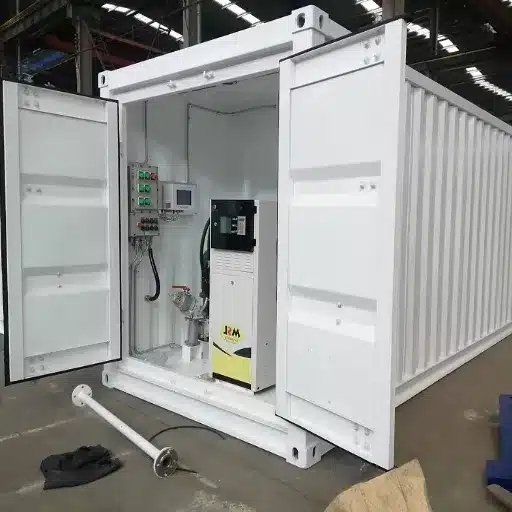
Less than a month after a newly-commissioned fuel station opened shop in West Africa, a project manager received an unwanted call. Rainwater had been pooling around the downfill of one of the tanks, leading him to an investigation and finding a tiny, poorly sealed manhole well to blame. This allowed groundwater to infiltrate through the underground storage tank system. The cost of the contamination cleanup was over three times the price of the right equipment. This erroneous budget saved about 400. Themistake cost 400. The mistake cost 14,000.
Most of these cases happen more often than gas station operators would think and are usually preventable as visible in the case narrated above. Getting the correct gas station manhole well is not merely an end-of-the-day purchase. It carries a whole lot more weight in safety and engineering implications on containment integrity, regulatory compliance, and longer-term maintenance costs.
This manual is intended to provide an answer to a question any person in the industry might have about new or retrofit manhole construction: five significant choices in fuel station manhole wells, material options with comparative specifications directly, major parameters that the pumping units must meet, as well as a step-by-step guideline in the right choice of a solution for your site. It’s the guide suitable for reference before pointing to the dealer because it is to be a new-build station or old infrastructure upgrade.
What Is a Manhole Well in a Gas Station?
Definition and Function
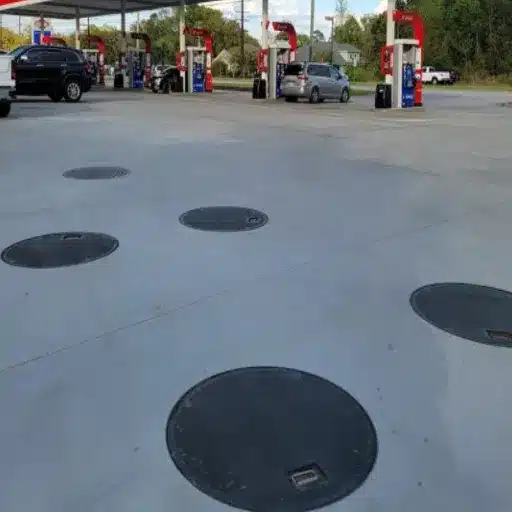
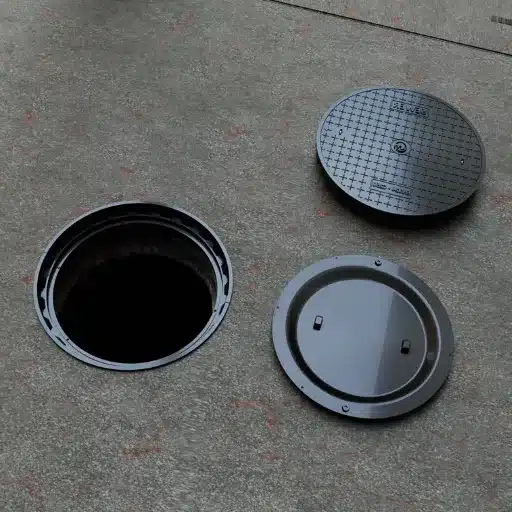
A manhole sump, also known as a narrow space manhole, access chamber, or underground access floor, among others, is a closed structure situated below-grade and used to house underground equipment at a fuel station with access. It becomes a guarded entryway into all buried infrastructures.
Equipment for such manhole wells or beneath them typically includes such things as submersible pumps, fitting in tanks, pipe junctions, valves, sensors, and more. Everything is kept convenient for inspection and servicing of these system components while the structure acts as secondary containment against the spread of fuel vapors, leaks, and, finally, groundwater.
If one would not engineer a manhole well properly, any pin-sized flex seal leak that would occur would create a straightaway into the ground fuel systems as well as soils or groundwater around them. According to the Agency, approximately 10 percent of the underground storage tanks (UST) systems that have registered to date were in confirmed release at some point. Access points were found to be of no good access points opening back into them in many of these scenarios.
Where Manhole Wells Are Located in a Fuel Station
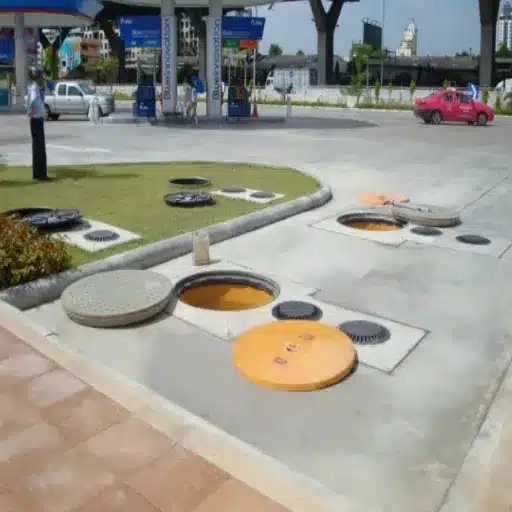
A typical retail fuelling station will have several manhole wells at multiple points.
- At the top of the storage tank – They cover the top tank fittings and the submersible pump
- The fill points-These are the points where the fuel delivery tankers connect to the underground tank
- Underneath the dispensers-These include under the pump valleys housing the piping connections for each pump island
- The monitoring wells-It includes access to groundwater or to any of the interstitial monitoring sensors
Each of these has different structural requirements. For example, in the fill area, the directly unloaded tanker vehicle load acts on it. In the same way, island dispensers experience constant passenger vehicle loads. An error that seems very costly happens when considering the same manhole well in all of these places.
Why Manhole Wells Are Critical to Safety and Compliance
In most markets, it is compulsory to have secondary containment. Markets in Europe, North America, the Middle East and large parts of Africa and Asia saw the need to build regulations that would require fuel station operators to put in place mechanisms to demonstrate that leakage of product from underground systems would be collected in the containment tub before it gets to the groundwater or soil.
It is the manhole well that serves as the primary type of containment. If the containment or specification of the well is compromised, there can be contaminations, leading to regulatory fines to stop the station’s work, clean-up costs in the hundreds of thousands of dollars, and considerable damage to a company’s ‘reputation.’ Investing still at the beginning costs only a fraction of the late costs corrective action would require, as the case may be.
Ready to specify the right manhole well for your project? Contact the Shengrui engineering team for product specifications and a project-specific recommendation.
Types of Manhole Wells Used at Gas Stations
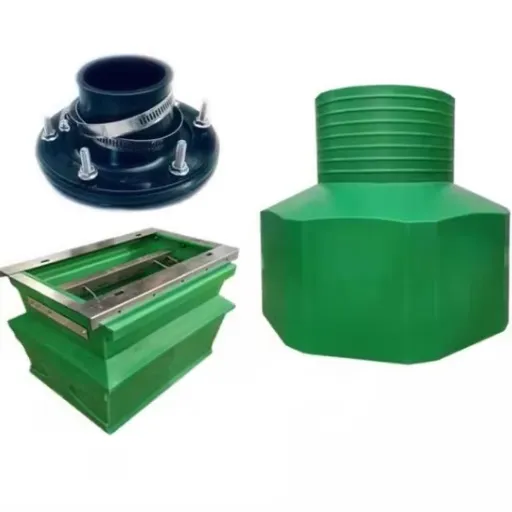
Understanding the five main types will help you match the right solution to each location on your site.
Tank Top Sump (Turbine Sump)
This turbine sump is directly placed on the tank top. Very often, it is called a turbine sump. The container with which it sits is then allowed to accommodate access for fixing the various parts like the turbine pump, contoured assemblies from the tank, leak detection sensors, and interstitial monitor ends.
This well is considered the most important one for the whole setup. Here, a broken portion enables groundwater to gush into the tank system, obviously washing down expensive tank cleaning operations. Most standard sizes range from 600 to 1,200 mm, depending on the number of fittings that are to be accessed. The depth correlates with the burial depth of the tank, typically between 1.5 and 3 m.
Fill Pipe Sump
Surrounding fuel tankers make a connection and flow through a fill riser extending from the underground tank to the fill pipe spill sump. These transport processes commonly feature spill containment trays to handle any overfill during the delivery of the product.
This well has to handle something distributed through a direct vehicle load in the case of a fill point located in a drive-over area. Specifying a D400-rated cover suitable for 40-ton traffic loads is common practice for fill points used by fuel delivery vehicles.
Dispenser Sump
Dispenser sumps are usually found underneath each fuel dispensing machine. They are, in essence, a chamber sitting under the ground and have connections to underground piping and the shear valve. It is the place where the fuel will go in case something is dripping out of the nozzle.
Dispenser sumps are commonly of a rectangular shape to fit a certain dispenser model, and these ensure that all the installers are able to enter through an opening in the base of the dispenser. They have vacuum testing that has to be passed before the opening, for an integrity check of the whole sealed design in the station’s opening.
Monitoring Well Manhole
New environmental monitoring wells installed every so often at a gas station detect fuel leakage to groundwater. Each well will need a well flush-mounted manhole cover placed at grade to preserve the integrity of the well casing against vehicular movement and exclude surface water.
The boards become so small that they need to be accessed from the tank, which will range from 150 mm to 300 mm in diameter, and are constructed from materials that do not produce sparks. Aluminum is usually used due to its weight, its corrosion resistance, and no risk for static electricity, which can ignite the fuel vapors.
Multiport Manway
Multiple access uses in an individual structure, such as fill pipe, vapor recovery, and tank monitoring access, are merged together into a multiport manway. This lessens the numerous separate openings on the gas station forecourt; better aesthetics, fewer trip hazards, and simpler maintenance logistics are likely to be evident.
There is an increasing trend for the extensive use of multiport design in today’s new forecourts, particularly where regulations make it compulsory to have a clear layout. This necessitates some careful engineering in ensuring that all basic functions internally maintain distinction and water integrity.
Manhole Well Materials: HDPE, Fiberglass, and Steel Compared
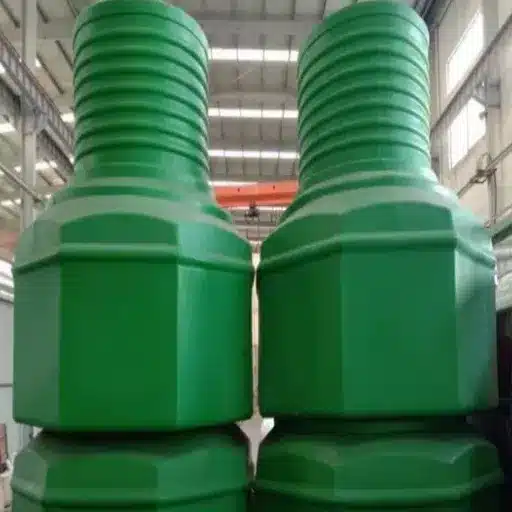
Material selection is the single most consequential specification decision for a gas station manhole well. Each option has distinct performance characteristics, cost implications, and suitability for different site conditions.
HDPE Manhole Wells
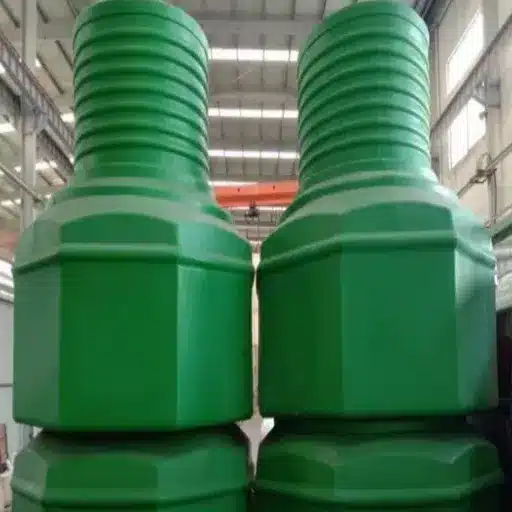
High-density polyethylene is the material most used in the finest of underground fuel storage tank chambers, approximately in fuel stations worldwide. The cases may be easily and seamlessly connected by rotational molding or extrusion welding, where they are found to be chemically inert against any petroleum products and fully corrosion-free.
It is the lightweight that HDPE chambers have introduced, which, this time around, can be installed in a small excavation by a fairly short installation crew. Heating techniques enable on-site fabrication of the HDPE wells, which makes them adaptive when the required placement conditions are different from those designed or encountered. Above all, these together make this inherent attribute suitable for projects at any location.
HDPE, all the same, has one undesirable trait; HDPE lacks fullness in lateral pressure from behind or direct bearing on HDPE. Where the soil type or anticipated site conditions may not permit the application of high point loads on the structures, there are several guidelines that need to be followed in this regard. An engineer at the job site must take up structuring and proper backfill subsoil properties.
Fiberglass (FRP/GRP) Manhole Wells
Fiberglass-reinforced plastics, GRPs for short, are endowed with a compressive strength that is far higher than HDPE, as well as far better stability when dimensions are in question. This is achieved by laminating resin between layers of glass fiber, resulting in the creation of a solid skeleton that does not collapse on load.
FRP wells are installed in certain high-traffic areas, such as places where people bring fuel tankers, and truck stops that have fueling lanes, and also where most heavy vehicles regularly depart the site after installation. The thickness of the wall is consistent (most of the time has a minimum of 6 mm) and is known for holding its shape and its seal under a wide range of temperatures that span from -50 deg C to +50 deg C.
However, FRP chambers are more expensive by 40 to 60 percent than their closest equivalent, HDPE. So with the cost comes the necessity to invest more for the trade-off and field modification difficulty. It cannot be heat-welded and needs bonded tendons for any on-site modification, thus, less error-tolerant than welding with HDPE.
Steel and Composite Options
Steel manhole covers, particularly if they are of a ductile iron make, are still very much in use in places where composite materials are hard to come by or if there is an enforcement requirement for local supply of materials, like, for instance, that necessary for ensuring EN124 D400 loading. Ductile also has outstanding tensile properties, making it open to the very high traffic areas for cover applications.
The Achilles’ heel of steel lies in the fuel station applications because it cannot withstand corrosion. The uncompromisingly rapid degradation of uncoated steel occurs from petroleum products, salt, and cleaning chemicals. Use galvanized or epoxy-coated steel for extended service life, yet maintenance demands are more than for polymer replacements.
Composite SMC (sheet moulding compound) covers offer the possibility of combining the strength of iron, plastic, and corrosion resistance. SMC today takes a bigger share of the cake everywhere in Europe and the Middle East, as its use is becoming more of a requirement for procurement for both compliance to EN124 and longevity necessities.
Material Comparison at a Glance
| Property | HDPE | Fiberglass (FRP) | Steel/Ductile Iron |
|---|---|---|---|
| Corrosion resistance | Excellent | Excellent | Poor (uncoated), Good (coated) |
| Load capacity | Good | Excellent | Excellent |
| Field modification | Easy (heat weld) | Difficult | Requires specialist |
| Weight | Light | Medium | Heavy |
| Cost (relative) | Low | High | Medium |
| Service life | 20-30 years | 30-50+ years | 10-20 years (coated) |
| Chemical resistance | Broad | Broad | Requires coating |
For most new fuel stations built in developing and developed markets, HDPE balances performance and installed costs perfectly. In applications that impose high loads, FRP is an engineering material. In applications where load ratings and resistance to corrosion have to coexist with each other within a set price, composite SMC makes sense.
Not sure which material suits your site conditions? Shengrui’s engineering team reviews project specifications and recommends the appropriate solution — at no cost. Request a technical consultation.
Key Specifications to Evaluate Before Purchasing
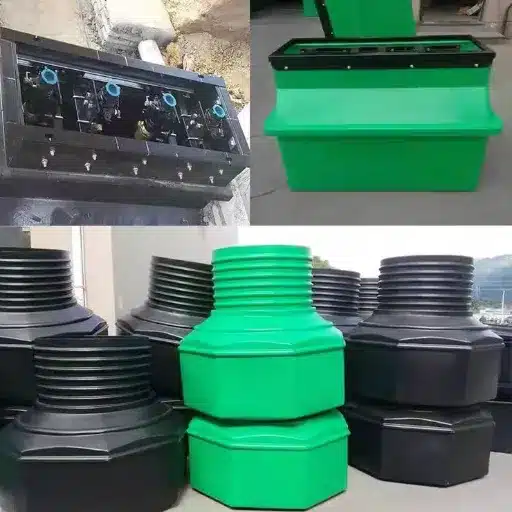
Load Rating (EN124 Classes)
The European Standard EN 124 classifies manhole covers by the maximum load they can sustain. At a fuel station, the relevant classes are:
- B125: 12.5 tonnes — suitable for pedestrian areas and light vehicle zones only
- C250: 25 tonnes — appropriate for standard passenger vehicle lanes
- D400: 40 tonnes — required for any area accessed by delivery vehicles or tankers
- E600: 60 tonnes — industrial or port applications
Always specify D400 for the fill point area. Fuel delivery tankers routinely exceed 30 tonnes. Using a C250-rated cover in that location is a compliance failure and a structural risk.
Sealing and Vapor Containment
Spill jars should vapour-seal every pit in a petroleum-station environment, as fuel fumes of most markets are combustible and toxic. Systems of containment must not allow movement of vapor from underground to the adjacent utility conduits.
Inspect the seals for multi-wiper gasket designs, pressure test ratings (5 psi is the benchmark), and biofuel grade: E10, E85, and B20 compatibility between the in-house fuels. Some seal materials break down with considerable ethanol compatibility; it is good to check the chemical compatibility with your distributor before placing an order.
Depth and Diameter Options
The selection of dimensions of the well casing is largely determined by the depth of installation below ground and the quantity of system components that will require access. Typical diameter options range from 600 mm to 1500 mm. Extension risers are then available by the increment of 300 mm for those bottoms with deeper tank installations.
It is always better that you plan for future access needs: it might even cost some premium in the initial buy, making it. Get the turbine sump big enough that a guy can get in and reach all the fittings from the top, and it can go through practically 20-plus years of maintenance cycles.
Chemical Resistance for Fuel Environments
Please verify that everything wetted- the seals, gaskets, coatings, and even the chamber body-has an appropriate rating covering long-term exposure to the full range of petroleum products that may be found at your site, including petrol, diesel, aviation fuel, kerosene, and their market-specific blend additives.
Request compatibility data sheets from your supplier. This should already form part of the service of any ISO9001-certified manufacturer.
Compliance and Safety Standards
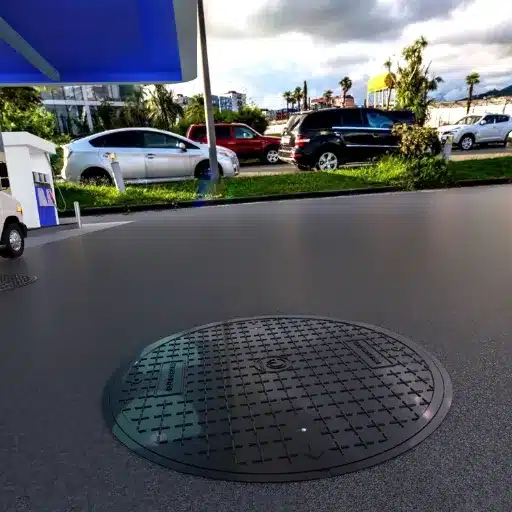
International Standards
The primary standards governing manhole well specifications for fuel stations are:
- EN124 (Europe and widely adopted internationally): Classifies covers by load group; requires third-party testing for compliance claims
- EPA Underground Storage Tank Regulations (United States): Mandates secondary containment and integrity testing for all UST access points
- PEI (Petroleum Equipment Institute) Recommended Practices: Technical guidance on sump installation, testing, and maintenance
ISO9001 certification of the manufacturer is a baseline quality assurance requirement for international procurement. It confirms that the production process is controlled, that traceability exists from raw material to finished product, and that specifications are consistently met across batches.
Regional Requirements
Requirements vary significantly across global markets:
- Middle East and Gulf States: EN124 compliance is standard; many projects also require ATEX certification for explosion-proof components in hazardous zones
- Sub-Saharan Africa: Regulatory frameworks are developing rapidly; projects often require compliance with both local standards and the specifications of international oil company (IOC) partners
- Southeast Asia: Markets including Vietnam, Indonesia, and the Philippines follow a mix of ISO standards and national petroleum authority codes
- Europe: EN124 is mandatory; vapor recovery regulations require specific sump configurations at fill points
Confirm the applicable standards for your market before finalizing specifications. A supplier with proven international deployment experience should be able to advise on regional requirements.
How to Choose the Right Manhole Well for Your Station
High-Traffic vs. Low-Traffic Areas
Map your site before you formalize. Mark out each place to which a manhole will be moved on completion, and classify it by the vehicle that it is expected to carry it most heavily. D400 is specified for those places and fill point areas where tanker access routes are planned. Dispenser islands are just passenger areas that typically use C250. Pedestrian-only areas can utilize B125 or equivalent.
In this manner, over-specification (expensive, heavier covers on locations where they are not necessary) and under-specification (structural failure and safety risk where load capacity is insufficient) are both avoided.
Environmental and Climate Factors
Look at the operating conditions:
- Poor coastal or humidity areas: for such a condition, the most important attribute is corrosion resistance; HDPE or FRP would have higher corrosion resistance than steel without the need for maintenance
- Extreme temperature range: FRP can retain its dimensions properly even from -50 °C to +50 °C; check a HDPE rating for a specific temperature range that the site
- Large area, poorly cohesive soil: FRP is competitively rigid and biodegrades less competently than HDPE in difficult soil conditions
- Very high water tables: The vacuum-tested multi-seal assemblies constitute the containment function. It’s a critical component’s total failure.
State a case of one EPC team member who landed and locked the installation of a fuel pump station in the coastal land of Nigeria. He insisted on the use of carbon steel cover standards commonly fitted inland instead. In just 18 months, two dispenser sump covers failed due to corrosion. The subsequent replacement and excavation, as well as revenue lost during the time of repair, were estimated to be four times higher than the alternatives that could withstand corrosion. Therefore, do not project the solutions according to the budget line; tailor them to the environment for which they are intended.
Budget vs. Long-Term Cost of Ownership
The installation cost of a manhole well is just 1 percent of the actual cost. Then consider the following:
- Service Life: A big difference in the cost of ownership may be between FRP at 40 years and steel with coating at 15 years.
- Maintenance: Polymer materials do not require re-coating and only need to be covered for a much lesser time, whereas steel manholes need inspection and re-coating at least every 5-7 years.
- Remediation Risk: If a seal fails and allows fuel to reach water, remediation may result in expensive six or even seven-figure costs in the worst case. There is hardly any difference between an acceptable well-sump and a class-leading well-sump.
- Downtime costs: Usually, only spend relatively less money on a robustly specified installation suited for a service life of 30 years straight, compared to the repetition of R & R cycles with service disruptions.
What to Ask a Supplier
- What international certifications does this product carry (EN124, ISO9001, ATEX)?
- Can you provide chemical compatibility data for petroleum products and biofuel blends?
- What vacuum test rating does the seal assembly achieve?
- What is the expected service life under the specific conditions of our site?
- Do you offer OEM/ODM configuration if our installation dimensions or fitting layout are non-standard?
- What is the warranty period, and what does it cover?
Shengrui’s Manhole Well Solutions
Shandong Shengrui Intelligent Equipment Co., Ltd. is an expert in producing manhole wells for heavy loads, which is included in their set of products for pipeline and containment products, not only for gasoline stations. It is also applicable for both standard and custom-made projects across the globe.
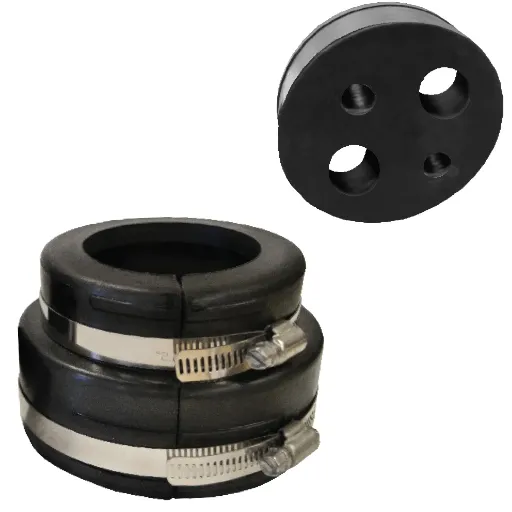
Shengrui’s manhole well systems come with a complete set of manhole wells; the composite underground piping, dispenser sumps, entry boots, and control systems, so that EPC contractors and station operators can source a complete, compatible underground containment system from one supplier. The company also possesses ISO9001 certification that runs all the way through all its processes of manufacture.
For technical specifications, product drawings, or a project-specific recommendation, contact the Shengrui engineering team at gas-stationequipment.com/piping-parts/.
Conclusion
A gas station manhole well is no run-of-the-mill thing. Far from that, it is that exquisitely designed safety element – jutting at the intersection of environmental protection, operational reliability, and regulatory compliance.
The key decisions are straightforward once you understand the framework:
- Type: Match the well type to its function – tank top sump, fill pipe sump, dispenser sump, monitoring well, or multiport manway
- Material: Use HDPE in general applications for cost-effectiveness, FRP in high-load zones, and composite SMC for EN124 compliance and corrosion resistance
- Load rating: For any tanker access area, D400; C250 for the passenger vehicle lanes
- Sealing: Practically, vacuum-thin, vapor-tight, and fuel-compatible in petroleum, virtually un-negotiable
- Compliance: Confirm applicable standards for your market before finalizing specifications
Getting these decisions right at the design stage costs nothing. Getting it all wrong after construction is, however, incredibly expensive.
Ready to specify the right manhole well system for your project? Contact Shengrui’s engineering team for technical guidance, product specifications, and a competitive quotation tailored to your site requirements.
Request a project consultation at gas-stationequipment.com/piping-parts/