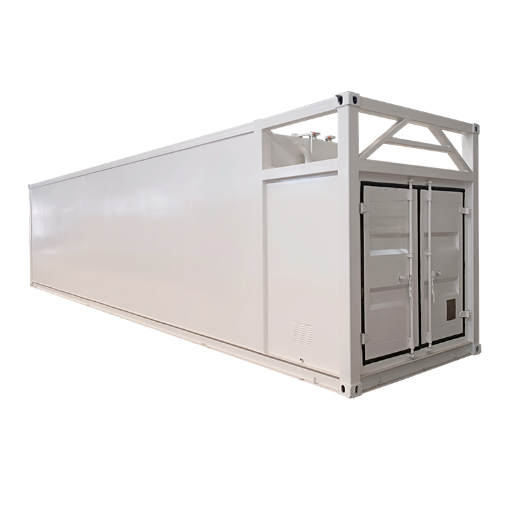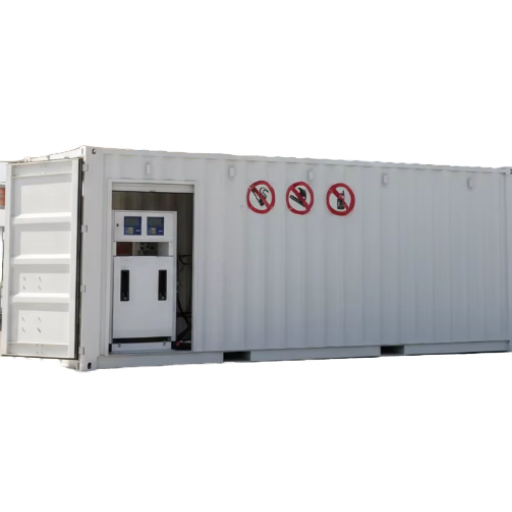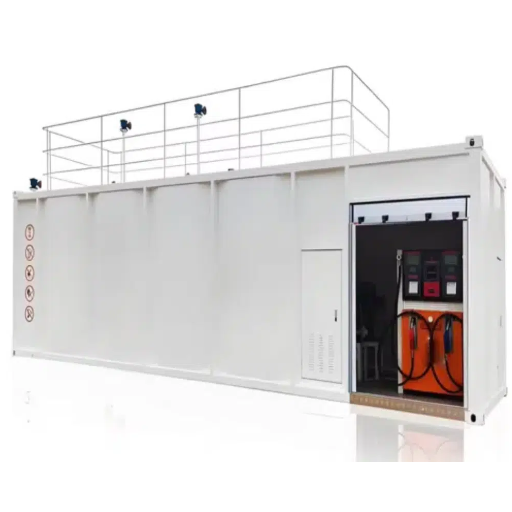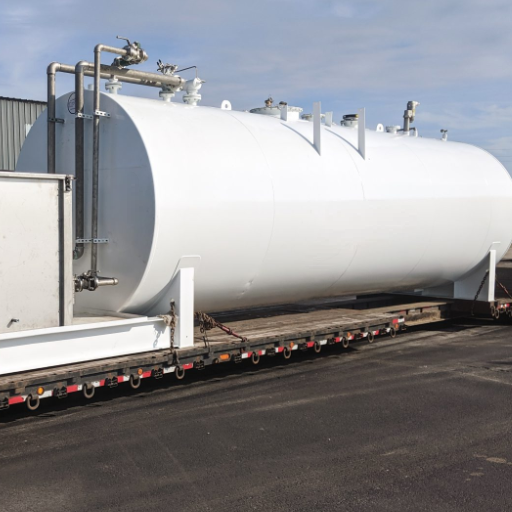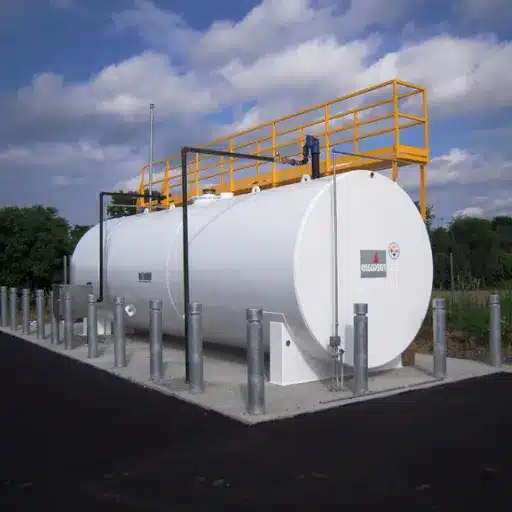
One 40ft skid station and two 20ft units on the same slab hold the same 40,000 L and weigh about the same 47 t. The choice between 40ft vs. two 20ft skid stations is therefore not a capacity question. It is a question about land, access, redundancy, refill logistics, permits, and dispensing.
Print two quotes for the same 40,000 L site, and the split is rarely where you expect. One supplier prices a single 40ft frame and one crane lift. Another prices two 20ft frames, two lifts, and two dispenser clusters. Both are defensible, and either can be wrong.
You probably suspect the bigger frame is the simpler buy. Often it is. This page proves when it is not.
The full 40ft skid station guide covers the format itself. This page compares them on land, steel, redundancy, refill, permits, and dispensing, then adds the hybrids most quotes never mention.
Key Takeaways
- At a 40,000 L working requirement, one 40ft and two 20ft skid stations hold the same volume and weigh 46.8 t against 47.0 t, so capacity does not decide it.
- Two 20ft units need 9% to 16% more clear site area than one 40ft on the same slab, because the 3 m vehicle envelope wraps two separate frames.
- Splitting storage does not split the SPCC threshold: two 20,000 L tanks are 10,567 US gallons combined, and the exemption ends at 1,320 US gallons.
- Two half-size units buy 50% redundancy, not full, and only when the island and controls are not shared.
- When none of the six decision questions applies, the default is one 40ft at the working capacity the site needs.
The short answer: for 40ft vs two 20ft skid stations, capacity ties
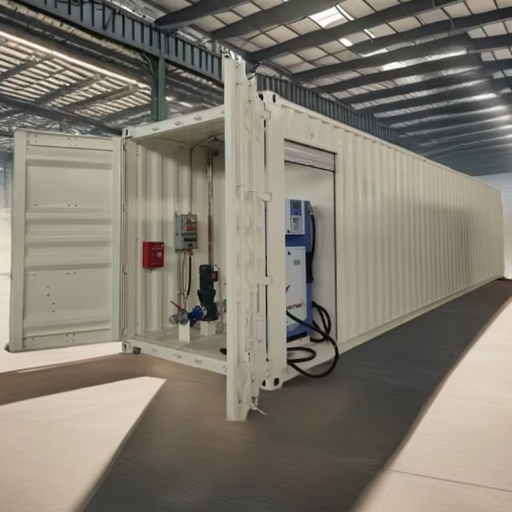
The capacity argument feels decisive because the headline numbers are far apart. They are not what a site runs on.
| Basis | One 40ft | Two 20ft | Evidence |
|---|---|---|---|
| Headline nominal | 60,000 L standard, 65,000 to 68,000 L high-cube | 30,000 L each, 60,000 L total | Both product pages, live 21 November 2026 |
| Practical working capacity | 40,000 L | 20,000 L each, 40,000 L total | 40ft capacity page; 20ft guide’s 10,000 to 22,000 L range |
| Full-load mass | about 46.8 t at 40,000 L | about 23.5 t each, 47.0 t for the pair | Product pages, diesel at 0.835 kg/L, 6.8 t tare |
At the top of the range the tie repeats: one 60,000 L standard 40ft and two 30,000 L 20ft units hold the same volume. Capacity is a tie at both ends, so every remaining argument is about something else.
One caution before you use this table in a tender. The live 20ft figures disagree with each other, and the 40ft page quotes 60,000 L in its table and 65,000 L in its hero. Ask for measured chamber and containment volumes in writing. What a 40ft tank really holds explains the gap.
Sizing a site now? Send the site plan and the liters you need. We will tell you which frame count we would quote, and where the access constraints sit.
Land, steel and lifts: what 40ft vs two 20ft skid stations cost
The footprint is a tie. The clearance is not.
A 40ft container is 12.192 m by 2.438 m, or 29.72 m². A 20ft container is 6.058 m by 2.438 m, or 14.77 m², so a pair covers 29.54 m², about 0.6% less than the single frame.
The 40ft product page recommends a 3 m clear perimeter on every side for vehicle movement, tanker discharge, and maintenance. Wrap that around each option, and the picture changes. One 40ft unit needs 153.5 m². Two 20ft units end to end need 178.2 m², 16.1% more; side by side they need 167.3 m², or 9.0% more.
In separate yards, the penalty stops being a percentage: a second access road, a second turning circle, often a second fence line. That is where the 40ft page’s 50% footprint claim holds.
Steel tells the same story. On the product data, the 20ft container weight is about 6,800 kg, and the 40ft container weight is about 13.4 t at 60,000 L, so two 20ft frames carry 13.6 t between them. Splitting the site buys two frames, two sets of corner castings, two lifting sets, and two transport moves for the same mass.
Both formats travel empty, so the CSC plate is a transport limit, not a storage limit. A 30,000 L 20ft full of diesel would weigh 31.85 t, about 1.37 t over its 30,480 kg plate. Neither that nor a 40 ft’s 63.5 t at 60,000 L matters on site. Both matter to whoever signs the crane lift plan.
That lift plan is where a 40ft earns its reputation. At 2.438 m, it sits inside the 102-inch federal width limit, so width is not the issue. It is a long load with a heavy lift at the end. The shipping and crane planning guide puts the 40ft lift at 50 to 100 t against about 25 t for a 20ft.
Kestrel, a hypothetical quarry, chose one 40ft at 40,000 L because the cost per liter looked better. The pad sat 9 m from the only crane setup position, behind a haul-road bend, so the lift needed a larger crane and a road closure.
The tank was fine. The access study decided the schedule.
Redundancy: half-capacity insurance, not a mirror
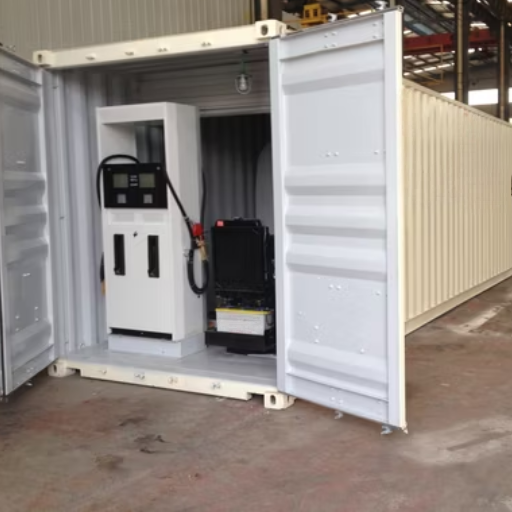
Two units at half the required capacity each do not give you full redundancy. If one goes out of service, the site keeps 50% of storage and 50% of dispensing.
That may be enough. A tank inspection, a dispenser fault, a leak alarm, or a chassis repair can take one unit offline while the other runs at half rate. A single 40ft cannot do that, because a frame-level fault stops every product at once.
Full redundancy is a different purchase. It means two units each sized for peak demand, which doubles tank capex and usually doubles the pad and dispenser count.
Two half-size units also protect less than buyers assume, because the shared parts do the failing. One fuel island fed by both tanks, one power feed, one control cabinet, and one access road are single points of failure that the second tank does nothing about.
Harborline, a hypothetical depot, learned this the expensive way. It ordered two 20ft units so either could run alone, then connected both to one existing island to save a dispenser cluster. When the island’s emergency stop failed, both tanks went offline.
The tanks were redundant. The island was not.
If the site can run at half rate for a day, two half-size units are enough. If it cannot, the honest comparison is two full-size units against one 40ft plus a standby.
Refill logistics: same liters, different drops and points
Using the 73% cyclable convention from the capacity page, which allows for 95% fill, a 2% dead bottom, and a 20% reserve, a 40,000 L site cycles 29,200 L. At 1,000 L per day, that is 29.2 days between refills; at 1,500 L per day, it is 19.5 days.
Split the same demand across two 20,000 L units, and each cycles 14,600 L against 500 or 750 L per day. The days between refills are identical. Two tanks do not buy time; they divide the same time across two points. Skid station capacity scaling is therefore about chamber size, not frame count.
A 20,000 L tanker needs two drops for the 40,000 L site either way. With one 40ft, both go into one connection point in one window. With two 20ft units, the driver makes two connections and, if the units are not adjacent, works two windows.
At the top of the range, the difference widens. A 60,000 L 40ft needs three 20,000 L drops. Two 30,000 L 20ft units need four, because a 30,000 L tank cannot take a full 20,000 L load twice without a partial or a spill risk at the vent.
Turnover is where equal tanks quietly fail. A 40ft split 28,000 L diesel and 12,000 L petrol, serving 700 L per day of diesel and 300 L per day of petrol, cycles both chambers in about 29 days. Two equal 20,000 L units on the same demand cycle the diesel in 21 days and leave the petrol sitting for 49 days. Stale petrol is a quality problem before it is a storage problem.
Marlow, a hypothetical fleet, bought one 20,000 L 20ft in year one and a second in year two, sizing them 14,000 L diesel and 6,000 L petrol, then 18,000 L diesel and 2,000 L petrol as demand moved. Matching chamber size to demand beat matching frame size.
For more information, see our article on 40ft skid station configurations.
Permits and containment: one application, twice the paperwork
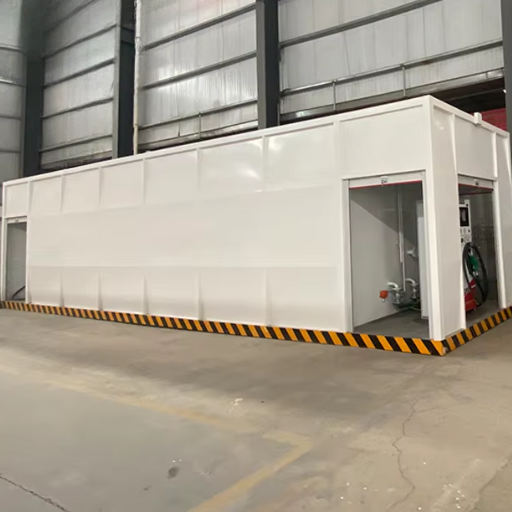
Under 40 CFR 112.1, a non-transportation-related facility is exempt from an SPCC plan only when its aggregate aboveground capacity is 1,320 US gallons or less, counting containers of 55 gallons or more. Two 20,000 L tanks hold 10,567 US gallons between them. The threshold is aggregated, and the plan is site-wide, so a second tank adds a tank line to one plan rather than escaping it.
Capacity alone does not trigger the rule. SPCC also asks whether there is a reasonable potential to discharge oil to navigable waters, so the answer belongs to a site assessment rather than a tank count. A two-tank fuel farm is still one plan.
The four approval tracks sit in the same place. Land use, fire and hazardous substances, environment and spill risk, and the petroleum market licence attach to the site and the activity, so two units do not create four more tracks. They do double the technical documents inside each track: two containment calculations, two vent schedules, two sets of tank certificates and two commissioning records.
Venting follows the same logic. UL 142 Section 8.1 requires normal and emergency venting on each primary containment tank and on each compartment of a compartment tank. A two-chamber 40 ft tank carries the same per-compartment obligation as two separate 20ft tanks.
Containment is settled in the product, not the yard. Both formats rely on a double-wall, monitored tank at working capacity, because a true 110% external bund inside a standard 20ft shell caps near 15,800 L. Two units mean two interstitial monitoring zones; one 40ft with two chambers means two chamber zones plus the shared interstice. Either way, a pad and bunding design has to show it, and remote monitoring needs a second set of probes and a second alarm to route.
Dispensing and the hybrid layouts the binary hides
Dispensing is where two units can genuinely outperform one, and it depends on vehicle flow.
The 40ft product page offers 50 to 400 L per minute, configurable, with up to four nozzles at one island. The 20ft page lists 50 to 80 L per minute as standard and 120 to 400 L per minute as an option. At 400 L per minute, a 1,000 L truck fill takes 2.5 minutes. At 80 L per minute, it takes 12.5 minutes, and at 120 L per minute, 8.3 minutes.
One 40ft concentrates its flow at a single point. Two 20ft units, each with a high-flow dispenser, can serve two vehicle streams at two points with shorter hose runs and less queueing. Site total can exceed 400 L per minute while each point stays slower.
The trade is duplication: two clusters mean two dispenser sets, two calibrations, two emergency stops, and two hose inventories. One cluster means one of each, and one failure point.
Most sites sit between those poles, so three hybrids are worth quoting.
Hybrid A: two 20ft tanks feeding one manifolded island. Both tanks join a common suction manifold and feed one cluster, giving 40,000 L of storage with one operator interface, but giving back redundancy because the island, power, and control cabinet are shared. Treat it as a design request: it needs non-return valves, independent interstitial monitoring per tank, and a designed suction sequence so one tank is not drained while the other stagnates. Ask the supplier to draw it before you accept the quote.
Hybrid B: one 40ft plus one 20ft. A 60,000 L 40ft carries the base load, and a 20,000 L 20ft serves a second product, a second location, or a standby role. Capex phases and the 20ft can be added later without re-engineering the 40ft, which is the modular fuel station argument at its strongest. The cost is a second pad, a second permit drawing set, and a second monitoring point.
Hybrid C: one 40ft plus a separate DEF skid. Diesel and petrol share the 40ft’s chambers while AdBlue sits on a small dedicated stainless skid, which keeps urea out of the same frame as 40,000 L of diesel and keeps the DEF tank turning over.
The real question is how many tanks, islands, and points of failure the site needs. Frame count follows from that.
Comparing quotes? The 40ft containerized fuel station range and the 20ft containerized gas station list what each frame can carry.
A worked 40,000 L comparison for 40ft vs two 20ft skid stations
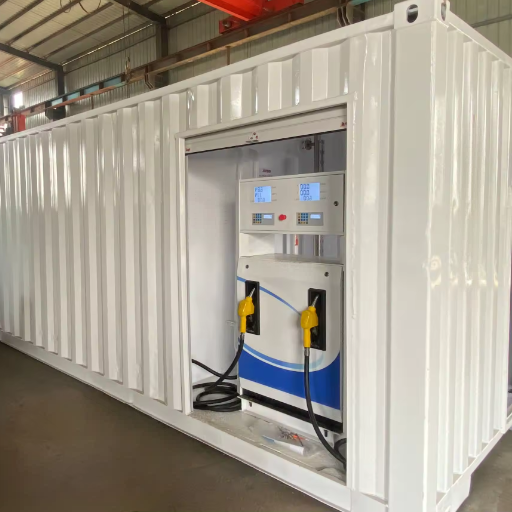
Assumptions, so you can change them: a 40,000 L requirement, diesel at 0.835 kg per liter, a 20,000 L tanker, 73% usable capacity, a 3 m clear perimeter, one dispenser cluster unless a row says otherwise.
| Criterion | One 40ft at 40,000 L | Two 20ft at 20,000 L each | Two 20ft, one manifolded island |
|---|---|---|---|
| Storage | 40,000 L | 40,000 L | 40,000 L |
| Clear site envelope | 153.5 m² | 167 to 178 m² | 167 to 178 m² |
| Empty steel | about 13.4 t, upper bound | 13.6 t | 13.6 t |
| Full mass | about 46.8 t | 47.0 t | 47.0 t |
| Lifts and crane | 1 heavy lift, 50 to 100 t | 2 short loads, about 25 t each | 2 short loads, about 25 t each |
| Dispensing | 1 cluster, up to 400 L per minute | 2 clusters, 120 to 400 L per minute each | 1 cluster, 120 to 400 L per minute |
| Redundancy | none at unit level | 50% capacity if one stops | none at island level |
| Tanker drops | 2 at one point | 2 at two points | 2 at one point |
| Monitoring and permits | 1 unit, 2 chamber zones, one permit set | 2 units, two containment and vent sets | 2 units, two document sets |
No price column appears, deliberately. The site publishes no verified 40ft price, so a percentage saving here would be invented. Compare cost lines instead: freight and lifts, pads, dispenser clusters, calibration, monitoring and permit documents. The ten-year cost model shows how they behave.
Ask six questions in order. The first match decides the format.
- Can a 12.2 m trailer and a 50 to 100 t crane reach the pad? If no, two 20ft.
- Does demand sit at two points drivers already travel between? If yes, two 20ft, one per point.
- Can the site run at half rate for a day? If no, two full-size units or a standby.
- Is peak flow above about 240 L per minute at one point? If yes, one 40ft at 400 L per minute, or two 20ft with high-flow dispensers.
- Is land the binding constraint? If yes, one 40ft; its clear envelope is 9% to 16% smaller than an adjacent pair.
- Is capex phased across more than one budget year? If yes, two 20ft; a 40ft cannot grow except by adding another unit.
If none of the six applies, the default is one 40ft at the working capacity the site needs. It is the simpler permit and monitoring set and the lower steel count, and that is the honest answer when the site is unremarkable.
FAQ
Is one 40ft cheaper than two 20ft skid stations?
There is no reliable general answer, and this site publishes no verified 40ft price. One 40ft saves a lift, a pad edge, and a dispenser cluster; two 20ft units save on crane class and can phase capex. Ask for line-item quotes that separate freight, pads, dispensing, and commissioning.
Can two 20ft skid stations share one fuel island?
Yes, as a manifolded pair: both tanks feed a common suction line and one dispenser cluster, with non-return valves, separate interstitial monitoring, and a designed draw sequence. It saves a dispenser set and gives back most of the redundancy.
Does splitting storage into two tanks avoid an SPCC plan?
No. The exemption applies only when aggregate aboveground capacity is 1,320 US gallons or less, and a 40,000 L site holds 10,567 US gallons; however, it is divided. A reasonable potential to discharge oil to navigable waters is the second condition.
How much land do two 20ft skid stations need?
With the 3 m clear perimeter recommended for vehicle movement and tanker discharge, budget 167 m² side by side or 178 m² end to end, against 153.5 m² for one 40ft. On separate yards, add access roads and turning space for each.
Does a 40ft skid station need an oversize load permit?
At 2.438 m wide, no, on width grounds. US federal rules allow 102 inches on the National Network, and the gross vehicle weight limit is 80,000 lb under 23 CFR 658.17. The constraints are the swept path of a 12.2 m trailer and the crane’s reach.
Next step
The cheapest way to settle 40ft vs. two 20ft skid stations is to stop comparing frames and start comparing sites. Treat the multiple skid stations site as one design brief, not two orders.
Send a site plan with the pad location, the tanker approach, the crane setup area, and the daily liters by product. We will come back with the frame count, the chamber split, and the clear envelope each option needs.
Two things to insist on in any quote: chamber and containment volumes in writing, and a lift plan that names the crane class and the setup radius.