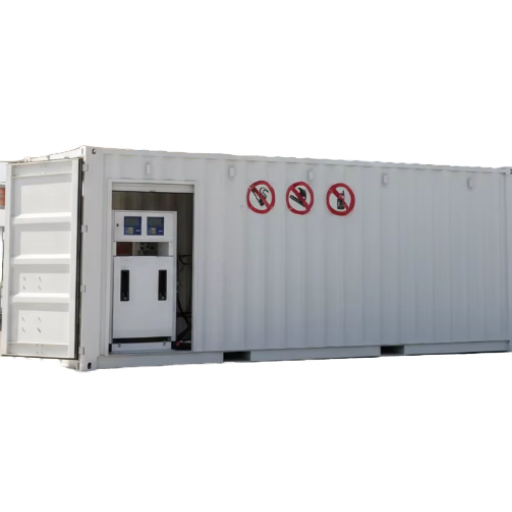
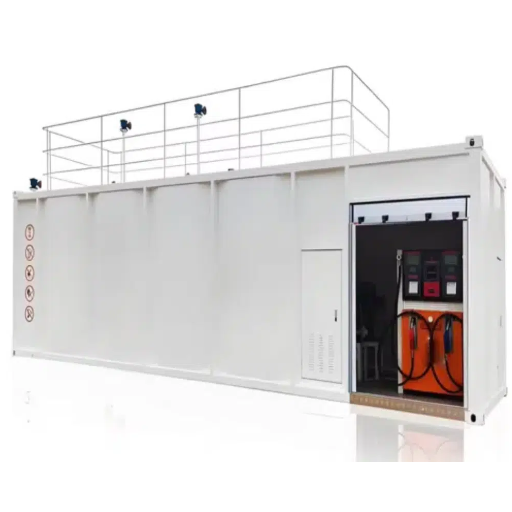
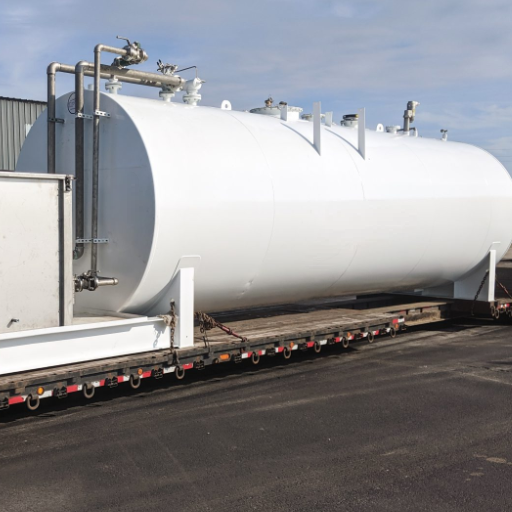
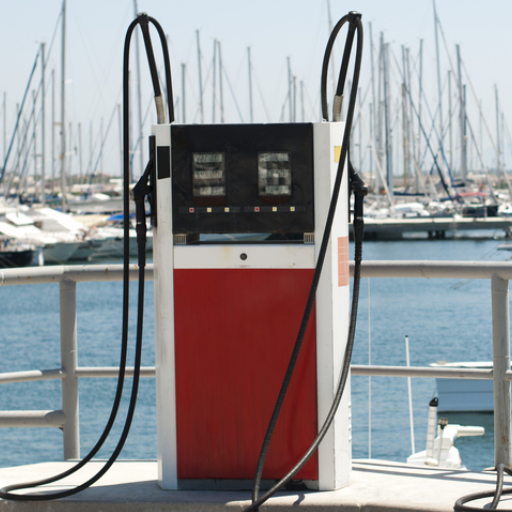
A 40ft skid station configuration runs from a single chamber to three. Each chamber you add costs about 1.5% of nominal capacity in dead volume, and each one also needs its own fill point, vent pair, suction line, meter, and overfill sensor.
The second cost is the one buyers underestimate. A compartment is not a divider dropped into a tank. It is a bulkhead, and the fire codes treat what sits on either side as a separate tank for venting and overfill.
Most projects start with diesel, petrol and AdBlue in one container. That is a system decision dressed as a capacity decision.
The full 40ft skid station guide covers capacity, weight and deployment. This article works out what a second and third chamber cost you in liters, fittings, and regulatory scope.
Published by Shandong Shengrui Intelligent Equipment Co., Ltd. · Last updated 20 November 2026
Know your products and want the frame? The 40ft containerized fuel station range lists the configurations we build.
Key Takeaways
- A 40ft frame can carry one, two or three chambers. A three-chamber 60,000 liter tank gives each product about 19,400 liters of product space, or 14,160 cyclable.
- Dead volume runs about 3% on a 60,000 liter three-chamber. The real cost is the split, because each chamber refills on its own draw.
- UL 142 section 8.1 requires normal and emergency venting for each compartment. Three chambers mean six vent provisions before the interstitial vent.
- One percent gasoline in diesel moves the flash point outside ASTM D-975 and destroys the lubricity the high-pressure pump needs.
- AdBlue is a fourth fluid system, not a third fuel. It needs 316L or compatible plastic, its own dispenser, and a 7% freeze allowance.
40ft skid station configurations the frame can carry
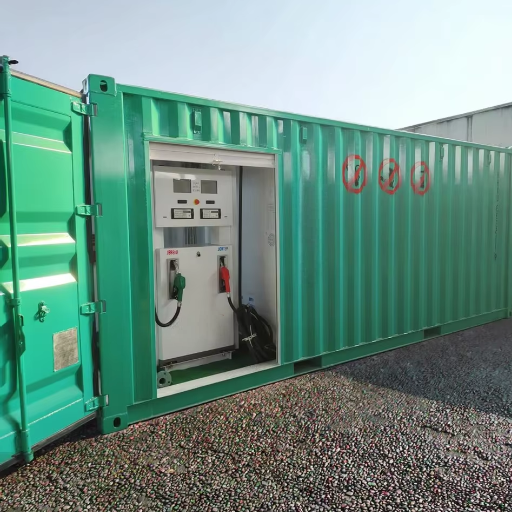
The live product page lists one to three chambers, custom ratios, and a diesel, petrol, and AdBlue combination. They behave differently, and not mainly in the tank.
| Configuration | Bulkheads | Typical product mix | What it adds |
|---|---|---|---|
| Single chamber | 0 | Diesel only, one fleet | Nothing. Cheapest per liter, largest single stock |
| Twin chamber | 1 | Diesel and petrol, or diesel and AdBlue | One fill point, one vent pair, one suction line, one meter, one overfill sensor |
| Three-chamber | 2 | Diesel, petrol and AdBlue | The same list twice |
| Fuel frame plus separate DEF unit | 0 | Diesel and petrol in the frame, DEF on its own skid | A second small unit, a second pad, a second permit line |
The fourth row is not a chamber count at all, and it often beats the three-chamber option. We return to it at the end.
The skid station capacity selection method covers how big each product’s share should be. Gas fuels raise different constraints, covered in the LPG, LNG and CNG station guide.
A fleet manager we will call Marcus specified a 60,000-liter three-chamber unit for a quarry: diesel for haul trucks, petrol for the light fleet, AdBlue for newer equipment. The quote carried one number. Six months later, he was taking three partial deliveries a fortnight.
Why a chamber is not a divider
A bulkhead is a fabricated, stiffened member welded across the shell. It separates the liquid, but not the obligations.
What UL 142 requires of every compartment
UL 142, the standard for aboveground steel tanks, is explicit. Section 8.1 reads:
“Each primary containment tank and each compartment of a compartment tank shall have provision for both normal and emergency venting. The openings for these vents shall be located at the top of the tank.”
Count it. A three-chamber tank needs six vent provisions: normal and emergency for each compartment. Add the interstitial emergency vent a double-wall tank requires, and the shell carries seven penetrations before a single fill point.
Each one is a fitting, a weld, a leak path, and an inspection item. That is why three chambers cost more than three times a single chamber would suggest. The text is reproduced in a MeyerFire engineering discussion of the same question.
What the capacity rules say about compartments
The second half runs the other way. Venting is owed to each compartment. Capacity limits apply to the tank as a whole.
Colorado’s aboveground storage tank rule holds both halves in one sentence. A tank’s capacity “is determined by the aggregate capacity of all individual primary tank compartments contained within the outer shell or structure of the tank, whether there is a shared bulkhead or not.” It adds that “each compartment of an AST must meet the operational requirements contained herein individually (e.g. venting, overfill prevention, release detection, etc.).”
You can read the full text of 7 CCR 1101-14-3-1 at Cornell’s legal archive.
Two findings follow. Operations are per compartment: overfill prevention, release detection, and venting are owed to every chamber, so a single overfill sensor in a common manifold is not a compliant answer. Capacity thresholds are aggregate: splitting a tank into three does not create three tanks. Colorado’s wording is one jurisdiction’s, quoted because it states the principle plainly; assume the same reading where you build.
What each chamber costs you in liters
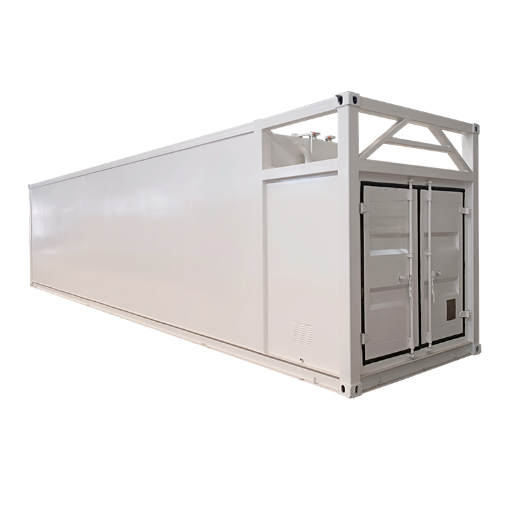
The figure used here matches the pillar’s 1% to 2% per bulkhead: 1.5% of nominal per bulkhead, with bulkheads equal to chambers minus one.
| Frame | Configuration | Bulkheads | Product space | Liters per chamber | Cyclable per chamber at 73% |
|---|---|---|---|---|---|
| 60,000 L standard | Single | 0 | 60,000 L | 60,000 L | 43,800 L |
| 60,000 L standard | Twin | 1 | 59,100 L | 29,550 L | 21,570 L |
| 60,000 L standard | Three-chamber | 2 | 58,200 L | 19,400 L | 14,160 L |
| 68,000 L high-cube | Single | 0 | 68,000 L | 68,000 L | 49,640 L |
| 68,000 L high-cube | Twin | 1 | 66,980 L | 33,490 L | 24,450 L |
| 68,000 L high-cube | Three-chamber | 2 | 65,960 L | 21,990 L | 16,050 L |
The 73% comes from the usable share of nominal capacity: 95% fill limit, 2% dead bottom, 20% operating reserve. It holds for every chamber, because each deduction is proportional.
The 3% that does not matter and the split that does
Two bulkheads in a multi-compartment fuel tank cost 1,800 liters of product space on a 60,000-liter unit. That is 3% of nameplate, and on its own it is no reason to reject a three-chamber design.
The number that matters is the split. Each chamber cycles on its own draw, and a three-chamber 60,000-liter unit gives each product 14,160 liters of cyclable stock.
| Daily draw of one product | Days between top-ups from a 14,160 L chamber |
|---|---|
| 300 L/day | 47 |
| 500 L/day | 28 |
| 1,000 L/day | 14 |
| 1,500 L/day | 9 |
That is the table Marcus needed. His site drew about 1,100 liters of diesel a day and 400 of petrol. The diesel chamber hit its reorder point every 13 days and the petrol chamber every 35. A single-chamber tank on the same draw would have run 40 days.
The split, not the dead volume, changed his schedule. It also meant three separate drops, three fill points to reach and three level readings to trust.
What a bulkhead actually carries
A fuel tank bulkhead between a full chamber and an empty one holds the full liquid head on one face. At a 2.0 m depth and a 2.35 m by 2.0 m face, 4.70 m², diesel at 0.835 kg/L gives 16.4 kPa at the base, an average of 8.19 kPa, and about 38.5 kN on one face. Roughly 3.9 tonnes.
Our product page lists 6 mm inner and outer walls, or 8 mm inner with 6 mm outer. Those are shell schedules. The bulkhead is specified separately, and its design basis is a fair question.
Petrol, diesel and the 1% problem
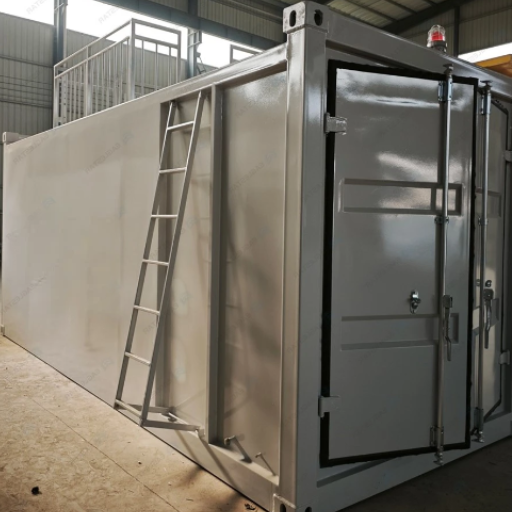
Sharing a frame is fine. Product segregation is: no shared fill point, line, hose, or meter.
| Contamination | What it does | Why it matters |
|---|---|---|
| Petrol into diesel | Lowers the flash point out of ASTM D-975 and destroys lubricity | High-pressure pump wear, metal debris, full fuel system replacement |
| Diesel into petrol | Lowers octane | Knock, smoke, injector and pump damage |
| Fuel or water into AdBlue | Contaminates the urea solution | SCR catalyst and NOx sensor damage, engine derate |
The petrol-in-diesel case is documented in unusual detail. A National Highway Traffic Safety Administration filing records that “ULSD fuel with a 1 % gasoline contamination will already reduce the diesel fuel’s flashpoint outside the ASTM D-975 specification and will degrade the effectiveness of the diesel fuel lubricity to a range that can cause serious damage.”
It goes on to describe the pump wear, the metal debris, and a repair that “require[s] a complete replacement of the fuel system.” The PE10-034 filing is public.
Note the direction. Petrol in diesel lowers the flash point, and that is only half the problem. Our diesel skid station design page puts diesel at roughly 52 to 96 °C flash point, NFPA 30 Class II, and petrol below −40 °C, Class I. Contamination walks a Class II liquid toward Class I behavior inside a chamber whose venting and electrical classification were designed around diesel.
One honest limit: the 1% figure comes from an automaker’s defect filing about vehicle fuel systems, not a bulk storage study. The threshold in a 20,000-liter chamber is not established by it.
A depot we will call Riverside kept one hose on the diesel dispenser for “emergency” petrol. A sample later failed its flash point specification. The expensive part was not the sample. It was disposing of a chamber of product that no longer met ASTM D-975.
Working out a mixed fleet station? Send the products, the daily draw for each, and your delivery access. We will return a chamber layout with liters per chamber and a fill-point plan, not a headline capacity.
AdBlue: the fourth fluid, not the third fuel
It is tempting to treat AdBlue as the third product in the third chamber. That works only if the chamber is built for it.
| Property | Value |
|---|---|
| Composition | 32.5% urea in deionized water |
| Quality standard | ISO 22241, parts 1 to 4 |
| Freeze point | about −11 °C |
| Expansion when frozen | up to 7% |
| Shelf life at 10 °C or below | 36 months |
| Shelf life at 25 °C or below | 18 months |
| Shelf life at 30 °C or below | 12 months |
| Shelf life at 35 °C or below | 6 months |
| Above 35 °C | Test before use |
The shelf-life figures come from the API DEF storage and handling fact sheet. It is blunt: use “dedicated bulk storage tanks” and “dedicated dispensing equipment,” and keep funnels, pitchers, and hoses away from other fluids.
Materials decide the rest. A DEF storage tank is built in 304 or 316L stainless steel or an additive-free plastic. Carbon steel, galvanized steel, copper, brass, and aluminum are all attacked by it.
DEF freezes at about −11 °C and expands up to 7%, so a site running through a northern winter needs a sub-tank that survives it. Our product page answers with dedicated 316L sub-tanks, insulated, heating optional. A mild steel chamber with a coating is not an equivalent, whatever the quote says.
A mine site we will call North Ridge ran DEF in an unheated sub-tank through a winter that reached −20 °C. The fluid froze, expanded, and split a fitting. The repair was small. The SCR warning light on every unit in the fleet was not.
There is no honest DEF-to-diesel ratio. Size the AdBlue tank to measured consumption, not to symmetry with the diesel chamber.
Metering when one 40ft skid station configuration carries three products
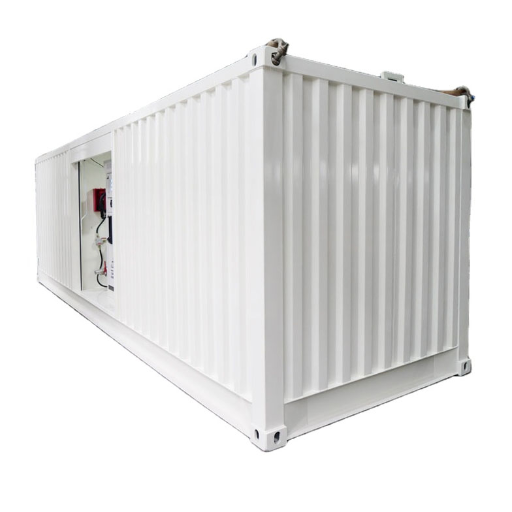
A chamber without its own meter is a chamber you cannot account for.
One meter downstream of a manifold tells the controller how many liters left the frame. It cannot say which product they were. Stock reconciliation, per-product cost allocation, and any custody-transfer claim fail at that point.
The minimum for a three-chamber station is one meter and one nozzle per product, plus a controller that books each transaction against the right chamber. Our high-flow dispenser range works to OIML R117, the international fuel meter accuracy standard, at roughly ±0.25% and some systems to ±0.2%.
The accuracy class matters more than the number. Custody transfer sits at class 0.2 or 0.3; internal allocation between cost centers at class 0.5. Buy the class the transaction needs, per product.
One split tank or two stations?
Both options deliver the products. They differ in footprint, delivery, redundancy, and how much stock each product really has.
| Criterion | One 40ft, three chambers | Two stations, product split |
|---|---|---|
| Footprint and permit | One pad, one approval package | Two pads, more site work, two drawings |
| Delivery | One vehicle, several drops and fill points | Each station takes a full single-product drop |
| Redundancy | One frame. Work on it can stop every product | The other product keeps dispensing during service |
| Stock per product | About 14,160 L cyclable in a 60,000 L three-chamber | Each unit sized to its own draw |
| Metering | One controller, per-product meters | Independent, simpler reconciliation |
Split by station rather than by chamber when any of these is true:
- The products serve different parts of the site, or different fleets with separate access.
- Either product must keep dispensing while the other is serviced.
- Any product’s cyclable chamber falls below about two weeks of its own daily draw.
- The site needs custody-grade metering per product to bill between cost centers.
Test three is arithmetic you can run from the table above. A 14,160-liter chamber covers 14 days at 1,000 liters a day, and a product drawing 1,500 liters a day is under two weeks on day one. That is usually the moment a three-product site should look at two frames instead.
The specification to demand
Whatever the layout, these eight items belong in the quote. A supplier who cannot answer them is selling a tank, not a configuration.
- The number of chambers and the liters per chamber, equal split or a stated custom ratio.
- The bulkhead design basis: the differential head it is rated for.
- Normal and emergency vent provision for each compartment, to UL 142 section 8.1.
- Overfill prevention and release detection for each compartment.
- A dedicated, labeled fill point per product.
- A dedicated suction line, meter, and nozzle per product.
- The DEF sub-tank material, insulation, and heating, with its own dispenser.
- The meter accuracy class per product and how stock is reconciled.
FAQ
What is a 40ft skid station configuration?
It is how a 40ft containerized fuel station is divided internally. Options run from one chamber holding a single product to three chambers holding diesel, petrol and an AdBlue sub-tank. Each chamber has its own fill point, venting, overfill protection, and meter.
Is a three-chamber fuel tank worse than three separate tanks?
Not worse, but different. A three-chamber fuel tank saves footprint, permits, and steel. Separate tanks give redundancy, because one unit can be serviced while the other keeps dispensing.
How much capacity does each compartment lose?
About 1.5% of nominal per bulkhead, roughly 900 liters per bulkhead on a 60,000-liter tank. A three-chamber unit holds about 58,200 liters against 60,000 for a single chamber. The bigger effect is the split.
Can diesel and petrol share a fill point?
No. Not a fill point, a line, a hose or a meter. One percent gasoline in diesel already moves the flash point outside ASTM D-975 and degrades lubricity enough to damage a high-pressure fuel pump.
Does AdBlue go in a third chamber?
Only if that chamber is built for it. AdBlue needs 304 or 316L stainless steel or a compatible plastic, a dedicated dispenser, and a freeze allowance of up to 7%. A coated mild steel chamber is not a substitute, and many sites do better with a separate DEF sub-tank.
Next step
The chamber count in a 40ft skid station configuration is a system decision. The liters per chamber are the consequence, and your refill calendar runs on those.
Take the specification list into your next supplier conversation. Ask for liters per chamber, the bulkhead design basis, and venting provision per compartment. If the answer is a single capacity figure, you have learned something useful about the quote.
The 40ft containerized fuel station range shows the chamber options we build, and the full 40ft skid station guide covers capacity, weight, and deployment. Send your product list, daily draw, and delivery access, and we will size the chambers rather than the box.