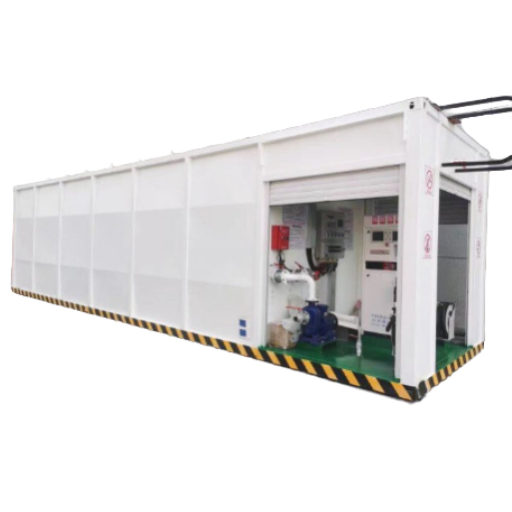
A 20ft skid station needs a load-bearing pad sized to the unit footprint and anchor pattern, designed for 25 to 31 tonnes fully laden and the point loads at the skid beams. It also needs secondary containment holding 110% of the largest tank, unless a self-bunded container and the local authority accept the tank walls as the bund. Here’s how to specify both before the unit ships.
Suppliers say “prepare a concrete pad” and publish anchor loads. Almost nobody publishes the arithmetic behind that pad, the options when ground is weak, or a worked bund example you can hand to a fire officer. That’s where projects lose a week, a crane booking, or a permit.
If you already have a signed anchor schedule and a written AHJ position on containment, skip ahead to the 20ft skid station configurations. Still briefing a local engineer? This guide gives you the load table, the pad decision rules, the bund math, and the survey pack to send before steel is cut.
Take a composite scenario. A fleet depot ordered a 20ft unit on a Friday. The pad was poured Monday to “something like the container size.” When the 25-tonne crane arrived, the anchor bolts didn’t match the supplier drawing, and the finished level sat 12 mm off across the skid base. The unit went back on the trailer.
Two weeks later, it returned to a pad that had been cored, surveyed, and re-poured to the drawing.
You probably believe the civil works are the simple part of a skid project. This guide pressure-tests that belief.
By the end, you’ll know what the ground has to carry, which base option fits your soil, how bund volume is calculated in your jurisdiction, and the eight site data items that should leave with the purchase order.
One clarification first. Foundation design here means the pad or hardstanding under a packaged skid station. It is not ringwall versus raft design for vertical storage tanks; that’s a different load path, covered in our vertical tank foundation guide. If you’re still choosing the deployment format itself, start with skid station versus a buried tank.
Key Takeaways
- Design the pad for point loads at the skid beams, not the average pressure under the footprint: 25 to 31 t fully laden on a 60 to 100 m² pad.
- Reinforced concrete is the default base; compacted hardstanding and piles are exceptions with clear failure modes.
- Containment is 110% of the largest tank in most jurisdictions. A self-bunded 20ft container may satisfy the rule without a civil bund if the AHJ accepts it in writing.
- Bunds are sized on tank capacity, not on the 95% safe-fill working volume.
- Collect eight site data items before fabrication releases: the survey pack that keeps the crane day from failing.
What the Ground Has to Carry
Dry, fuel, and fully laden: three numbers, three bases
Three weight figures circulate for a 20ft unit, and they are all true under different labels. Publish the basis with the number, or the pad will look wrong next to its own datasheet.
| Input | Figure | Basis |
|---|---|---|
| 20ft unit, dry | 4.2 to 7.0 t | Empty operating weight of the packaged station |
| ISO gross mass envelope | 30,480 kg | CSC plate / ISO container limit for a 20ft box |
| Fully laden, working figure | 25 to 31 t | Structure, tank, fuel, dispensers and fittings as designed for slab checks |
| Fuel alone, 15,000 L diesel | ~12.5 t | 15,000 × 0.835 kg/L |
| Fuel alone, 22,000 L | ~18.4 t | Top of the specification guide’s capacity band |
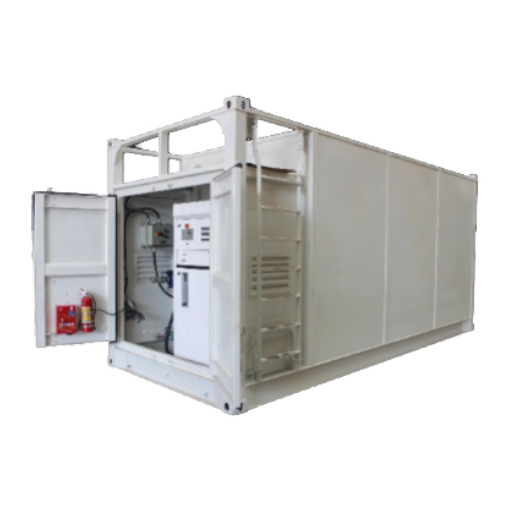
Dry weight drives crane selection. Our shipping weights, crane classes, and road limits guide puts a 20ft unit in the 25-tonne crane class and the dry range above. Fully laden weight drives the pad.
Fuel weight shows why the two differ. One fill can add 12 to 18 tonnes to a frame that arrived at 4 to 7.
Use the 20ft skid station specification guide for capacity arithmetic, safe fill and ullage. This article doesn’t restate a rated capacity. It designs the ground under whatever capacity the datasheet states.
Why point loads govern, not average pressure
Spread 15 tonnes over a 60 m² footprint and the average pressure is about 0.25 t/m². Almost any compacted yard passes that check. The pad fails when the load arrives at the skid beams as a line or point load, not as a uniform carpet.
A local structural engineer sizes the slab for:
- Beam-line bearing under the tank cradle and frame rails
- Anchor bolt pull-out from wind and seismic hold-down
- Differential settlement that racks the frame and cracks pipework
- Crane and delivery traffic on the approach, not only the final pad
That’s the sentence no competitor brochure prints: the supplier publishes anchor loads; someone else designs the slab.
Our installation guide states a working target of ground bearing capacity at or above 10 to 20 t/m², pad levelness within 3 mm across the skid base, and anchor bolts set to the supplier drawing. Treat those as our site’s stated targets, not a universal code value. Your geotech note confirms or replaces them.
Concrete Pad, Hardstanding or Piles: Choosing the Base
| Option | When it works | When it fails | Planning cost signal |
|---|---|---|---|
| Reinforced concrete pad (default) | Firm ground, bearing verified, level site, multi-year location | Weak or contaminated soil without thickening or piles | $140 to $340/m² planning band; structural slab with reinforcement sits at the upper end |
| Engineered compacted hardstanding | Mining and fleet yards that already run heavy plant; unit may move within the lease | Settlement-prone soils; anchors that need concrete embedment | Lower capex, higher settlement risk |
| Piles or ground improvement | Soft fill, high water table, mandatory settlement control | Overkill on rock or dense granular | Local geotech only; no global price |
| Existing slab, verified | Known industrial yard with drawings | Unknown thickness or reinforcement; no anchor embedment | Cover meter and core before the crane is booked |
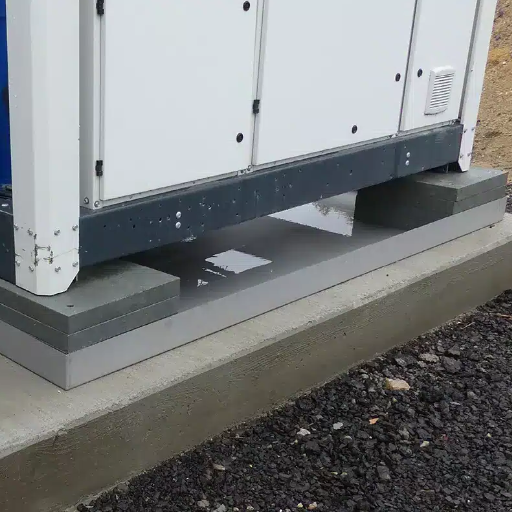
Reinforced concrete remains the default answer to skid station foundation design. Hardstanding earns its place when the surface already carries loaders and the unit is temporary enough that a structural slab is hard to justify.
Piles appear when the geotech note says so, not when the sales conversation does.
Three construction rules travel with every option:
- Cure before delivery. Green concrete cracks under load and will not hold anchor bolts reliably.
- Level to the drawing. The 3 mm target across the skid base is cheap to survey and expensive to ignore.
- Fall the pad for drainage. Surface water leaves the pad; it does not pond under the frame or into the bund.
The mobile fuel station installation guide covers the Phase 2 sequence, placement layout, and utility trenches. This article specifies what to put in that phase before the sequence starts.
Ready to check your plot against a real datasheet? Send us the site details, and we will return the anchor loads and drawing set your engineer needs.
Anchoring, Uplift and Drainage
Hold-down is a foundation input
Wind and seismic aren’t electrical afterthoughts. Uplift turns the pad into a tension element as well as a compression element. The anchor schedule from the supplier drawing is part of the foundation package: bolt pattern, embedment, torque, and any hold-down plates.
Where the authority treats seismic or wind as a permit input, that conversation belongs with skid station permit requirements, not with the concrete crew. Earthing is tested to the value in the acceptance criteria before first dispense.
Drainage leaves, bunds hold
The pad falls to a drain or soakaway outside the containment. Bund outlets stay closed unless the fire authority approves a controlled release. Drainage destination is a permit question that often arrives late. Settle it with the survey pack, not on delivery day.
Keep electrical panels, generators, and non-explosion-proof equipment outside the hazardous zone around dispensers and vents. Our installation guide notes that codes such as GB 50156 and NFPA 30A commonly classify areas within roughly 3 m of fuel handling points as hazardous. Confirm the zone with your AHJ.
Bunding a 20ft Station: Self-Bunded, Civil Bund, or Both
The 110% rule and when it applies
Secondary containment exists so a tank release never reaches soil or groundwater. The most common formulation in English-language guidance is:
- 110% of the largest tank in the bunded area, or
- 25% of the total volume of all containers in that area, whichever is greater.
That rule appears across UK and Commonwealth guidance. Our own installation guide cites NFPA 30A typically calling for 110% of the largest tank, and notes that GB 50156 and related Chinese standards often specify 10 to 50% of tank volume depending on local interpretation. Always confirm the rule that applies in your region.
Worked example: 22,000 L to 24,200 L
Illustrative only. Substitute your tank capacity.
- Largest tank: 22,000 L
- Bund volume at 110%: 22,000 × 1.10 = 24,200 L
- Pad area band: 60 to 100 m²
- Implied depth if the bund is the full pad: 240 to 400 mm
That depth fights door swings, step-over access, hose reels and drainage. Freeboard and rainwater are design inputs, not footnotes. A bund sized only to the liquid volume fails the first storm of the season if the outlet is open.
Safe fill doesn’t reduce the bund requirement. A 95% fill limit protects ullage and overfill, not containment. Bunds are sized on tank capacity, not working volume.
Three containment options
| Option | How it satisfies containment | Typical use |
|---|---|---|
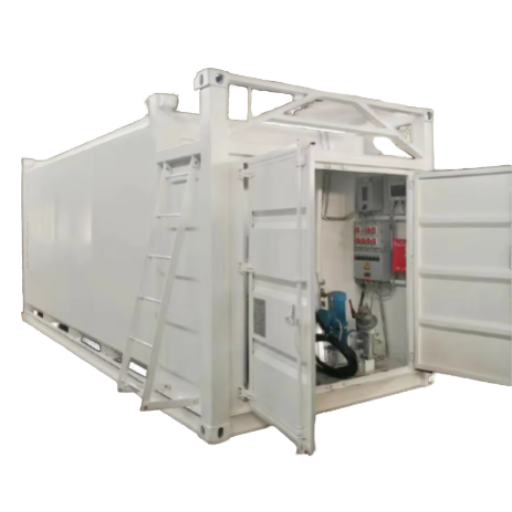
| Self-bunded or double-wall container | Tank walls are the secondary barrier; interstitial monitoring watches the gap | Default for many 20ft CSC units |
| External civil bund | 110% (or local equivalent) of largest tank volume | AHJ requires a bund regardless of tank type, or dispensers sit outside the tank envelope |
| Under-skid and drip containment | Catches dispenser and hose spills, not a full tank release | Almost always in addition to one of the above |
A self-bunded tank can remove the civil bund obligation only when the authority accepts the tank walls as the bund in writing. Until that letter exists, design the civil bund.
Our spill containment systems guide covers the wider site picture. NFPA 30A requirements cover dispensing-facility scope and separation.
Regional table: name the code, do not improvise
| Regime | Common containment framing | Link style |
|---|---|---|
| NFPA 30A (US motor fueling) | Typically 110% of largest tank | Internal NFPA 30A guide |
| UK / EU practice | 110% of largest or 25% total, whichever is greater | HSE HSG176 |
| Australia | AS 1940 storage guidance; bunding rules by state | Name the standard; verify local clause at write time |
| US maritime / OSHA | Clearance and handling rules for containers | OSHA 1917.156 |
| GB 50156 (China) | Often 10 to 50% of tank volume, local interpretation | Cite as Chinese standard; no invented clause number |
| Local AHJ | Always governs | Permit requirements |
Secondary explainers such as Hazchem Safety’s bunded storage requirements restate the 110% and 25% rule clearly, but they do not size a bund for a 20ft station. Prefer the primary code for compliance decisions.
Which Codes the Fire Authority Will Use
Pad design is civil. Containment is environmental and fire. The authority will read both against local code, not against the supplier datasheet. Name the documents, then hand the package to the AHJ early:
- Tank construction standards (for example UL 142, UL 2080, UL 2085 families) describe how the vessel is built. They don’t design your slab. Our specification guide maps which certificate covers what.
- NFPA 30 and NFPA 30A frame flammable liquid storage and motor fueling in the US context.
- HSE HSG176 is the UK reference for flammable liquid storage in tanks.
- Local planning, fire, and electrical AHJs decide separation, containment acceptance, and temporary status.
Don’t claim a Shandong Shengrui product holds a certificate number that hasn’t been verified. Ask the supplier for the document set instead; our manufacturer evaluation criteria list what to request.
The Survey Pack to Send Before the Unit Ships
Tie this list to the pillar’s submittal register. The supplier’s twelve documents travel one way; the site’s eight items travel the other.
- Geotechnical note or at least a bearing estimate against the 10 to 20 t/m² target
- Site levels and finished pad level relative to the approach road
- Drainage outfall consent or stormwater path
- Confirmed anchor schedule from the supplier drawing, signed by a local engineer
- Crane position and crane pad, sized for the 25-tonne class used on 20ft units
- Hazardous-zone boundaries for electrical and housekeeping
- Bund option chosen (self-bunded vs civil) and the AHJ’s written position
- Power, earthing and test-value target from the acceptance criteria
Site works also belong in the money conversation. Pad area, hardstanding rates and commissioning sit inside site works in the ten-year cost model, not as a surprise line after the crane is booked.
Frequently Asked Questions
What foundation does a skid station need?
A skid station needs a load-bearing pad, usually reinforced concrete, sized to the unit footprint and anchor pattern and designed for the point loads at the skid beams when fully laden. For a 20ft unit, that means checking bearing capacity, levelness, cure before delivery, and wind or seismic hold-down with a local structural engineer.
How thick should a concrete pad be for a 20ft fuel container?
Thickness follows reinforcement, soil bearing, and beam-line loads, not a single universal number. Use the supplier’s anchor loads, a bearing target such as the 10 to 20 t/m² figure in our installation guide, and a local engineer’s slab design. Levelness within 3 mm across the skid base matters as much as thickness.
How big does a bund need to be for a 20,000 litre fuel tank?
Under the common 110% rule, a 20,000 L largest tank needs a bund of at least 22,000 L. Some regimes use 110% of the largest tank or 25% of total contents, whichever is greater. Confirm the rule with your AHJ before you pour.
Do I need a separate bund if the tank is self-bunded?
Only if your authority requires one. A self-bunded container can satisfy secondary containment when the fire or environmental authority accepts the tank walls as the bund in writing. Until that acceptance exists, design a civil bund at the local percentage.
How much does a 20ft skid station weigh when full?
Dry packaged weight is roughly 4.2 to 7.0 t. Fuel alone adds about 12.5 t at 15,000 L or 18.4 t at 22,000 L of diesel. Working fully laden figures of 25 to 31 t include structure, dispensers and fittings. Crane and road planning use dry weight; slab design uses the laden case.
Conclusion
Skid station foundation design comes down to three decisions made before the unit ships: a base sized for point loads at the skid beams, a containment strategy sized on tank capacity at 110% unless the AHJ accepts a self-bunded tank, and a survey pack that matches the supplier drawing.
The pad isn’t the simple line item. It’s the interface between a factory machine and a local site, and it’s inspected by the same authority that reads your permits.
If you have a plot, a throughput target, and a soil note, talk to our team about anchor loads, drawing sets, and bund options for 20ft skid station configurations. Bring the survey pack early. The crane day stays on schedule when the drawings agree.