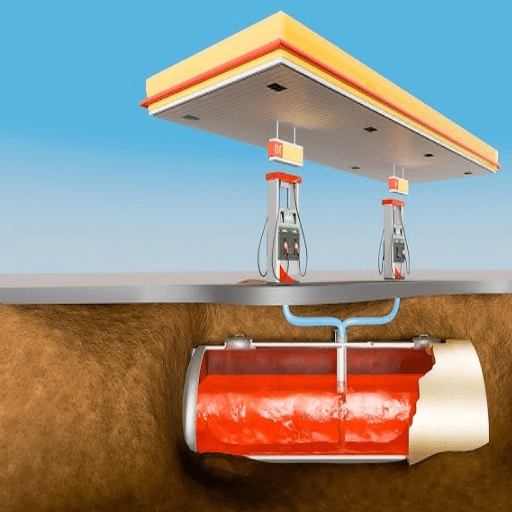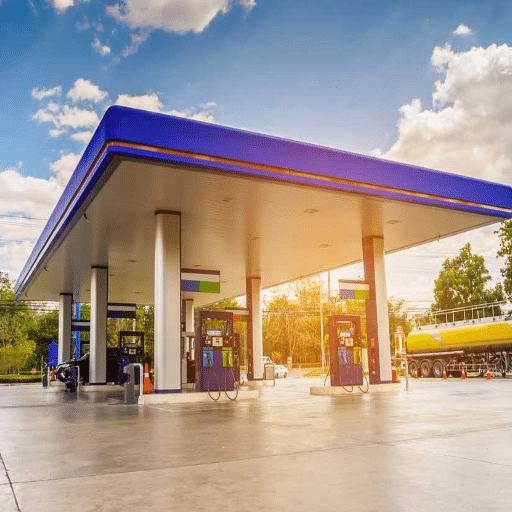
When Hurricane Katrina struck the Gulf Coast in 2005, dozens of gas station canopies collapsed. The wind did not simply blow them over. Engineers later discovered that open-structure wind loads had been underestimated by as much as 30–50 percent. Stress ratios inside column bases reached 1.3 to 1.5 times the allowable limit. In some cases, shallow foundation embedment of just 0.30 meters allowed entire canopies to lift straight off their footings.
If you think a canopy is simply a structure that decorates the roof, then consider its application as a temporary roof of a building under construction. This is an especially important risk in tropical coastal areas where corrosion, heat, and humidity may shorten the life of concrete elements.
In this guide, we will cover gas station canopy design from an engineering-first perspective. You will learn how bolt-ball space frames compare to welded trusses, how wind loads actually work on open forecourt structures, what LED lighting and smart technology integration requires, and how much a canopy costs from raw prefab China FOB to installed turnkey in the United States or Europe.
What you will learn:
- How to select the right structural system for your climate and span
- Why do open canopies experience higher wind uplift than enclosed buildings
- What IES lighting standards require under the canopy
- Real cost ranges for prefab vs. installed canopy projects
- How major fuel brands are redesigning canopies for 2026
Mini-story: The wake-up call in Louisiana
Roberto managed a Shell-branded station just outside New Orleans. His canopy was fifteen years old, built with single-row tubular columns and a flat steel roof. When Katrina hit, the wind got under the roof deck and pulled the entire structure upward. The columns did not bend. They pulled straight out of the concrete pads because embedment was only thirty centimeters deep. The insurance claim totaled 340,000. There placement canopy, engineered with deep foundation anchoring and a bolt−ball space frame, cost 180,000 and survived two subsequent hurricanes without damage. Roberto now tells every station owner he meets: the cheapest canopy is the most expensive decision you will ever make.
Types of Gas Station Canopy Structures

All canopies are created differently. The grade and type of construction of the fuel station canopy will largely inform what its span will be, how achievable it is to install, how much of a maintenance liability it will be and what the total cost will be over those years.
Bolt-Ball Space Frames
Bolt-ball space frames are the dominant structural system for modern petrol station canopies, especially in markets where prefabrication and rapid installation matter. This approach has become the default in gas station canopy design for projects that demand both long span and fast installation.
The system uses Q235B or Q355B steel pipes connected at nodes by 45# steel forged bolt balls. High-strength bolts in Grade 10.9S (typically 40Cr alloy steel) secure each joint. The result is a double-layer grid shell that distributes loads in three dimensions rather than along linear truss lines. A bolted space frame canopy of this type can be prefabricated in a factory, shipped in containers, and assembled on site with no field welding.
Key specifications:
- Span: Column-free coverage from 15 meters to over 40 meters
- Weight: 30 to 50 kilograms per square meter, including frame and roofing
- Design life: 50+ years with proper surface treatment
- Installation speed: 60 to 70 percent faster than welded structures because joints are bolted, not field-welded
- Ground clearance: Lower chord typically 6 meters or higher from the ground
Even sheets that are plated or coated with protective finishes can be worn. Blasting to achieve Sa2.5 and hot dip galvanising or multilayer applications of epoxy primer that contains a very high content of zinc in a matrix over the steel is required to protect metal in structures. This is especially useful when the structure is in an environment of high humidity or a seaside area.
Steel Truss Systems
Welded or bolted steel trusses offer a simpler alternative for shorter spans. They use fewer connection points but require heavier individual members. Truss systems work well for canopies under 20 meters in span, where crane access is limited and local labor is skilled in welding.
The trade-off is weight and labor. Truss canopies typically require 20 to 40 percent more field labor than space frames. Over a thirty-year lifecycle, welded joints also demand more inspection and maintenance because fatigue cracks can initiate at heat-affected zones.
Membrane and Composite Canopies
When it comes to aesthetic appeal and effectiveness, the PTFE membrane roofs, aluminum composite panel systems and polycarbonate panels come into play. Most of these are suited in the renowned brand fuel stations which require a curved or elevated roof. Even the curved configurations of the membrane and composite systems are possible to be executed without the metallic or composite sub-frame structures but with inter-skins limitations between the structures.
Structural Comparison
| Feature | Bolt-Ball Space Frame | Steel Truss | Membrane / Composite |
|---|---|---|---|
| Typical span | 15–40+ m | 10–25 m | 8–20 m |
| Weight | 30–50 kg/m² | 40–70 kg/m² | 15–35 kg/m² (shell only) |
| Install speed | Very fast (bolted) | Moderate (welded/bolted) | Slow (subframe + membrane) |
| Field labor | Low | Moderate to high | High |
| Maintenance | Low | Moderate | Moderate to high |
| Design life | 50+ years | 40–50 years | 20–40 years |
| Best for | Large forecourts, high wind | Small stations, limited access | Premium brand aesthetics |
Want to see how a space frame canopy integrates with a complete station build? Explore our turnkey gas station construction packages that include canopy, OIML-certified fuel dispensers, and tank systems engineered as one project.
Engineering Loads and Structural Design

A forecourt canopy is an open structure. That classification changes everything about how wind acts on it.
Wind Load Design Standards
Three major codes govern canopy wind loads, and they do not all agree:
In the case of vehicular loading in the ASCE 7-16 standards of wind loading in the United States, specific provisions of attached canopies were introduced in Section 30.11. The freestanding open canopies, however, call for consideration of the upper surface downward pressure, the lower surface uplift suction and the net combined pressure. The wind action force normal to the inclined roof system is assumed to act at 1/4th of the height of the roof from the windward edge and creates torsion in supports, which most older buildings do not consider.
The standard GB50009-2012 (China) provides data on the necessary wind loads and snow loads required to be observed in the construction of structures. With this enormous increase in the weather disruptions, the Chinese engineering code now reports that 50 years wind pressure recurrence period is recommended for the evaluation in the canopy design.
EN 1991-1-4 (Europe) uses force coefficients and obstruction factors. The factor phi measures how much of the space below the roof is blocked by dispensers, vehicles, or equipment. A fully obstructed canopy sees different pressure distributions than an empty one.
Since the standard wind speeds in different regions are specific, in the United States, for example, the coastal areas can experience mean speeds of wind from 90 to 150+ mph at the time of providing for suchuma. However, in the Asian regions plagued with cyclone storms, engineers would sometimes pioneer with a system that allows for designing for speeds of up to 30 meters per second or more. Understanding these differences is therefore also important in the design of gas station canopies in any high-wind area.
Snow, Seismic, and Live Loads
Beyond wind, canopies must handle:
- Uniform load capacity: Approximately 3.5 kilonewtons per square meter for standard designs
- Snow loads: Engineered per local ground snow load maps; drift accumulation at roof edges must be considered
- Seismic forces: Chinese codes reference GB50011-2016; seismic bracing or moment-frame connections may be required in high seismic zones
- Deflection limits: Typically span divided by 200 to prevent visible sag that alarms customers
Hurricane Failure Analysis and Prevention
The most dangerous configuration was a single row of aligned columns acting as cantilevers. Primary failure modes included:
- Column pull-out from shallow foundations
- Plastic hinging at column bases
- Tubular column buckling under combined compression and bending
Prevention is straightforward but not cheap. Coordinating the canopy foundation with fuel storage tank solutions and site civil work ensures the entire forecourt performs as one system:
- Deep foundation embedment of at least 1 meter into reinforced concrete
- Rigid connections or steel moment frames instead of simple pin connections
- Two-row column configurations with cross-bracing for large spans
- Regular inspection of coatings and fasteners in coastal environments
Mini-story: The project that almost went wrong
In 2023, a project integrator named Ahmed was sourcing a canopy for a new station in coastal Nigeria. A local contractor quoted 95 per square meter for a welded truss canopy with single−row columns. Ahmed asked for wind−load calculations. The contractor had none. Ahmed instead sourced a bolt−ball space frame from a Chinese manufacturer at 48 per square meter FOB, then hired a structural engineer to design foundations for 35 m/s wind speed. Total installed cost: $210 per square meter. Six months later, a tropical storm with 28 m/s winds passed through the region. Three neighboring stations lost canopies. Ahmed’s station stayed intact. The difference was not luck. It was engineering.
LED Lighting and Smart Technology Integration
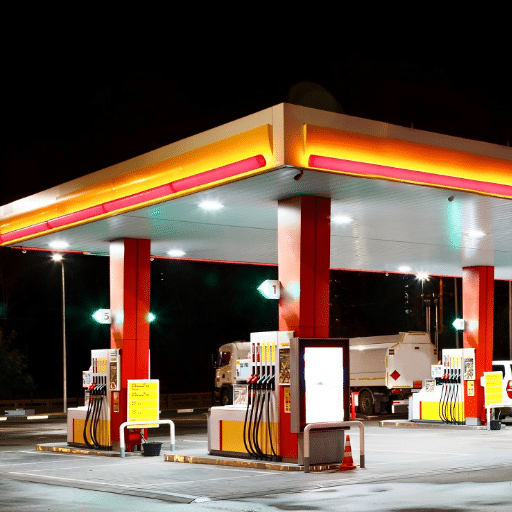
The canopy is also an electrical and technology platform. What hangs beneath the roof is just as important as the frame above. Buyers should plan lighting as an integral part of gas station canopy design, not as an afterthought.
IES RP-33 Lighting Standards
The Illuminating Engineering Society sets the benchmark for forecourt lighting. Canopy LED lighting design guides recommend that under-canopy pump islands deliver 20 to 30 maintained foot-candles average, with a uniformity ratio of 4:1 or better. Some municipalities cap maximum canopy brightness at approximately 22 foot-candles to control light pollution.
Recessed full LED fixtures are now the new industry norm for del and a key part of the modern canopy LED lighting layout. A typical fixture is designed to produce around 10,000 lumen and 15,000 lumen. This is measured with the lumen method where canopy area is times target foot candles divided by fixture lumen, utilization factor, and light loss factor.
Smart IoT Controls
Modern canopy lighting is no longer on/off. IoT-enabled systems adjust output based on:
- Motion detection at pump islands
- Daylight harvesting and time-of-day dimming
- Weather conditions (rain, fog, dust)
- Remote monitoring and fault alerting
These controls can reduce lighting energy consumption by 50 to 70 percent compared to traditional HID systems.
EV Charging and Solar Integration
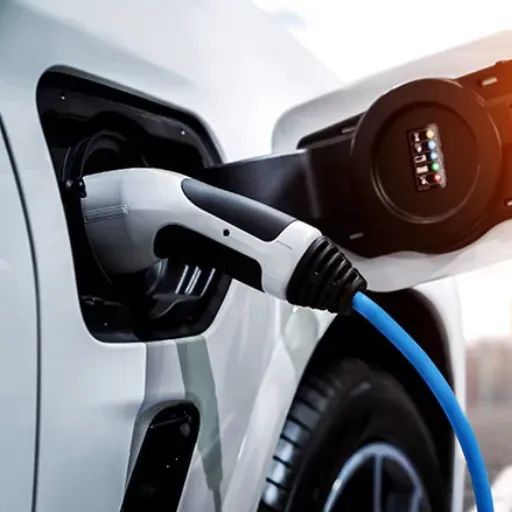
As sites transform and become energy centers, the canopy electrical infrastructure will have to adjust. Lots of infrastructure would have to be added to wring out more than 150 to 350 kilowatts for the DC fast bays, especially because these costs require more substantial installation such as dedicated circuits which have to be installed.
- Mounting infrastructure for payment terminals, security cameras, and digital displays
- Conduit runs and switchgear sized for future EV expansion
- Solar photovoltaic panels on the roof surface, paired with battery storage
- Foundation pads and electrical rooms prepped for hydrogen dispensing equipment
If you are going to install an electric vehicle charging station in your gas station, it is necessary to do canopy electrical design integration from the beginning. It is three to five times more expensive to retrofit a canopy for high-power charging than to do the canopy design precisely for it. If the canopy requires explosion-proof equipment in relation to electrical components, review explosion-proof gas station equipment standards that one must be aware of, namely those that deal with lighting and wiring.
Cost Framework: China FOB vs. Turnkey Installation

The canopy’s price is influenced by many factors, including the geographical location of the buyer or the installer, and the number and types of accessories one is interested in. It is important to ensure that the design of a gas station canopy is optimal such that the structure’s performance requirements are met, branding needs are satisfied and the whole life costs are taken into account from the very beginning.
Prefabricated Space Frame Pricing (FOB China)
Understanding gas station canopy cost requires looking at both equipment and installation. For bulk orders sourced directly from Chinese manufacturers:
- Budget lightweight steel: 20 to 46 per square meter (high MOQ, typically 200+ sqm)
- Standard bolt-ball space frame: 30 to 80 per square meter (common for 100 to 500 sqm orders)
- LED-integrated or custom profiles: 70 to 120+ per square meter
- Small order premium: 48 to 57 per square meter for very low quantities
These prices cover the steel frame, bolt balls, bolts, and basic roof panels. Shipping, customs, and local installation are additional.
Installed Turnkey Costs by Region
In developed markets with high labor and compliance costs:
- United States installed: 325 to 485 per square meter (30 to 45 per square foot)
- Painting and under-deck coatings: 32 to 54 per square meter
- Lighting installation: 2,000 to 10,000 total per project
- Total project range: 50,000 to 300,000 for a complete station canopy
Total Cost of Ownership
Over a thirty-year period, impact-loaded wire and bolt spaceframes appear to require about 40 percent less man-hours of installation time compared to the impact-loaded wire and bolt welded long-span trusses. In addition, cost savings by 50% to 70% can be realized with the help of LED lighting and smart control. These two aspects can help in offsetting the greater cost in the purchase of equipment during the first seven to ten years of operation.
| Cost Category | FOB China (Prefab) | U.S. Installed Turnkey |
|---|---|---|
| Structure only | $30–80 / sqm | $325–485 / sqm |
| LED lighting | +$15–30 / sqm | +$2,000–10,000 total |
| Custom profiles / branding | +$20–50 / sqm | +$50–100 / sqm |
| Foundation and install | Local labor only | Included in turnkey |
| Typical 200 sqm project | $12,000–25,000 (materials) | $80,000–150,000 (total) |
These figures show why many project integrators pair canopy procurement with SF double-wall tank systems from the same manufacturing source to simplify logistics and quality control.
Planning a complete station build? Compare turnkey gas station China packages that bundle canopy, dispensers, and fuel storage into a single procurement contract with one point of accountability.
Branding, Signage, and Customer Experience
The canopy is your station’s most powerful roadside advertisement. Drivers decide whether to pull in from hundreds of meters away, and the canopy silhouette drives that decision. Effective gas station canopy design treats the roof as both a structure and a marketing asset.
Major Brand Image Standards
Chevron’s nationwide Texaco refresh, scheduled for completion by 2026, mandates 3D canopy designs with evolved brighter color schemes, updated pump flags, and more visible pole signs. The canopy is no longer flat. It has dimensional presence.
Phillips 66 standards for new branded sites require:
- 36-inch or 48-inch flat fascia extending over all multi-product dispensers
- All LED under-canopy lighting, flush mount, fully recessed
- Square corners for new builds
- Clean fascia with no discretionary signage on dispensers
Fascia, Signage, and Wayfinding
There is a location where the brand essence is located at the fascia panel beneath the roof. Enlightened coastal brands, lightweight displays and LED platinum accents were intended to render the projecting eaves of the filling station a visible landmark. However, many towns now regulate or even prohibit advertising on the canopy poles. Always check the local building code before the actualization of the fascia design.
Safety Perception and Nighttime Appeal
It is also worth mentioning that the antireflective surfaces (whitening the ceiling and the columns, uniform white light from the LED luminous sources ) create very clean and comfortable transport facilities. Data studies and other research also confirm (and even underline) that well-lighted installations with modern elements and technologies secure the confidence of drivers, which in turn results in an increased number of visits after dusk. This is what they refer to as the beacon effect, that is to say, a well illuminated canopy that is in place is associated with an increase in moisture traffic than one that is an old, poorly lit one.
Mini-story: The refresh that paid for itself
In suburban Houston, Carlos managed a Texaco which had last been remodeled in 2008. The sales started decreasing during the past three years. By the beginning of 2025, he embarked on full canopy restoration compliant with Chevron’s new standards: for instance, 3-D shape of roof, LED flush-mount lights, new fascia with backlighted signages, white panel ceiling. The project was worth $185,000. Over the following eight months, there was an increase in the fuel sales volume per month by 14%. Carlos could identify this shift to specific night time population as well as better depiction of the business area due to the illuminated roadway signs. The canopy was not only to cover the pumps, but also to assist in the sale of fuel.
2025-2026 Trends and Future-Proofing

Canopy design is evolving fast. Three forces are reshaping what buyers should specify today. Forward-thinking gas station canopy design must account for solar, EV, and 3D architectural trends simultaneously.
Solar PV Integration
Solar panels mounted directly on canopy roofs generate on-site renewable energy. This power can run convenience stores, EV chargers, and canopy lighting. When this power capability unit is incorporated with a storage unit, the demand of the grid is lessened and in case of power failure, the service station has power backup. In fact, several operators in Europe already mandate the construction of solar canopies in all of their facilities. Most players in Europe are making the construction of solar canopies the de facto standard and not an option.
EV-Ready Canopy Design
Stations adding DC fast charging must plan canopy coverage for those bays. Customers charging for 20 to 30 minutes expect shelter. Canopy electrical infrastructure must handle loads equivalent to dozens of homes. Forward-thinking designs include:
- Oversized electrical rooms with space for future switchgear
- Foundation pads prepped for additional charger pedestals
- Cable tray systems sized for 350+ kW circuits
- Segregated traffic flow between liquid fuel and EV bays
3D Architectural Profiles and Sustainability
Over time, the concept of the flat roof has evolved: open plan and wide overhangs have become popular, giving it a new identity. The most recent trend is to use recyclable aluminum materials and prefabricated metal panelling, which is further coated by fluorocarbon paint for long-lasting. The trend also applies to rainwater piping which is no longer visible, enhancing the appearance of the building. Indeed, there are many governments today that require all companies to provide evidence that their business activities minimize environmental damage.
To explore the market expectations, it is necessary to mention that some visitors can now step into the future and assess the gas station canopy designs. Currently, there are liquid fuel pump islands, roofed so that the only employees would need weather protective clothing. This shall prove to be a very expensive transformation for these roof structures in the next 5–10 years if the number of electric vehicles on the road continues to grow.
When it comes to installing modular or containerized fueling solutions, gas station pump canopy systems are often incorporated with bolt-ball metal roof deck components including lateral beams that interface with skid-mounted systems, promoting the ability to set up quickly and easily in pre-engineered metal buildings in off-site locations.
Conclusion
Gas station canopy design is the perfect bridge for all consultants in the industry of providing safe, aesthetic, and high-tech refilling systems. The proper design ensures customers’ safety, protects it from punishing environmental conditions, helps reduce maintenance costs, and increases refuelling volume by improving the facility’s visibility and the perceived safety.
Key takeaways:
- Bolt-ball space frames offer the best span-to-weight ratio and fastest installation for most forecourt projects
- Open-structure wind loads are higher than enclosed building loads; foundation depth and connection rigidity matter
- LED lighting with smart controls pays back through energy savings and improved customer perception
- Raw prefab costs from China start around 30 per square meter; installed turnkey in Western markets runs $325 to $485 per square meter
- Major brand refreshes and EV integration are reshaping canopy requirements for 2025-2026
Need more information about Chinese gas station equipment? Please click on our guide about Chinese gas station equipment.
Ready to engineer a canopy that lasts? Contact our technical team for a site-specific structural assessment, lighting layout, and custom gas station canopy design integrated with your complete station project.