Every thermal storage tank starts as a single number: the energy you must move from the hours you make heating or cooling to the hours you need it. Turning that number into a vessel you can actually order takes two lines of arithmetic — and the temperature differential you design for is the lever that can cut the tank you buy almost in half.
Thermal storage tank sizing is usually answered with a catalogue page, a software default, or a rule of thumb. Rarely is it answered with the arithmetic you can check, in the units you actually use. That gap is what this guide closes.
By the end, you will be able to size a thermal storage tank for both heating and cooling duty, in gallons or litres. You will have the ton-hours relationship, the volumetric formula, the figure of merit that separates nominal from usable volume, a temperature lookup table, a medium comparison, and four worked examples. If you are new to the technology, start with our complete thermal store tank guide; for the physics behind the efficiency factor, see how stratification works.
What You Need Before You Size (Inputs and Definitions)
Before any formula, gather four inputs. First, the energy to shift — the peak load minus what your source can supply, multiplied by the hours you need to ride through. Second, the design ΔT — the usable temperature swing of your loop. Third, the usable fraction, or figure of merit, which accounts for the capacity a real tank cannot recover. Fourth, the medium — water, chilled water, ice, or a phase-change material.
In short, thermal storage tank sizing converts energy into volume. A thermal storage tank is an insulated vessel that stores energy as a temperature difference; sizing means finding the volume that holds the energy you need within the ΔT your system can deliver.
Keep these units handy:
- 1 ton-hour = 12,000 BTU = 3.517 kWh
- Water holds ~8.33 BTU per gallon per °F (1 litre ≈ 1.16 Wh per °C)
- Charging and discharging durations come from the flow rate, not the volume
For cooling duty, the system design behind the numbers lives in our chilled water storage tank guide. For heating duty, the application and heat-source mix are covered in stratified hot water storage tanks.
The Thermal Storage Tank Sizing Formula
Two equations dominate the field, and they are the same equation one factor apart. The first is the government and utility form:
Ton-hours ≈ (usable gallons × ΔT °F) ÷ 1,439
Rearrange it, and you get volume: gallons ≈ (ton-hours × 1,439) ÷ ΔT. The 1,439 is simply 12,000 BTU per ton-hour divided by 8.33 BTU per gallon per °F — that is the whole constant.
The second form, published by vessel makers, adds the efficiency term:
V = Q_load ÷ (ΔT × 8.33 × FOM × SG)
Here V is volume, Q_load is the load in BTU, 8.33 converts gallons to pounds, and FOM is the figure of merit — typically 0.90 for a well-stratified tank. SG is specific gravity, which is 1 for water and matters only for glycol or aggressive-water loops.
Now the reconciliation, and the reason it matters. Because 1,439 is close to 12,000 ÷ 8.33, the two formulas are identical — except the second divides by the figure of merit. That division makes the nominal tank larger, because a real, stratifying tank cannot return every stored BTU. The ton-hours form alone gives a volume with no efficiency allowance; the FOM form gives the tank you must actually build.
Software-led teams often see a third shape, the flow-and-time form: Q = V̇ × Cp × ρ × ΔT × t, where V̇ is flow rate, and t is the charging time. In metric terms, the twin is V (m³) = E (kWh) ÷ (ΔT °C × 1.163 × FOM), since one cubic metre of water holds about 1.163 kWh per °C.
Two sentences carry the whole method. The ΔT is the dominant lever — widen it, and the tank shrinks. The figure of merit is where stratification earns its keep; it comes down to thermocline and diffuser design. Latent media, such as a phase-change material storage tank, break the sensible formula entirely, because they store heat at a nearly constant temperature.
Gallons per Ton-Hour by ΔT
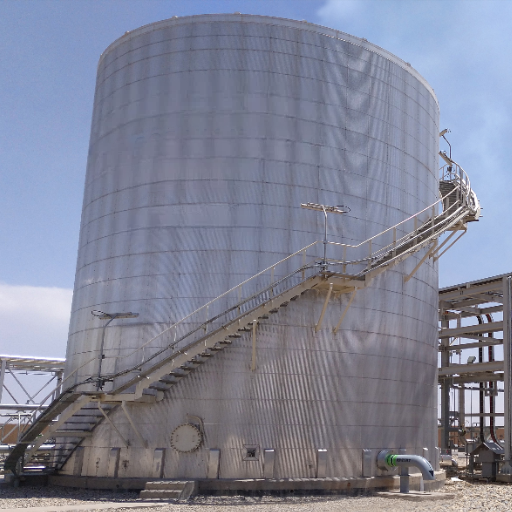
The single most useful number in the whole method is how many gallons one ton-hour requires. It depends on one variable — ΔT — and at a figure of merit of 0.90 it looks like this.
| ΔT (°F) | Gallons per ton-hour (FOM 0.90) | Ton-hours from 10,000 gal |
|---|---|---|
| 10 | ~160 | ~63 |
| 12 | ~133 | ~75 |
| 14 | ~114 | ~88 |
| 16 | ~100 | ~100 |
| 18 | ~89 | ~113 |
| 20 | ~80 | ~125 |
Read the middle column as a price list. A chilled-water system running a 16 °F ΔT needs roughly 90 to 100 gallons per ton-hour — the widely quoted rule of thumb. Widen the design ΔT to 20 °F and the same ton-hour costs about 80 gallons. A 25% wider ΔT is roughly a 20% smaller tank, and the cheapest storage capacity you will ever buy is a better-designed loop ΔT.
The classic anchor case makes this concrete: 45,000 gallons at a 16 °F ΔT stores about 500 ton-hours — enough to carry a 1,000-ton load for 30 minutes, or a 100-ton load for five hours. Typical design bands run 10 to 20 °F for chilled water and 20 to 60 °F or more for hot water, depending on the emitters.
Worked Examples
Four examples, four duties, one method.
Example 1 — Chilled-water storage (cooling). A facility wants to shift a 100-ton cooling load for five hours. Energy to shift = 100 × 5 = 500 ton-hours. At a 16 °F ΔT (about 42 °F supply and 58 °F return), usable volume = (500 × 1,439) ÷ 16 ≈ 45,000 gallons. Apply the figure of merit of 0.90 and the nominal tank becomes about 50,000 gallons, or roughly 190 cubic metres.
Example 2 — Hot-water storage (heating). A plant needs to store 1,000,000 BTU at a 40 °F ΔT — say a store cycling between 120 °F and 160 °F. Volume = 1,000,000 ÷ (40 × 8.33 × 0.90) ≈ 3,330 gallons, about 12.6 cubic metres. Run the metric check with a 22 °C ΔT: 293 kWh ÷ (22 × 1.163 × 0.9) ≈ 12.6 m³. The two unit systems agree. Now the contrast that proves the point: the same 1,000,000 BTU across only a 20 °F ΔT needs about 6,660 gallons — double the tank.
Example 3 — Boiler buffer (anti-short-cycling). A 200,000 BTU/h boiler with a 10-minute minimum run time, a 5,000 BTU/h concurrent load, and a 30 °F swing. Volume = 10 × (200,000 − 5,000) ÷ (500 × 30) ≈ 130 gallons. The 500 is simply 8.33 × 60. Note that a wider allowable swing shrinks the tank fast — this is the same ΔT principle wearing a different hat.
Example 4 — Biomass accumulator (batch burn). For a batch-burning boiler, size from the fuel load, not a per-MBH rule: V = 701 × (firewood pounds) × (combustion efficiency) ÷ ΔT, or, more simply, roughly 130 gallons per cubic foot of primary combustion chamber. This is why batch-burn systems typically land between 300 and 1,000 gallons.
A short story shows how much ΔT matters. One plant had budgeted a tank for a 10 °F loop and a fixed 800 ton-hours. After the engineers re-checked coil performance and return temperatures and widened the design ΔT to 16 °F, the required volume fell by roughly 40% at no loss of ton-hours. Same system, smaller vessel.
Three routes hand off to neighbouring guides. The heat-pump buffer rule (10 to 25 L/kW) and the four-pipe configuration belong to heat pump buffer tank sizing. Solar charge sizing, at roughly 25 litres per square metre of collector, belongs with hot-water storage. And ice or PCM tank sizing belongs with latent media.
Storage Density: Why the Medium Sets the Volume
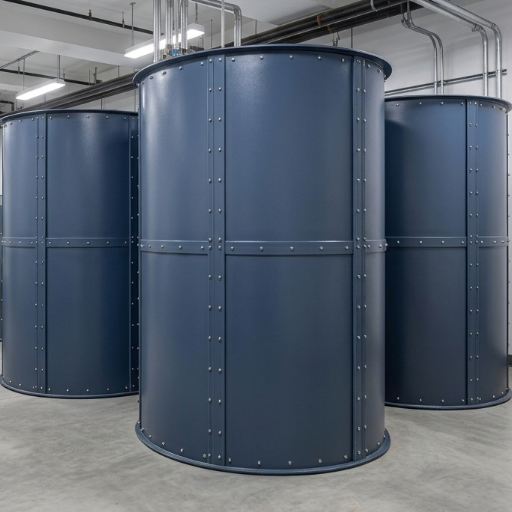
Volume is only half the decision. The medium you choose can change the tank size by a factor of five for the same duty, so pick the medium before you pick the volume.
| Medium | Storage density | Design note |
|---|---|---|
| Sensible hot water | ~23 kWh/m³ at 20 °C ΔT, up to ~93 kWh/m³ at 80 °C ΔT | The default; density is set entirely by ΔT |
| Sensible chilled water | 303–595 L per ton-hour (≈ 6–12 kWh/m³) | The small 5–8 °C ΔT is the limiting factor |
| Ice (latent) | ~2–3 ft³ per ton-hour (≈ 40–60 kWh/m³) | About five times denser than chilled water; needs glycol and a low-temperature chiller |
| PCM (latent) | ~40–50 kWh/m³ | Between water and ice; more cost and complexity |
Water is the baseline, at about 1.16 Wh per litre per degree Celsius. Chilled water looks weak only because chilled loops run so close together — a tiny ΔT dilutes its density. Ice packs use far more energy per cubic metre but demand a colder chiller and glycol, and phase-change materials sit between the two.
From Volume to Vessel: Aspect Ratio and Geometry
A volume is not yet a tank. Sizing sets the vessel, and the geometry you choose decides how much of that volume you can actually use.
Height-to-diameter ratio is the first lever. Taller tanks stratify better. An H/D around 1.5 to 2 is common practice, and research found that raising H/D from 1.54 to 4.20 lifted discharge efficiency from 44% to 57% — up to about 30% more useful energy under high flow. Squat, wide tanks lose capacity to mixing; a real consulting thread about a 180,000-gallon tank, 40 feet across but only 10 feet deep, is a textbook example of the wrong shape.
Then subtract the dead zone. The thermocline — the transition band between hot and cold water — is roughly one metre thick and is not usable height. Size the working volume, not the shell volume. Insulation and standby loss come next.
Finally, the practical envelope. A full 50,000-gallon tank is about 417,000 pounds of water, so foundations follow codes such as AWWA D100 and D110. Diameter is often capped by what roads and cranes will carry, which turns very large volumes into modular tank arrays with extra heat-loss surface. An expansion tank, if needed, is often estimated at roughly 10% of storage volume — but treat that as a check to verify, not a rule to trust.
For the full insulation and barrier method, see our guide to thermal storage tank insulation.
Mistakes, Derates, and Rules of Thumb
A few habits separate a working size from a costly misjudgment.
Do not use the ton-hours form without the efficiency allowance. The derates are real: apply FOM ≈ 0.90, assume a usable fraction of about 0.80 for a well-stratified tank (lower if diffusion is poor), and add 15 to 25% for losses and stratification. Some references add about 20% on top for daily heat gain.
Do not size against the plant nameplate. In chilled-water buffer work, the correct basis is the first capacity step — the smallest stage that runs alone — not total plant capacity. Otherwise you size for a load the machine never sees. And do not blindly accept a rule of thumb at the concept stage: quick averages are useful to check a number, not to replace it. Common ones include about 120 gallons per ton-hour, 1 to 2 gallons per MBH of boiler output, and 10 to 25 L/kW for heat-pump buffers.
Standards worth naming by name for the method: ASHRAE’s HVAC Systems and Equipment Handbook and its Design Guide for Cool Thermal Storage, which use design-day load profiles and a capacity-deviation factor of 0.65 to 0.75; VDI 4657 Part 2 for storage dimensioning; and ICC/SRCC 500 for thermal storage tank rating. The materials and code details sit in the ASME guide above.
FAQ
How do you size a thermal storage tank?
Start with the energy to shift in ton-hours, kWh, or BTU. Divide by the design ΔT and the fluid’s heat capacity, then divide by the figure of merit. The result is the working volume — the tank you must actually build.
What is a ton-hour of thermal storage?
A ton-hour is the energy from one ton of refrigeration running for one hour. It equals 12,000 BTU, or about 3.517 kWh. A 500 ton-hour tank therefore holds roughly 6 million BTU of usable capacity.
How many gallons per ton-hour do I need?
It depends on ΔT. At a 16 °F ΔT, you need about 90 to 100 gallons per ton-hour; at 20 °F, about 80. The general relationship is roughly 1,439 divided by ΔT, then adjusted for the figure of merit.
How does ΔT affect tank size?
ΔT is the single biggest lever. Volume is inversely proportional to it, so widening the design ΔT shrinks the tank proportionally. Going from 10 °F to 16 °F can cut the required volume by around 40% at the same stored energy.
What is a figure of merit?
The figure of merit (FOM) is the ratio of a tank’s actual usable discharge capacity to the theoretical maximum of a perfectly charged tank. A well-stratified tank reaches about 0.90. Dividing by it turns an ideal volume into a buildable nominal volume.
How much of the tank is actually usable?
A well-designed stratified tank recovers roughly 85 to 95% of its stored capacity; a poorly stratified or mixed tank may recover only 60 to 70%. A common planning figure is about 80% usable, so always confirm what fraction a published capacity assumes.
What aspect ratio should a thermal storage tank be?
Taller stores stratify better. An H/D of about 1.5 to 2 is typical, and higher ratios improve discharge efficiency further. Squat, wide tanks lose usable capacity to mixing, so height-to-diameter matters as much as total volume.
How do I size a buffer tank for my boiler?
Use the run-time formula: V = t × (Q_source − Q_load) ÷ (500 × ΔT), where t is the minimum run time in minutes, and 500 is 8.33 × 60. A wider allowable ΔT reduces the volume. A common cross-check is 1 to 2 gallons per MBH of output.
How much storage per kW of heat pump?
The usual rule of thumb is 10 to 25 litres per kW, but the right figure depends on whether you want a hydraulic header or real storage. That full method is covered in our heat pump buffer tank sizing guide.
Can latent or ice storage be smaller?
Yes. Ice stores roughly five times more energy per cubic metre than chilled water — about 2 to 3 cubic feet per ton-hour — so the tank is far smaller. The trade-off is a colder chiller and glycol, and the detail lives with latent storage.
Conclusion
Sizing a thermal storage tank comes down to a load, a temperature differential, and an efficiency factor. Convert the energy you must shift into ton-hours or kWh, divide by the design ΔT and the fluid’s heat capacity, apply a figure of merit near 0.90, and you have a working volume. The ΔT is the lever; the figure of merit is where stratification earns its keep; and the medium and geometry decide how much of that volume you can actually use.
Three habits will keep you out of trouble. Widen the loop ΔT before you widen the tank. Apply every derate — FOM, usable fraction, and losses. And treat the resulting volume as a vessel specification, not just a number, because diameter, aspect ratio, foundation, and transport limits shape the tank you can build.
If you would like a second set of eyes, send us your duty, your load profile, and your design ΔT. We will size the vessel and fabricate it — in the storage tank range or as a custom build — and our engineers are glad to walk your team through the thermocline and diffuser design that makes the numbers hold. Talk to our engineers and get a properly sized thermal storage tank for your project.