Open the door of a modern plant room, and you’ll see one insulated cylinder doing three jobs at once. It makes mains-pressure hot water at 60 °C and above for the taps, feeds low-temperature underfloor heating at roughly half that, and on a mild afternoon accepts heat from a solar array, a heat pump, and a boiler at once.
It manages all of that because of one property: it never mixes its water. It keeps it in layers, hottest at the top and coldest at the bottom. That layering is stratification, the entire point of a stratified hot water storage tank.
Get the layering right, and one vessel quietly becomes the heart of a multi-source system. Get it wrong, and you’ve bought an expensive warm-water tank that runs out of hot water exactly when the house is full of guests.
This guide explains what a stratified hot water storage tank is, how its layers serve different loads, which heat sources it can combine, and why stratification decides both performance and hot-water safety. You’ll learn:
- What makes a hot water tank “stratified,” and why layering beats mixing
- The top, middle, and bottom zones, and what each serves
- How to match solar, heat pump, boiler, biomass, and immersion to the right connection
- Why stratification sets usable capacity, efficiency, and hygiene
- The checks that protect the layers, and where the sizing detail lives
For the bigger picture, start with our thermal store tank guide. For the physics of how the layering forms, see how stratification works.
What Is a Stratified Hot Water Storage Tank?
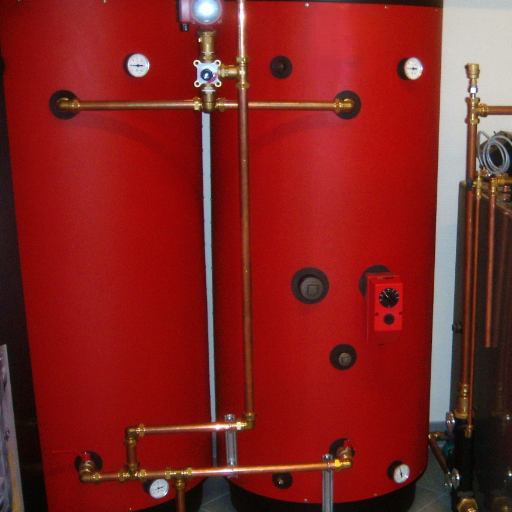
Here’s the definition worth keeping. A stratified hot water storage tank is an insulated vessel that keeps its water in temperature layers, hottest at the top and coldest at the bottom, instead of mixing. Because the layers stay separate, one tank can feed high-temperature hot water and lower-temperature heating at once, and store heat from several sources.
Four facts sit behind that sentence. First, the tank stores and shifts heat; it does not generate it. Second, the stored water is usually primary, non-potable system water, not the water that comes out of your tap, so the tank is not a cylinder in the usual sense. Third, domestic hot water is made instantaneously: mains water runs through a coil or plate heat exchanger inside the store and passes through a thermostatic mixing valve before it reaches the outlet. Fourth, the names overlap, so “stratified store,” “thermal store,” “stratified cylinder,” and “stratified hot water tank” all describe the same principle. For how those terms differ from a buffer tank, see our guide to thermal store vs buffer tank.
How a Stratified Store Works: Zones, Thermocline & Charging
The mechanism is simple. Warm water is less dense than cold water, so it floats. In a vertical tank, this produces stable layers, hottest at the top and coldest at the bottom, with a narrow transition band between them called the thermocline.
A stratified store is really three devices stacked in one shell.
| Zone | Typical temperature band | What draws from it | Notes |
|---|---|---|---|
| Top | ~75–80 °C store; ≥60 °C at the DHW draw-off | Domestic hot water (via coil or plate HX + mixing valve), high-grade heat | The hottest, most stable layer; the hygiene assurance zone |
| Upper-middle | ~45–55 °C | Radiators or fan coils on a mixed system | Drawn below the DHW zone to protect it |
| Lower-middle | ~35 °C | Low-temperature underfloor heating | Load matched to height |
| Bottom | Coldest (collector or heat-pump return) | Solar collector and heat-pump return | Charging low keeps collector efficiency high |
The rule that makes it work is one sentence: heat enters at the height that matches its temperature, and is drawn from the height that matches the load. A boiler at 80 °C charges the top, a solar collector returns cool water to the bottom, and underfloor heating draws from the lower-middle, so nothing fights the layers. That is why the store is the “heart” of a multi-source system, and why diffuser geometry and thermocline thickness matter- depth that belongs in our article on thermal energy storage tank design.
Stratified Store vs a Standard Hot Water Cylinder
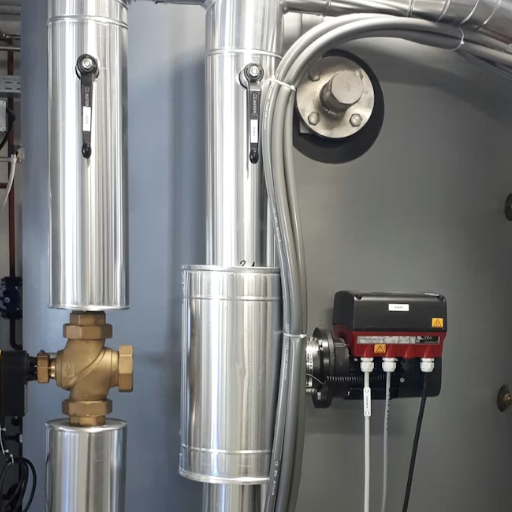
A standard cylinder heats potable water that is drawn from the tap and replaced by cold mains water. A stratified store heats primary water and makes hot water indirectly. That single difference changes almost everything downstream.
Put plainly, as installers do: a cylinder stores hot water; a thermal store stores heat.
The practical consequences stack up quickly:
- The store runs hotter (commonly ~75–80 °C) because it must have heat in reserve, not just enough for the next tap.
- Hot water arrives at mains pressure, roughly 3 bar and 25 litres per minute, comparable to an unvented cylinder.
- Because the store does not hold domestic hot water under pressure, it usually does not need G3 qualification or the discharge safety valves an unvented cylinder requires.
- The same vessel can also serve space heating, which a hot water cylinder cannot.
The trade-off is that a store is only as good as its stratification and its controls. A poorly stratified cylinder still gives you hot water. A poorly stratified store gives you a lukewarm tank. The full four-vessel comparison (store, buffer, accumulator, and cylinder) lives in our guide to thermal store vs buffer tank.
Heat Sources for a Stratified Hot Water Store
What separates a stratified store from a plain cylinder is that it can accept several heat sources at once, each charging the layer that suits its temperature.
| Heat source | Where it connects | Typical temperature | Control / note |
|---|---|---|---|
| Solar thermal | Bottom (coldest water) via internal or external HX | Collector-dependent; highest when the return is cold | Solar zone ≥30% of capacity; ≥25 L per 1 m² net collector; ~50–70% of annual hot water |
| Heat pump | Lower/middle via coil or HX (antifreeze loop) | Low flow temperature (~35–55 °C) | Best with low-temperature heating; buffer sizing is a separate rule |
| Gas / oil boiler | Top / upper zone | High (~70–80 °C+) | The hot-water and top-up source; heat-only boilers suit stores well |
| Biomass / solid fuel | Bottom / dedicated coil | High; delivered in batches | The store absorbs a full burn and releases it over hours |
| Immersion heater / solar diverter | Direct, or via a sleeve | Electric, to ~60–70 °C+ | Top-up when renewables are low; also used to raise the store for hygiene |
Coldest sources charge the bottom, so a solar collector always meets the lowest possible temperature and stays efficient. Hottest sources charge the top, building the layer that makes hot water.
Solar thermal draws from the bottom for exactly that reason. The Hot Water Association recommends a solar zone of at least 30% of capacity and roughly 25 litres of solar volume per square metre of collector; in a good system, solar supplies about 50–70% of annual hot water. A heat pump charges the lower and middle zones rather than the top, because its flow temperature is low, and it pairs best with low-temperature heating.
The boiler or biomass unit does the high-grade work, charging the top zone and guaranteeing the hot-water draw-off, while a log or pellet boiler’s batch burn is absorbed and released over hours. Immersion heaters and solar diverters top up when renewables are low. The result is a vessel that accepts whichever source is cheapest or available and delivers to the right load from the right height: the “heart” role in practice.
Why Stratification Matters: Usable Capacity, Efficiency & Hygiene
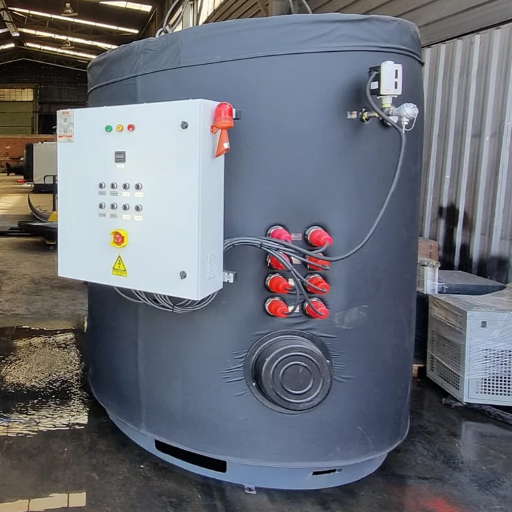
Stratification is not a nice-to-have. It decides how much of the heat you paid for you can actually use, and it has a direct bearing on hot-water safety.
Start with usable capacity. A well-stratified store recovers roughly 85 to 95% of its stored capacity as usable heat; a poorly stratified, fully mixed tank may recover only 60 to 70%. Picture a 1,000-litre store with 250 litres at 80 °C on top of 750 litres at 20 °C. Drawn off in layers, that is many long, hot showers. Mix the whole tank, and it settles at about 35 °C. Same tank, same energy, unusable.
Now efficiency. Stratification preserves the quality of the stored heat, not just its quantity. A well-stratified store gives roughly a 5 to 15% performance advantage over a mixed one, and a proper inlet distributor holds around 95% storage efficiency versus roughly 85% with plain inlet ports. Lose it, and the heat pump or boiler must run hotter to compensate: field experience puts the penalty at 2 to 3% of efficiency for every 1 °C of added lift, or 6 to 15% across a heating season.
Then hygiene, where stratification does more than save money. Legionella grows between roughly 20 and 50 °C, with the ideal around 32 to 42 °C, so domestic hot water should be stored at 60 °C or above. Here is the part buyers rarely hear: a well-stratified store keeps its high-temperature top zone intact and holds the colder water at the bottom, which shrinks the intermediate band where Legionella can thrive. A mixed store spends more of its volume at exactly the temperatures the bacteria prefer. Stratification is a safety feature, not just an efficiency one. Store at 60 °C or above and mix down at the outlet with a thermostatic valve.
Want a store specified around your heat sources and load profile? Talk to our engineers before you fix a size.
Inlet Stratifiers & Diffusers at the System Level
Inlet stratifiers and diffusers are the devices that protect the layers, and they are where a lot of real systems quietly fail. The practical findings are simple. Rigid open-hole stratifiers can mix more than they stratify below about 5 litres per minute (they work best around 5 to 8 L/min), two-layer fabric stratifiers perform about as well as a good rigid design with non-return valves, and multi-outlet stratifiers release water at the height where the store temperature already matches, which matters most when the incoming temperature swings.
The most common failure mode is not the diffuser at all. It is a side-mounted plate heat exchanger driven by a circulating pump, which drags the layers with it, or a heat source connected at the wrong height. Hence the counter-intuitive lesson: when a store “loses capacity,” the fix is often a redesigned diffuser or a rerouted connection, not a bigger tank. Keep inlet velocity low, add a stabilisation section, avoid long horizontal diffuser pipes, and strip out unnecessary tappings and loops.
Sizing & Connecting a Stratified Hot Water Store
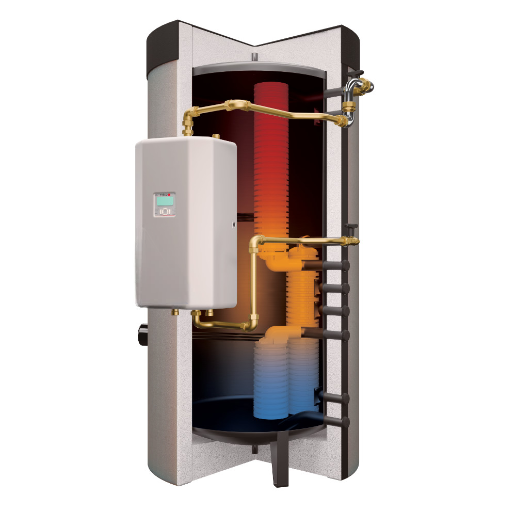
Sizing a store properly is a method, not a rule of thumb. But the connection logic runs in five steps.
- Choose the heat-source mix. Decide which of solar, heat pump, boiler, biomass, and immersion will feed the store; the mix sets the temperature bands the store must hold.
- Set the top setpoint and the system ΔT. Keep the top zone at 60 °C or above for hygiene, and choose a ΔT wide enough to store meaningful energy.
- Place the connections by height. Hot water draws from the top, radiators from the upper-middle, underfloor heating from the lower-middle, and solar and heat-pump returns at the bottom.
- Size the volume. For solar, allow at least 25 litres per square metre of collector and a solar zone of at least 30% of capacity; a common domestic rule is 45 to 60 litres of store per person.
- Verify stratification at commissioning. Profile the temperature up the tank. A clean stepped profile means the layers are holding; a smooth gradient means something is mixing.
Materials follow the duty. For primary-water service, carbon steel to ASTM A516 Grade 70 with an epoxy lining is standard; for aggressive water or potable contact, use 304 or 316L stainless. The vessel is usually built to ASME BPVC Section VIII or Section IV Part HLW, with GB/T 150 for Chinese-market export; unvented hot water follows Approved Document G3, biomass accumulators BS EN 303-5, and heat-pump coil sizing MCS MIS 3005-D.
Frequently Asked Questions
What is a stratified hot water storage tank?
It’s an insulated vessel that keeps its water in temperature layers, hottest at the top and coldest at the bottom, instead of mixing. Because the layers stay separate, one tank can feed high-temperature hot water and lower-temperature heating at once.
What temperature should a thermal store be?
Store temperature is usually held around 70 to 80 °C, with the domestic hot water draw-off at 60 °C or above to control Legionella. Mains cold water is heated instantaneously through a coil or plate heat exchanger and blended to a safe outlet temperature by a mixing valve.
Can a stratified store provide both hot water and heating?
Yes, and that is its main advantage. The top zone serves domestic hot water, while the middle and lower zones feed radiators and underfloor heating. A standard hot water cylinder can generally do only one of those jobs.
How much of my hot water can solar thermal provide?
Typically about 50 to 70% of annual domestic hot water, depending on climate and system size. The remainder is topped up by the boiler or immersion heater, which is why the store must reserve a solar zone of at least 30% of its capacity.
Why is my thermal store running out of hot water?
Almost always because it is mixing, not because it is too small. A side-mounted heat exchanger with a circulator, a heat source connected at the wrong height, or an over-fast diffuser can all stir the layers. The fix is usually the diffuser or the connection, not a bigger tank.
Does a stratified tank help prevent legionella?
It helps. Legionella multiplies between roughly 20 and 50 °C, so a well-stratified store keeps its hot top zone intact and shrinks the intermediate band where the bacteria can grow. You should still store domestic hot water at 60 °C or above.
The Bottom Line
A stratified hot water storage tank works because it refuses to mix: one vessel makes high-temperature hot water, feeds lower-temperature heating, and accepts heat from solar, a heat pump, a boiler, and more.
Three points are worth holding onto. First, heat goes in at the height that matches its temperature, and comes out at the height that matches the load. Second, stratification sets your usable capacity (85 to 95% versus 60 to 70% for a mixed tank), your efficiency, and your hot-water hygiene. Third, when a store underperforms, the cure is almost always better layering, not a bigger tank.
At Shandong Shengrui Intelligent Equipment Co., Ltd., we fabricate carbon steel and stainless steel vessels for thermal storage duty, from the diffuser internals and heat-exchanger coils to the lining and insulation, and document them for the market you build in. The steel shell is the easy part. The value is in how the water inside is layered, and that is what we engineer.
Specifying a stratified hot water storage tank for your heat sources? Request a custom quote, and our engineers will size the vessel and set its internals to your source mix and load profile, or review our storage tank range to get started.