Daniel had three quotes on his desk for a new underground tank at a depot outside Lagos. All three suppliers called their product a “double-wall fuel tank.” All three attached a certificate. One was a fiberglass double-wall fuel tank, one was steel-fiberglass, and the third was steel-steel. He assumed the certificates were interchangeable and nearly picked on price.
They are not interchangeable. In the United States, the two main double-wall constructions are approved under different paragraphs of the same federal rule. They are also certified to different standards.
A fiberglass tank qualifies one way. A steel tank with a fiberglass jacket qualifies another. The certificates do not swap.
This article covers the FF double-wall tank specifically: what it is, what it is certified to, and the site conditions where it genuinely beats steel-fiberglass. You will get:
- The regulatory split that most comparison tables skip entirely
- What a compliant FF specification should state, line by line
- Where FF wins, where SF wins, and the failure modes behind each
- A decision checklist you can hand to a procurement team
If you are specifying an underground tank and want a second opinion on the construction, our engineering team can review your draft specification before it goes to tender.
What Is a Fiberglass Double Wall Fuel Tank?
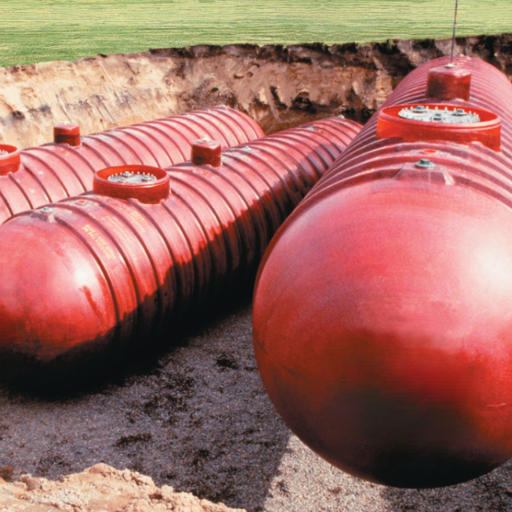
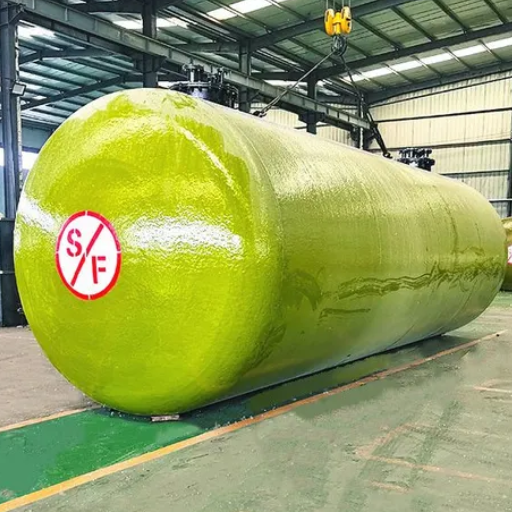
A fiberglass double wall fuel tank is an underground storage tank built from two layers of fiberglass-reinforced plastic (FRP), with an inner tank that holds the product and an outer tank that provides secondary containment. The narrow gap between them is monitored for leaks. Both walls are non-metallic, which is why the construction is written as FF: fiberglass inner, fiberglass outer.
In practice, these are sold as a fiberglass fuel tank for gas stations, depots, and industrial use, in capacities that run from small fleet tanks up to large retail installations. The construction is the same. What changes is the certification route, and that is where the buying decision gets made.
That is the whole definition, and it is worth stating plainly, because the naming is where most procurement errors start.
The industry uses a three-letter shorthand for double wall constructions:
| Code | Inner wall | Outer wall |
|---|---|---|
| FF | FRP | FRP |
| SF | Steel | FRP |
| SS | Steel | Steel |
SF is often written out as “steel fiberglass” or “steel-fiberglass.” FF is written out as “fiberglass-fiberglass.” The acronym is standard in Chinese procurement and appears on most manufacturer datasheets, which is why it shows up in tenders even when nobody in the buyer’s office uses it in conversation.
Here is the part that matters. FF and SF are not two flavours of one product. They are approved under two different routes in federal regulation, and each route names its own certification standard. That single fact reorganizes the entire comparison.
The Certification Split Most FF vs SF Tables Miss
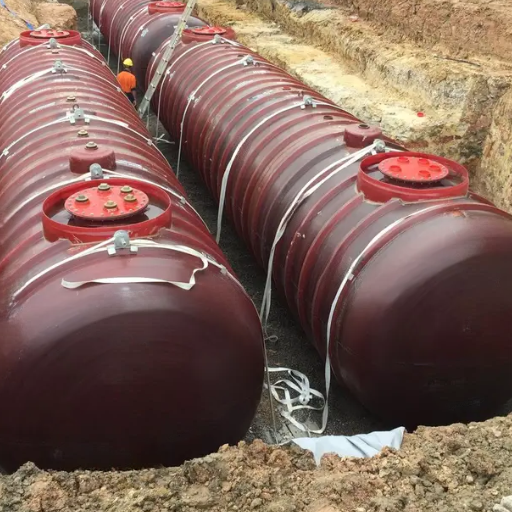
We compared the SF vs FF sections on several published guides before writing this, and they follow the same pattern. They compare materials, strength, lifespan, and cost. Almost none compare what each construction is certified to. That is the column that decides whether a tank is acceptable on your site.
The US rule is 40 CFR Part 280, which governs underground storage tanks. Section 280.20(a) requires that any portion of a tank regularly holding product while underground be corrosion protected. It lists the accepted routes, and each carries a note naming codes of practice:
| CFR route | What it approves | Standards named in the note |
|---|---|---|
| 280.20(a)(1) | Fiberglass-reinforced plastic tank construction | UL 1316, ULC S615 |
| 280.20(a)(2) | Steel tank with cathodic protection | UL 58, STI-P3, STI F841, UL 1746 |
| 280.20(a)(3) | Steel tank clad or jacketed with a non-corrodible material | UL 1746, STI ACT-100, ACT-100-U, Permatank |
Read that table twice, because it settles the argument:
- An FF tank is approved under (a)(1). It is certified to UL 1316.
- An SF tank is approved under (a)(3). Its outer layer is a UL 1746 protection system, and its steel inner wall is built to UL 58.
UL 1746 is titled External Corrosion Protection Systems for Steel Underground Storage Tanks. Every route that names it is a steel route. An FF tank has no steel, so there is nothing for UL 1746 to protect. Asking a supplier whether their FF tank is “UL 1746 certified” is a category error.
There is a second, subtler consequence. UL 1746 shows up in the notes to both (a)(2) and (a)(3), which means “UL 1746 certified” does not by itself tell you which protection system you are buying. A cathodically protected steel tank and a clad or jacketed steel tank can both point to the same standard. The certificate narrows the field. It does not settle the specification.
Why this matters more than it sounds
It matters because it is a fast, free supplier filter.
A supplier who answers “yes” to that question has either misunderstood their own product or is hoping you will not check. Neither is a good sign on a tank you will bury for thirty years. A supplier who says “no, FF is certified to UL 1316, here is our file number” has told you something real about how they operate.
What to ask for in an FF submittal
Whether you are buying FF or SF, the document set is where the claim becomes verifiable. For an FF tank, ask for:
- The UL 1316 file number, and verify it yourself in UL’s public product directory. Do not accept a certificate image as proof.
- The resin system on the drawing, not just in the brochure. Polyester, vinyl ester, and epoxy behave differently against aggressive fuels.
- Inner and outer wall thickness, stated as a minimum with a tolerance.
- Test records for both walls. This is the point buyers miss on FF. On an SF tank, the steel inner wall carries the structural argument and the FRP outer wall is the barrier. On an FF tank, both walls are structural, and both are barriers, so both need the same evidence: hydrostatic test and a holiday (spark) test across the full surface.
- The bedding and backfill specification, because on FF tanks this document matters more than the material choice. More on that below.
Ready to pressure-test your specification? Send us your draft tank spec, and we will tell you which clauses a fabricator can safely ignore, and which ones will get a weak bid rejected.
How an FF Tank Is Built
Resin Selection
The resin is the part of an FF tank that determines its service life. Standard polyester is the cheapest option and is adequate for gasoline and diesel in neutral soils. Vinyl ester resists fuel permeation and chemical attack better, and is the usual choice for aggressive service. Epoxy appears in higher-temperature and specialty applications.
If a quote does not name the resin, treat the price as non-comparable. You cannot compare what you cannot see. Two FF tanks at the same wall thickness can differ by a decade of service life on resin alone.
Wall Thickness and the Interstitial Gap
Wall thickness is specified as a minimum, and the minimum should appear on the drawing. The interstitial gap between the two walls needs to be continuous across the entire tank surface.
If the gap closes anywhere, a leak in that region can’t reach a sensor, and the secondary containment is theoretical rather than real. The US rule is explicit on this point. 40 CFR 280.43(g)(1) requires that interstitial monitoring detect a leak through the inner wall anywhere the tank normally holds product. A gap that pinches shut defeats the requirement even though the drawing says “double wall.”
For the sensor side of that equation, our guide to interstitial monitoring methods for double wall tanks compares the available approaches.
What Factory Testing Should Prove
A holiday test passes a high voltage across the laminate to find pinholes and voids. It is the test that proves the barrier is a barrier. On an FF tank, insist that it was applied to the inner wall as well as the outer wall.
The US EPA publishes the underground storage tank rules and the codes it accepts, which is a better reference than a brochure when you are checking a supplier’s claim: EPA UST laws and regulations.
FF vs SF: Where Each Construction Actually Wins
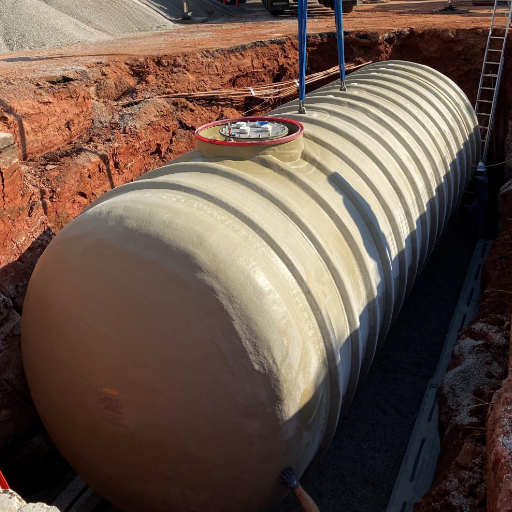
Both constructions are legitimate. The right answer depends on the site, and a supplier who tells you one is always correct is selling, not advising.
Where FF Is the Better Choice
- Highly acidic or saline soil. FRP does not corrode, so the aggressive-soil problem that drives SF specification largely disappears.
- Aggressive chemical service. Where the stored product or the groundwater chemistry attacks steel, removing steel from the wetted path removes the failure mode.
- Internal corrosion risk from biodiesel or additives. Same logic applied to the inside of the tank.
- Weight-constrained sites. An FF tank is lighter, which matters where crane capacity or soil bearing is limited.
Where SF Is the Better Choice
- Standard retail petrol and diesel. This is the majority of stations, and SF is the sensible default.
- Heavy traffic loading over the tank. The steel inner wall carries load predictably, and the design case is well understood.
- Sites where the steel shell simplifies bedding. A stiffer tank is more forgiving of a marginal bedding design.
The Failure Modes You Are Actually Buying
Neither construction fails randomly. Each has a characteristic failure mode, and both are installation-sensitive.
FF tanks fail through resin aging, cracking, and point loads introduced by poor bedding. A void under the tank becomes a stress concentration, and FRP does not redistribute that stress the way steel does. SF tanks fail through weld defects, which are normally caught at the factory, and through damage to the FRP outer wall during handling and backfill.
The practical conclusion is uncomfortable but honest: on a marginal site, the bedding specification matters more than the material choice.
Fuel Compatibility and Permeation
FRP is not attacked by hydrocarbons the way steel is by water and salts, but permeation is a real long-term consideration. Over decades, fuel vapour can migrate through a resin matrix, and the rate depends on the resin system and the wall thickness.
For ethanol blends and biodiesel, specify vinyl ester and ask the manufacturer for permeation data specific to the blend you will store. Do not accept a general statement that the tank is “suitable for all fuels.” It is the kind of claim that is true until it is not, and the failure shows up a decade later.
The steel inner wall of an SF tank is unaffected by permeation but is exposed to internal corrosion from water in the product and from aggressive biodiesel chemistry. That is the trade. FF moves the risk to the resin. SF moves it to the steel.
If you are weighing that trade at the material level rather than the construction level, stainless steel vs fiberglass fuel tanks works through the corrosion behaviour of each.
Installation, Bedding, and Anti-Flotation
An FF tank cannot be anchored the way a steel tank is anchored, because there is no steel shell to weld or clamp to. Anti-flotation design therefore has to be resolved differently, usually through a concrete hold-down slab or by ballasting, and the method needs to be settled at the design stage rather than on site.
Bedding is the other critical item. Both constructions need a properly compacted bed, but FF is less forgiving. Point loads from a hard spot or a void concentrate directly into the laminate.
This is where a specification earns its keep. Naming the bedding material, the compaction requirement, and the inspection hold point before excavation is far cheaper than discovering the problem after backfill. Our underground tank bedding and anti-flotation requirements cover the installation sequence in detail.
Cost, Lifespan, and a Decision Checklist
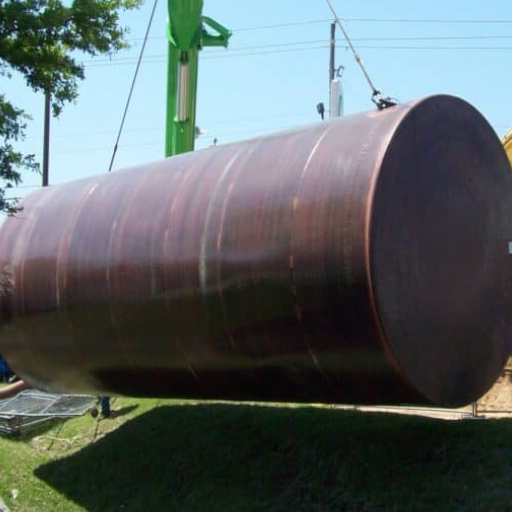
FF tanks generally cost more than SF tanks of the same capacity. We are not going to give you a percentage, because the premium moves with resin choice, wall thickness, diameter, and freight, and a range quoted without a source is worse than no range at all. Get quotes for your actual size and site.
Design life for both constructions is commonly stated as thirty years or more in correct service. The differentiator is not the headline number. It is how well the tank suits the ground it is going into.
Aisha, a project engineer in Mombasa, ran this exact comparison for a depot on reclaimed ground with high chloride content. Her first instinct was SF, because it was the familiar specification.
A corrosion assessment put the soil firmly in the aggressive category. The SF quotes all required additional coating and cathodic protection measures to stay compliant. The FF option came in higher on equipment cost and lower on total installed cost once those measures were removed.
She specified FF. The deciding document was the corrosion assessment, not the tank brochure.
Use this checklist:
- Has a corrosion assessment classified the soil, or are you guessing?
- Is the required certification route identified before tender: (a)(1) for FF, (a)(3) for SF?
- Does the quote name the resin system, or only the wall thickness?
- Are holiday test records required for both walls on an FF tank?
- Is the bedding and compaction specification written into the tender documents?
- Is the anti-flotation method defined for the groundwater condition on site?
- Will you verify the UL file number independently before award?
If you are comparing a fiberglass double wall fuel tank against an SF bid and want the certification checked before you commit, request a specification review. It is a shorter conversation than a failed installation.
FAQ
What does FF stand for in a double wall tank?
FF means fiberglass inner wall and fiberglass outer wall. The first letter describes the primary tank and the second describes the secondary containment. SF means steel inner and fiberglass outer. SS means steel inner and steel outer.
Is an FF tank UL 1746 certified?
No. An FF tank is certified to UL 1316, which covers fiberglass-reinforced plastic underground storage tanks. UL 1746 covers external corrosion protection systems for steel tanks, so it does not apply to a tank with no steel in it. In the US rule, FF sits at 40 CFR 280.20(a)(1), and SF sits at (a)(3), where UL 1746 is the protection system and UL 58 governs the steel inner wall.
Which is better, FF or SF?
For a standard retail station on normal ground, SF is the sensible default. FF is the better choice on highly acidic or saline sites, in aggressive chemical service, where internal corrosion from biodiesel or additives is the governing risk, or where tank weight is constrained. The site conditions should drive the decision, not the supplier’s product range.
Can an FF tank store ethanol blends?
Yes, but the resin system must suit the blend. Specify vinyl ester where ethanol or aggressive biodiesel is involved, and ask for permeation data for the specific blend rather than a general compatibility statement.
How long does an FF tank last?
Design life is commonly stated as thirty years or more when the tank is correctly bedded and installed. Resin choice, wall thickness, and bedding quality influence real service life more than the headline figure does.
Can FF tanks be installed under a traffic area?
They can, but the load case must be designed for, and the bedding must be right. FF is less tolerant of point loads than steel, so a traffic-rated installation needs an engineered bedding and backfill design rather than a standard detail copied from an SF project.
Conclusion
The FF versus SF question is usually framed as a materials argument. It is really a certification argument, and that framing is more useful to a buyer specifying a fiberglass double wall fuel tank for a gas station or depot.
Four things worth carrying into your next tender:
- FF and SF are approved under different routes. FF is 40 CFR 280.20(a)(1) and UL 1316. SF is (a)(3), with UL 1746 as the outer protection system and UL 58 governing the steel inner wall.
- The certificates do not swap. Asking for UL 1746 on an FF tank is a category error, and the answer tells you something about the supplier.
- FF wins on aggressive ground, weight constraints, and internal corrosion risk. SF wins on standard sites, heavy traffic loading, and forgiving bedding.
- Bedding and submittal documents decide more outcomes than the material choice. Specify them before tender, not after.
If your site is standard, an SF tank is well understood, and our SF double-layer tank specification is a reasonable starting point. If your corrosion assessment came back aggressive, the FF case deserves a serious look, and we will tell you so.
For a wider view of containment options, our guide to secondary containment for double-wall fuel tanks covers the regulatory and cost case. Our full SF double-wall tank guide covers the steel-fiberglass construction in detail.
The right tank is the one that suits your ground. Everything else is a price.