When Ravi Patel reviewed the specification for his new fuel station in Mumbai, every electrical component was marked Ex d flameproof. The flow meter sensors. The display modules. Even the low-power temperature probes. Six months later, a safety auditor pointed out that half of those Ex d enclosures were unnecessary. The project had spent $18,000 on overbuilt protection when intrinsic safety would have met the same Zone 1 requirements at half the cost.
You already know that hazardous area equipment needs the right protection level. What is harder is understanding which protection method applies to which component, why a fuel dispenser uses both intrinsic safety and flameproof protection in the same cabinet, and how choosing the wrong method either wastes money or creates a safety gap.
This guide covers exactly that. You will learn what makes intrinsic safety vs explosion proof different, how each protection method works at the component level, which method suits each part of a fuel dispenser, and how to avoid the specification mistakes that inflate costs or leave you underprotected. For a broader view of hazardous area standards, see our hazardous area classification guide.
For a complete overview of certified gas station equipment, see our explosion-proof gas station equipment guide.
What Is the Difference Between Intrinsic Safety and Explosion-Proof?
Prevention vs Containment: The Core Distinction
Intrinsic safety and explosion-proof protection solve the same problem through opposite approaches. Intrinsic safety prevents an ignition from ever occurring. Explosion-proof containment assumes an ignition might happen and stops it from reaching the outside atmosphere.
Think of it this way. Intrinsic safety is like a fuse — it limits energy so nothing dangerous can happen. Explosion-proof is like a safe — it contains whatever happens inside so it cannot hurt anyone outside.
An intrinsically safe circuit limits voltage, current, and stored energy to levels below what is needed to ignite the hazardous gas mixture. Even if a wire shorts or a component fails, the energy released is too small to spark or heat the surrounding vapor above its ignition point.
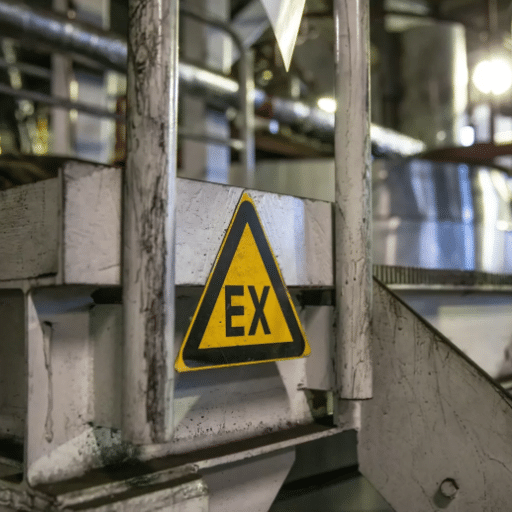
An explosion-proof or flameproof enclosure, designated Ex d, uses a heavy housing with machined flame paths. If an arc ignites gas inside the enclosure, the housing withstands the pressure and the flame paths cool the escaping gases below ignition temperature before they reach the outside.
Intrinsic Safety (Ex i): Energy Limitation
Intrinsic safety, designated Ex i under IEC 60079-11, works by designing the circuit so it is physically incapable of causing ignition. Engineers calculate the minimum ignition energy of the target gas — approximately 0.28 millijoules for gasoline vapors — and then design the circuit to stay well below that threshold under all fault conditions.
This is achieved through three controls. First, voltage and current are limited by barriers or isolators. Second, capacitance and inductance in the circuit are controlled so that stored energy cannot discharge dangerously. Third, the design is fault-tested. Ex ia must remain safe after two independent faults. Ex ib must remain safe after one fault. Ex ic is safe under normal operation only.
Because it addresses the energy source rather than the enclosure, Ex i is the only protection method generally accepted for Zone 0, where explosive atmospheres are present continuously.
Explosion-Proof / Flameproof (Ex d): Enclosure Strength
Flameproof enclosure, designated Ex d under IEC 60079-1, does not try to prevent ignition. It accepts that high-power components like motors, relays, and switching power supplies may produce arcs or surface temperatures that could ignite vapors. Instead of limiting energy, Ex d contains it.
The enclosure is built to withstand an internal explosion without rupturing. Door seams, cable entries, and joints are machined with precise gaps called flame paths. When hot gases escape through these narrow paths, they are cooled by contact with the metal surfaces. By the time the gases reach the outside atmosphere, their temperature is below the ignition point of the surrounding gas mixture.
Ex d is essential for components that cannot function on the low power levels required by intrinsic safety. Motors, high-current relay boards, and main power supplies all require Ex d protection in hazardous areas.
Featured Snippet Definition
Intrinsic safety limits electrical energy within a circuit to levels incapable of igniting a hazardous atmosphere, making it ideal for low-power sensors and Zone 0. Explosion-proof containment uses a reinforced housing to withstand and cool any internal explosion, making it necessary for high-power components like motors and relay boards.
How Each Protection Method Works
Intrinsic Safety: Ex ia, Ex ib, and Ex ic
Intrinsic safety comes in three grades based on fault tolerance. Ex ia is two-fault tolerant and accepted in Zone 0. Ex ib is one-fault tolerant and accepted in Zone 1. Ex ic is safe under normal operation and accepted in Zone 2.
The key enabler of intrinsic safety is the IS barrier. A Zener barrier uses a combination of resistors, Zener diodes, and fuses to limit voltage and current entering the hazardous area. A galvanic isolator uses transformers and optocouplers to provide the same protection while also breaking the ground loop between safe and hazardous areas.
These barriers are mounted in the safe area, not inside the hazardous zone. This is a critical detail many integrators miss. The barrier must sit between the non-intrinsically safe power supply and the intrinsically safe field device. Without it, the field device is not protected.
The entity concept governs compatibility. Every intrinsically safe device has entity parameters: maximum voltage (Ui), maximum current (Ii), maximum capacitance (Ci), and maximum inductance (Li) it can safely receive.
The barrier has matching output parameters: maximum output voltage (Uo), maximum output current (Io), maximum allowed capacitance (Co), and maximum allowed inductance (Lo). The loop is safe only when the barrier’s output parameters are lower than the device’s input parameters.
Flameproof Enclosure: Ex d
Ex d protection relies on mechanical engineering rather than electrical design. The enclosure must pass a pressure test where an explosive gas mixture is ignited inside at 1.5 times the maximum explosion pressure the equipment could generate. The enclosure must not deform or rupture.
After the pressure test, the flame path gaps are measured. For Group IIB gases like gasoline, the maximum gap is typically 0.15 mm for an enclosure volume under 100 cm3. For larger volumes, the gap requirement tightens. These gaps are not seals — they are intentionally designed leak paths that cool the gas as it escapes.
The temperature class is equally important. Ex d enclosures are rated T1 through T6 based on maximum surface temperature. Gasoline vapors require T3 or better, meaning the surface temperature must not exceed 200 degrees Celsius. For hydrogen refueling, T1 is required because hydrogen has a lower ignition temperature.
Increased Safety: Ex e
Increased safety, designated Ex e under IEC 60079-7, is a middle-ground method. It does not limit energy like Ex i, nor does it contain explosions like Ex d. Instead, Ex e prevents ignition through construction quality.
Terminal blocks, cable glands, and junction boxes use Ex e protection. The design eliminates arcs, sparks, and hot surfaces under normal operation through enhanced insulation, greater creepage and clearance distances, and higher-quality terminals. Ex e is restricted to Zone 1 and Zone 2 because it assumes explosive atmospheres are not continuously present.
At a gas station, Ex e is commonly used for terminal blocks inside dispenser cabinets, cable entry glands, and lighting fixture connections. For more on lighting protection methods, see our guide to explosion-proof lighting for gas stations. Ex e provides a cost-effective alternative to Ex d for components that do not generate significant energy but still need protection.
| Protection Method | How It Works | Suitable Zones | Typical Gas Station Components |
|---|---|---|---|
| Ex ia (Intrinsic Safety) | Two-fault tolerant energy limitation | Zone 0, 1, 2 | Tank level sensors, gas detectors |
| Ex ib (Intrinsic Safety) | One-fault tolerant energy limitation | Zone 1, 2 | Flow meter sensors, temperature probes |
| Ex ic (Intrinsic Safety) | Normal operation safety | Zone 2 | Low-risk instrumentation |
| Ex d (Flameproof) | Contains and cools internal explosion | Zone 1, 2 | Dispenser housings, motors, relay boards |
| Ex e (Increased Safety) | Prevents sparks through construction | Zone 1, 2 | Terminal blocks, cable glands, lighting |
Intrinsic Safety vs Explosion-Proof in Fuel Dispensers

The Dispenser as a Hybrid System
A modern fuel dispenser is not simply Ex d or Ex i. It is a hybrid system that uses multiple protection methods in the same cabinet. Understanding why each component uses a specific method is the key to correct specification.
The dispenser cabinet itself is a flameproof Ex d enclosure. It must contain any internal faults from high-power components like the relay board and power supply. Inside that Ex d shell, individual low-power components may use Ex ib intrinsic safety. This layered approach optimizes both safety and cost.
Which Components Use Which Method
The flow meter sensor inside the dispenser operates at very low power. It generates a pulse signal that the control board counts to measure volume. Because the sensor circuit uses milliamps at low voltage, it can be designed as Ex ib intrinsically safe. This eliminates the need for a heavy flameproof housing around the sensor itself, reducing cost and improving accessibility.
The relay board and main power supply are a different story. These components switch currents of several amps and generate heat under load. They cannot function on the limited energy of an intrinsically safe circuit. They must be housed in the Ex d dispenser cabinet, which contains any faults they might produce.
The display module and payment terminal sit in the middle. Depending on the design, they may use Ex d if they share the main power supply, or Ex ib if they operate on a separate low-power circuit. Modern smart dispensers increasingly use Ex ib for display and payment components because it allows thinner, lighter modules and reduces the overall weight of the dispenser housing.
| Component | Protection Method | Zone | Reason |
|---|---|---|---|
| Dispenser cabinet | Ex d | Zone 1 | Contains high-power component faults |
| Flow meter sensor | Ex ib | Zone 1 | Low energy, precision signal |
| Relay board / power supply | Ex d | Zone 1 | High current switching |
| Display module | Ex d or Ex ib | Zone 1 | Depends on power design |
| Payment terminal | Ex d or Ex ib | Zone 1 | Depends on power design |
| Terminal blocks | Ex e | Zone 1 | Connection integrity |
| Cable glands | Ex e | Zone 1 | Seal and strain relief |
| Vapor recovery valve | Ex d or Ex ib | Zone 1 | Depends on actuator type |
For a deeper look at how these components integrate within a certified dispenser, see our explosion-proof fuel dispensers guide.
Why the Flow Meter Sensor Uses Ex ib, Not Ex d
A flow meter sensor in a fuel dispenser generates a series of electrical pulses as fuel passes through the meter. The circuit typically operates at 5-12 volts DC with currents under 20 milliamps. At these energy levels, ignition of gasoline vapors is physically impossible.
Designing this sensor as Ex ib means it can use a lightweight housing with standard cable entry. If it were designed as Ex d, the sensor housing would need thick cast-aluminum walls, machined flame paths, and pressure-tested seals.
The Ex d sensor would cost 1,200−1,800. The Ex ib sensor costs 600-900. The protection level is identical for Zone 1, but the cost difference is 50-100%.
If you are specifying dispenser components, the first question is always: Does this component need high power to function? If not, intrinsic safety is almost always the more efficient choice.
Why the Housing Must Use Ex d, Not Ex i
The dispenser housing contains the relay board, power supply, and motor connections. These components draw currents of 5-20 amps at 110-240 volts AC. At these power levels, intrinsic safety is impossible. The energy required to run a motor or switch a relay is thousands of times higher than the 0.28 millijoule ignition threshold for gasoline.
The only viable protection method for these components is Ex d. The heavy enclosure contains any arc or spark they might produce and prevents it from reaching the hazardous atmosphere outside. This is why every fuel dispenser cabinet, regardless of brand or market, uses flameproof construction.
Intrinsic Safety vs Explosion Proof: When to Choose Ex i
Ideal Applications for Ex i
Intrinsic safety is the right choice for low-power instrumentation, sensors, and communication circuits. At a gas station, this includes tank level sensors, temperature probes, pressure transmitters, flow meter pulsers, and gas detection heads. Any component that measures, monitors, or communicates rather than powering a load is a candidate for Ex i.
Zone 0 Requirements
Inside underground fuel storage tanks, in vapor spaces above liquid fuel, and within sealed process vessels, the atmosphere is classified as Zone 0. Here, explosive gas mixtures are present continuously. Only Ex ia intrinsic safety is generally accepted. Ex d and Ex e are not permitted in Zone 0 because they assume explosive atmospheres are intermittent, not constant.
Cost Advantages
Intrinsic safety sensors typically cost 30-50% less than flameproof equivalents for the same measurement function. The savings come from simpler housing, lighter materials, and less machining. Installation costs are also lower because IS wiring uses standard multi-core cable rather than heavy armored conduit.
A European integrator installed intrinsically safe tank level sensors at a new station in Rotterdam. The sensors cost EUR 420 each. The equivalent Ex d sensors from the same manufacturer cost EUR 890 each. Across eight tanks, the Ex i specification saved EUR 3,760 with no reduction in safety compliance.
Live Maintenance Benefits
One of the most significant operational advantages of intrinsic safety is that circuits can be maintained, tested, and adjusted while energized. Because the energy is inherently limited, technicians can open junction boxes, replace sensors, and check connections without shutting down the system or obtaining hot-work permits.
A Middle East fleet operator switched from Ex d tank gauging to Ex i instrumentation. Maintenance crews could now calibrate sensors during operations instead of shutting down the station for 4 hours per quarter. Over one year, the switch eliminated 64 hours of downtime, worth approximately $48,000 in lost fueling revenue.
Power Limitations: What Ex i Cannot Power
Intrinsic safety cannot power motors, lighting fixtures, heating elements, or relay coils. The energy limitation that makes Ex i safe also makes it incapable of driving high-power loads. A typical intrinsically safe circuit delivers milliwatts. A dispenser motor requires hundreds of watts. The gap is insurmountable by design.
If you are specifying a component that generates heat, switches current, or drives mechanical motion, Ex i is not an option. Ex d or Ex e is required.
When to Choose Explosion-Proof / Flameproof

Ideal Applications for Ex d
Flameproof enclosure is the right choice for high-power components, permanent installations, and any equipment that cannot function on limited energy. At a gas station, this includes dispenser housings, pump motors, main power distribution boards, and high-current switching equipment.
High-Power Components
Motors, transformers, and relay boards generate arcs and surface temperatures as a normal part of operation. These arcs are not faults — they are how the equipment works. A relay opens and closes by creating a small arc between contacts. A motor commutator sparks as brushes transfer current to the rotor. These phenomena cannot be eliminated without stopping the equipment from working.
Ex d accepts these normal ignition sources and contains them. The enclosure is designed to handle the worst-case internal explosion pressure without rupturing. This makes Ex d the only viable protection method for power equipment.
Maintenance Requirements
Ex d equipment requires de-energization before opening the enclosure. Technicians must follow lockout-tagout procedures, verify zero energy state, and use only approved tools that will not damage flame paths. Opening an Ex d enclosure while energized is a serious safety violation.
Maintenance downtime for Ex d equipment typically runs 2-4 hours per enclosure for safe inspection and reassembly. Technicians must inspect flame paths for corrosion, check gasket integrity, and verify that all fasteners are torqued to specification before returning the equipment to service.
Cost Considerations
Ex d enclosures are expensive. A small Ex d junction box for Zone 1 costs 800−2,500, depending on size and certification. An equivalent Exeterminal box costs 200-500. An Ex i barrier costs $150-500 per loop. The cost gap is substantial, which is why correct specification matters.
A station operator in Southeast Asia specified Ex d flameproof flow meter sensors at 1,800 each, when Exib intrinsic safety sensors at 850 would have met the same Zone 1 requirements. Across 16 dispensers, the unnecessary specification added $15,200 to the project with no safety benefit.
Wiring, Installation, and Maintenance Differences
Intrinsic Safety Wiring Requirements
Intrinsically safe wiring uses lighter cable than explosion-proof systems. Multi-core screened cable is standard. The screen is grounded at one end only, typically in the safe area, to prevent ground loops. Cable capacitance and inductance must be accounted for in the entity calculations because they add to the total energy in the loop.
IS circuits must be segregated from non-IS circuits. They cannot share conduits, cable trays, or terminal blocks. This prevents a fault in a non-IS circuit from injecting energy into an IS circuit. Segregation distances vary by standard but are typically 50 mm for cables in free air and full physical separation in enclosures.
IS barriers must be installed in the safe area, on the non-hazardous side of the boundary. The barrier is the boundary. Cables on the hazardous side of the barrier are intrinsically safe. Cables on the safe side are not. A European integrator learned this the hard way when he installed intrinsically safe tank level sensors but forgot the IS barriers in the safe-area control room. During commissioning, a ground fault in the non-intrinsically safe power supply sent excess voltage into the hazardous area, destroying all sensors and requiring a full reinstallation. Total cost: 12,000 sensors plus 8,000 in re-work labor.
Explosion-Proof Installation Requirements
Ex d wiring uses heavy rigid metal conduit or armored cable with sealing fittings at every boundary crossing. The conduit must be explosion-proof rated and properly threaded. Sealing fittings prevent flame propagation through the conduit system from one enclosure to another.
Flame path gaps must be protected during installation. Paint, gaskets, or foreign material in a flame path can destroy the protection. Ex d enclosures must be closed with all fasteners in place before energizing. Operating an Ex d enclosure with the cover removed defeats the protection entirely.
If you need to use explosion-proof electrical enclosures, please read our article about Explosion Proof Electrical Enclosures.
Maintenance: Live vs De-Energized
The maintenance difference between Ex i and Ex d is one of the most significant operational distinctions. Ex i circuits can be worked on live. Technicians can disconnect sensors, check wiring, and replace components without shutting down the system. This reduces downtime and simplifies troubleshooting.
Ex d circuits must be de-energized before opening. This means scheduling maintenance windows, isolating power, verifying zero energy, and tracking lockout-tagout procedures. The administrative and operational overhead is substantial.
For stations where uptime is revenue, this difference can be decisive. A high-volume retail station that shuts down for 4 hours of Ex d maintenance loses fueling revenue, customer loyalty, and convenience store sales. Ex i instrumentation reduces that exposure.
Protection Method Selection Framework

Choosing the right protection method for each component does not require an engineering degree. It requires answering five questions in sequence.
Step 1: Identify the Zone Classification. Zone 0 requires Ex ia. Zone 1 accepts Ex ia, Ex ib, Ex d, or Ex e. Zone 2 accepts Ex ic, Ex ib, Ex d, or Ex e. The zone narrows your options immediately.
Step 2: Determine the Power Requirement. Does the component need more than a few milliwatts to function? If yes, Ex d or Ex e is required. If no, Ex i is a candidate.
Step 3: Assess Maintenance Access Needs. Will technicians need to adjust, calibrate, or replace the component during normal operations? If yes, Ex i provides live-work capability that Ex d cannot match.
Step 4: Evaluate Cost vs Safety Margins. Ex i sensors cost 30-50% less than Ex d equivalents. Installation is 20-40% cheaper due to lighter wiring. If Ex i meets the zone and power requirements, it is usually the more economical choice with identical safety margins.
Step 5: Check Standards Compliance. Verify that your chosen method is listed in IEC 60079-11 for Ex i, IEC 60079-1 for Ex d, or IEC 60079-7 for Ex e. Cross-reference with NFPA 30A for US fuel retail requirements and ATEX Directive 2014/34/EU for European markets. For guidance on certification scheme differences, see our ATEX vs IECEx vs UL certification guide.
If you are unsure which protection method to specify for a component, start with Step 1 and work down. The zone classification eliminates wrong answers before you reach the cost question.
Frequently Asked Questions
What is the difference between intrinsic safety and explosion-proof?
Intrinsic safety prevents ignition by limiting electrical energy to levels below what can ignite the hazardous atmosphere. Explosion-proof containment uses a reinforced housing to withstand and cool any internal explosion, preventing it from reaching the outside. One prevents the event; the other contains it.
Is intrinsic safety safer than explosion-proof?
Neither is universally safer. Ex i prevents ignition, which is inherently safe. Ex d contains ignition, which is robust but reactive. For low-power instrumentation, Ex i is preferred. For high-power components, Ex d is the only option. The right choice depends on the application.
Can I use Ex i for fuel dispenser motors?
No. Motors require too much power to operate on intrinsically safe energy levels. A typical dispenser motor draws hundreds of watts. An Ex i circuit delivers milliwatts. The energy gap is insurmountable. Motors must use Ex d or Ex e protection.
Why do fuel dispensers use both Ex d and Ex ib?
Fuel dispensers are hybrid systems. The cabinet, relay board, and power supply use Ex d because they handle high power. The flow meter sensor and some display modules use Ex ib because they operate at low power. This layered approach optimizes safety and cost.
Conclusion
Understanding intrinsic safety vs explosion proof is essential for anyone specifying hazardous area equipment. These two protection methods solve the same problem through fundamentally different engineering. Intrinsic safety prevents ignition by limiting energy. Explosion-proof containment stops a potential ignition from reaching the outside atmosphere. Neither is universally better. The right choice depends on the component’s power needs, the zone classification, maintenance requirements, and cost constraints.
The key takeaways are simple. Use Ex i for low-power sensors and instrumentation where live maintenance and lower costs matter. Use Ex d for high-power components like motors and relay boards where energy limitation is impossible. Use Ex e for terminal blocks and connections that need construction-quality protection without heavy enclosures. Specify a hybrid approach for complex equipment like fuel dispensers, matching each component to the most efficient protection method.
If you need help selecting protection methods for your fuel station project, contact our engineering team. We design fuel dispensers and gas station equipment using Ex i, Ex d, and Ex e protection methods certified for ATEX, IECEx, and UL standards worldwide.