What if the most expensive fuel dispenser you ever buy is the one that looked like a bargain? Every month, station owners discover that a mismatch in flow rate, pump system, or certification turns a fast-fill island into a bottleneck, a customs delay, or a compliance violation.
You already know that fuel dispensers sit at the heart of any fueling operation. You also know that the right choice depends on more than brand or price. In this guide, you’ll learn how to choose a fuel dispenser by starting with your station requirements and working inward: throughput, pump system, flow rate, nozzle configuration, accuracy, certifications, integration, and total cost of ownership.
Whether you’re building a retail station, upgrading a fleet depot, or adding fueling to a remote site, this article will help you specify the right dispenser the first time.
New to dispenser technology? Start with our complete guide to fuel dispensers to understand how metering, pumps, and safety systems work together.
Start With Your Station, Not the Dispenser

The biggest mistake buyers make is starting with a product catalog. The right approach starts with your station’s operational reality.
Daily Throughput and Peak-Hour Traffic
Estimate how many vehicles fuel per day and how many arrive during the busiest hour. A rural station with 80 vehicles per day needs a different configuration than a highway site with 80 vehicles per hour.
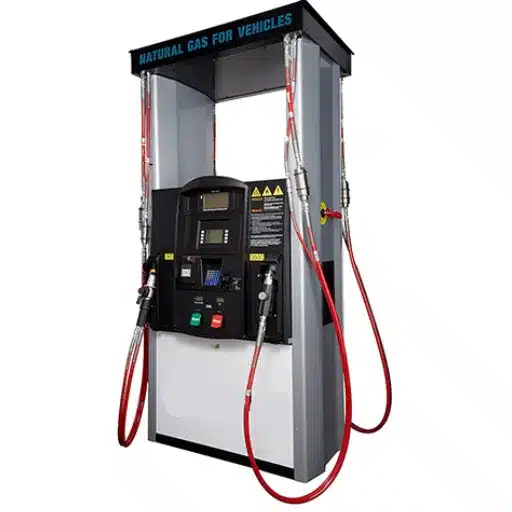
Peak-hour traffic determines how many refueling positions you need. A refueling position is not the same as a dispenser. A single dual-sided dispenser with two hoses can serve two vehicles at once, giving you two positions from one cabinet.
Fuel Mix and Future Plans
List every fuel you plan to sell now and in the next five years:
- Gasoline grades (regular, mid-grade, premium)
- Diesel
- Ethanol blends (E10, E15, E85)
- Biodiesel blends
- AdBlue/DEF for diesel exhaust treatment
- Alternative fuels (CNG, LNG, LPG, hydrogen)
Each fuel type affects hose material, seal compatibility, flow meter calibration, and certification requirements. If you may add alternative fuels later, specify dispensers with expansion paths or reserve space on the reserve island.
Site Infrastructure
Your tank and pump setup constrains dispenser choice. Key questions include:
- Are tanks underground or above-ground?
- How far are tanks from the fueling island?
- Is there a pump room, or will pumps sit inside the dispenser cabinet?
- What electrical supply is available on the island?
- What is the local climate range (temperature, humidity, dust, altitude)?
Long pipe runs favor submersible pump systems. Above-ground tanks or remote sites often favor suction pump systems.
When Elena, a project manager in Mexico, designed a new retail station in 2024, she initially selected four premium multi-product dispensers because of their modern displays. After reviewing peak traffic data, she realized the site needed six refueling positions, not four. She switched to dual-sided dispensers with six hoses and saved $18,000 in unnecessary island expansion while cutting average wait time by 35%.
Choose the Right Pump System First
The pump system moves fuel from the tank to the dispenser. Get this wrong and even the best dispenser will underperform.
Submersible Pump Systems
In a submersible system, a turbine pump sits inside the storage tank and pushes fuel through pipes to multiple dispensers. This setup is common at modern high-volume retail stations.
Advantages:
- Supports multiple dispensers from one pump
- Quieter operation on the island
- Better for long pipe runs
- Higher flow capacity per dispenser
Best for: busy retail stations, multi-product forecourts, and sites with long pipe runs.
Suction Pump Systems
In a suction system, the pump sits inside the dispenser cabinet and pulls fuel from the tank. This setup is common at small stations, remote sites, and locations with above-ground tanks.
Suction pumps come in two main types:
- Gear pumps are quieter, handle higher lift better, and resist vapor lock and cavitation.
- Vane pumps are traditional, cost-effective, and widely used in basic installations.
Best for: small stations, temporary sites, above-ground tanks, and locations where submersible pumps are impractical.
For a deeper understanding, please read our Fuel Dispenser Installation Guide.
How Pump Choice Constrains Dispenser Choice
A dispenser must match the inlet pressure and flow capacity of the pump system. A submersible pump delivering high pressure to a dispenser rated for low-pressure suction can cause leaks or metering errors. A suction pump trying to feed a high-flow fleet dispenser may cause vapor lock and slow fills.
| Pump System | Best For | Typical Flow Range | Dispenser Match |
|---|---|---|---|
| Submersible | High-volume retail | 30–60 L/min per nozzle | Electronic multi-product |
| Suction (gear) | Small/remote sites | 20–50 L/min per nozzle | Mechanical or electronic |
| Suction (vane) | Budget installations | 20–40 L/min per nozzle | Basic retail |
Match Flow Rate to Your Customers

Flow rate determines how fast a vehicle tank fills. Too slow and customers queue. Too fast for the application and you risk splash-back, increased wear, or reduced accuracy. Calibration is very important for a fuel dispenser, you can read our article about fuel dispenser calibration.
Retail Passenger Vehicles
Standard retail dispensers for cars and light trucks typically deliver 30–50 L/min (about 8–13 GPM). This range balances speed with safe, accurate fueling for small tanks.
Fleet and Commercial Vehicles
Trucks, buses, and heavy equipment have larger tanks and can accept higher flow rates. Fleet dispensers commonly deliver 70–120 L/min. High-volume fleet depots may use units up to 180 L/min.
Industrial and Mining Applications
Industrial sites with large off-road equipment may need flow rates of 180–300 L/min or more. At this level, durability, dust sealing, and nozzle construction matter as much as speed.
Flow Rate vs Accuracy Trade-Off
Higher flow rates can challenge measurement precision. Make sure the flow meter inside the dispenser is rated for the maximum flow rate you plan to run. For custody-transfer accuracy, four-piston positive-displacement meters are commonly rated at ±0.2% accuracy with repeatability of ≤0.1%.
| Application | Typical Flow Rate | Nozzle/Inlet Size |
|---|---|---|
| Retail gasoline | 30–50 L/min | 3/4″ NPT |
| Retail diesel | 40–70 L/min | 3/4″ NPT |
| Fleet/commercial | 70–120 L/min | 1″ NPT |
| Industrial/mining | 180–300 L/min | 1″–1.5″ NPT |
A fleet operator in Turkey bought standard retail dispensers for a truck depot to save money. The 40 L/min flow rate added 8–10 minutes per fill at peak shifts. After switching to 100 L/min fleet dispensers, throughput doubled during the morning rush and driver complaints dropped almost overnight.
Select Nozzle and Product Configuration
Nozzle count and product layout affect how many customers you can serve and how flexible your island is.
Number of Nozzles
- 1 nozzle: Small fleet sites, mobile stations, or single-fuel operations
- 2 nozzles: Standard single-lane retail station
- 4 nozzles: Multi-lane forecourts or high-throughput sites
- 6+ nozzles: Large highway stations or multi-product hubs
A dual-sided dispenser with two nozzles per side gives four refueling positions from one cabinet. This can reduce island length and installation cost.
Multi-Product Dispensers
Multi-product dispensers dispense several fuel grades from one cabinet. Common layouts include:
- 2-product: Regular and premium gasoline
- 3-product: Regular, mid-grade, premium
- 4-product: Regular, mid-grade, premium, diesel
Use dedicated hoses for incompatible fuels. For example, gasoline and diesel should not share hoses. Ethanol blends may require specific seal materials.
Nozzle Types and Sizes
Retail gasoline and light diesel typically use 3/4″ NPT inlet nozzles. High-flow commercial applications use 1″ inlet nozzles or larger.
In regulated gasoline markets, vapor-recovery nozzles capture fuel vapors during dispensing. Automatic shutoff nozzles stop flow when the tank is full. Both features improve safety and environmental compliance.
Accuracy and Certifications
A dispenser’s accuracy protects your revenue and your customers’ trust. Certifications protect your legal right to operate.
OIML R117 and Regional Metrology
OIML R117 is the international recommendation for dynamic measuring systems for liquids other than water. For fuel dispensers, the most relevant accuracy classes are:
| Accuracy Class | System MPE (Line A) | Meter MPE (Line B) |
|---|---|---|
| Class 0.3 | ±0.3% | ±0.2% |
| Class 0.5 | ±0.5% | ±0.3% |
Retail gasoline and diesel dispensers typically meet Class 0.5. Custody-transfer or high-value fuel applications may require Class 0.3.
In the United States, NIST Handbook 44 governs weights and measures for liquid-measuring devices. In the European Union, the Measuring Instruments Directive (MID) applies alongside OIML recognition.
Safety Certifications
- ATEX / IECEx: Required for equipment used in potentially explosive atmospheres, common in Europe, the Middle East, Africa, and many Asian markets.
- UL / PEI: Required or preferred in North America for electrical safety and installation compliance.
- CE: General product safety mark for the European Economic Area.
- ISO 9001: Quality management system certification for the manufacturer.
How to Verify Certificates
Always verify certificates through official databases such as IECEx.org or the issuing notified body’s website. Confirm that the certificate covers the exact model, voltage, fuel type, and flow range you are ordering. Do not rely on supplier PDFs alone.
Payment and Management System Integration

Modern dispensers rarely operate alone. They must talk to your point-of-sale, fuel management, and payment systems.
POS Protocols
Common dispenser communication protocols include:
- Tatsuno
- Gilbarco
- Wayne
- Tokheim
- Bennett
- IFSF (International Forecourt Standards Forum)
- PTS (Pump-to-Sale)
- ITL
- PT
If you are replacing older dispensers, confirm that new units support your existing POS protocol. Replacing both dispensers and POS systems at the same time is usually more expensive than a compatible upgrade.
Fleet and Card Systems
Fleet sites often need support for:
- RFID cards
- NFC fleet cards
- Magnetic stripe cards
- Mobile payment apps
- PIN-based authorization
Remote Monitoring and Diagnostics
Smart/IoT dispensers can send alerts for calibration drift, filter blockage, nozzle faults, and low fuel levels. These features reduce downtime and simplify maintenance planning.
Total Cost of Ownership
The purchase price is only part of the cost. A complete budget includes installation, operation, and maintenance.
Upfront Equipment Cost
| Dispenser Type | Typical Price Range (USD) |
|---|---|
| Basic retail dispenser | 600–2,000 |
| Multi-product retail dispenser | 1,500–3,500 |
| High-flow fleet dispenser | 2,500–8,000 |
| Smart/IoT dispenser with payment | 3,000–6,000 |
| Mobile/skid-mounted station with dispenser | 10,000–80,000 |
Installation and Infrastructure
Installation costs often exceed equipment costs. Budget for:
- Pump system and piping
- Electrical work and island wiring
- Canopy and island construction
- POS and payment integration
- Calibration and commissioning
Operating Costs
Over a 10-year life, operating costs can equal or exceed the initial purchase. Include:
- Annual calibration and inspection
- Filters, seals, nozzles, hoses, and breakaways
- Spare display boards and keypads
- Warranty and service contracts
- Downtime and lost sales
Research suggests that dispenser downtime can impact a significant share of fuel sales. Keeping spare parts on hand and choosing suppliers with strong after-sales support reduces this risk.
A distributor in Kenya learned this lesson after his first shipment arrived without spare filters, seals, or display boards. When a nozzle boot failed after six months, he waited seven weeks for a replacement. The lost margin on fuel sales during that period cost him more than the original dispenser.
Red Flags and Common Mistakes
Avoid these common selection errors:
- Choosing price over local support. A cheap dispenser with no spare parts network becomes expensive quickly.
- Mismatched pump and dispenser ratings. High flow on a low-pressure pump causes vapor lock and poor accuracy.
- Ignoring future fuel plans. A dispenser that cannot handle E85 or biodiesel may need early replacement.
- Buying uncertified equipment. Missing ATEX, OIML, or UL certification can block installation or invalidate insurance.
- Underestimating peak traffic. A station that looks quiet most of the day can still create queues during rush hour.
- Forgetting payment integration. Retrofitting POS compatibility later is costly and disruptive.
Fuel Dispenser Selection Checklist

Use this checklist to build a specification you can send to suppliers:
- Station type: retail, fleet, industrial, mobile, or remote
- Peak vehicles per hour: __________
- Required refueling positions: __________
- Fuel types and grades: __________
- Pump system: submersible or suction
- Flow rate per nozzle: __________ L/min
- Nozzle count and configuration: __________
- Required certifications: __________
- POS protocol: __________
- Payment methods: __________
- Voltage and frequency: __________
- Environmental conditions: __________
- Spare parts and warranty expectations: __________
- Total budget including installation: __________
FAQ: How to Choose a Fuel Dispenser
How do I calculate the right flow rate for my station?
Divide your average fill volume by your target dwell time. For example, if you want a 3-minute average fill for a 50-litre car tank, you need roughly 17 L/min. For trucks with 200-litre tanks and a 2-minute target, you need 100 L/min.
How many nozzles do I need?
Start with peak-hour vehicle count and target wait time. A standard two-nozzle dispenser serves one vehicle at a time on each side. High-traffic sites need four or more nozzles to avoid queues.
What certifications does a fuel dispenser need?
The required certifications depend on your market. Common requirements include OIML R117 for metrology, ATEX or IECEx for explosion protection, UL/PEI for North America, CE/MID for Europe, and ISO 9001 for manufacturer quality management.
Can I upgrade my dispensers later?
Yes, but upgrades are easier if you plan for them. Choose pump systems, POS protocols, and island layouts with enough capacity for future dispenser models and fuel types.
What is the difference between mechanical and electronic dispensers?
Mechanical dispensers use simple mechanical meters and displays. They are cheaper and easier to repair but offer fewer features. Electronic dispensers use digital meters, programmable controllers, and modern displays. They support smart payments, remote monitoring, and POS integration.
How often should fuel dispensers be calibrated?
Most jurisdictions require annual calibration for retail dispensers. Custody-transfer or high-value fuel applications may need more frequent checks. Always follow local legal metrology requirements.
Conclusion
Learning how to choose a fuel dispenser means looking at the whole fueling system before you look at product specs. Start with your station’s throughput, fuel mix, and infrastructure. Then match the pump system, flow rate, nozzle configuration, accuracy class, certifications, and payment integration to those requirements.
Remember the key takeaways:
- Start with the station, not the catalog. Throughput and fuel mix drive every other decision.
- Match the pump system first. Submersible for high-volume retail, suction for small or remote sites.
- Size flow rate for your customers. Retail needs 30–50 L/min; fleet and industrial sites need much more.
- Verify certifications. OIML R117, ATEX/IECEx, UL, and CE/MID protect revenue and legal operation.
- Count total cost, not unit price. Installation, calibration, spare parts, and downtime matter as much as the purchase price.
If you need help building a dispenser specification for your station, contact our engineering team. We can match dispensers, pumps, tanks, and safety systems into a single compliant fueling solution.
Ready to choose smarter? Request a fuel dispenser specification review, and we’ll help you compare configurations for your project.