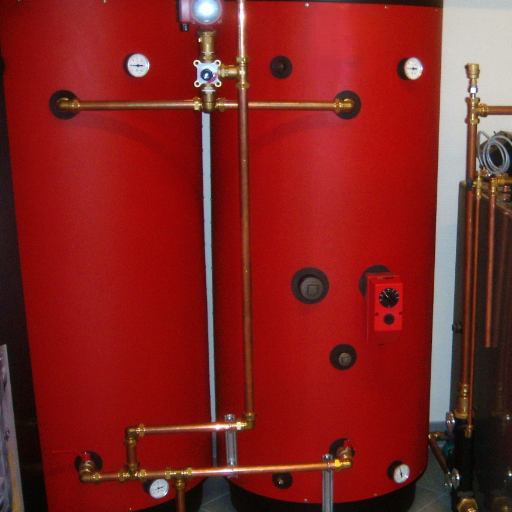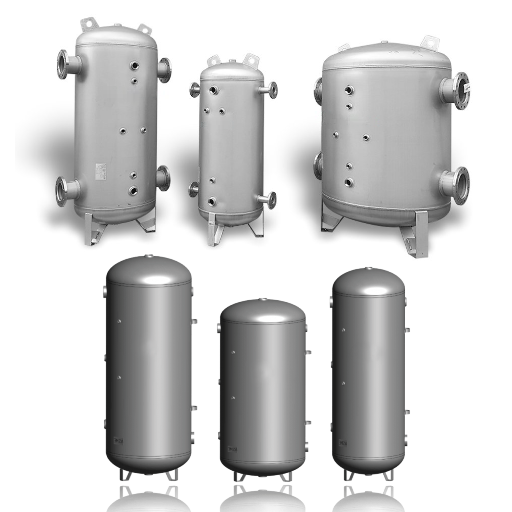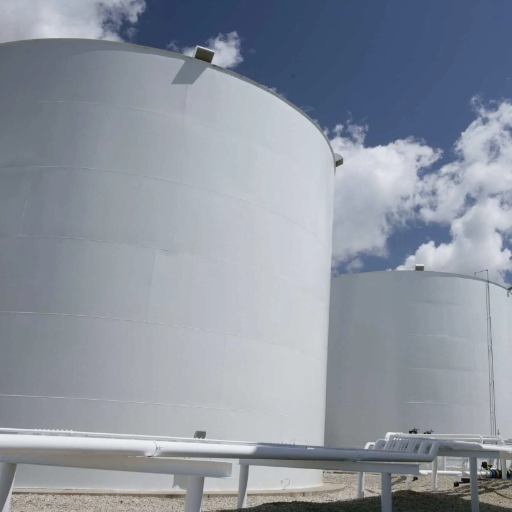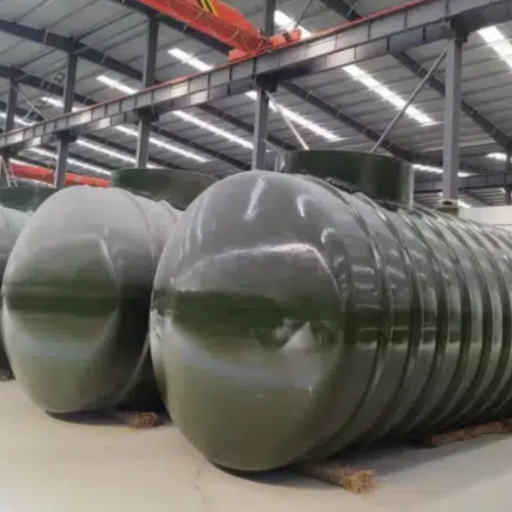
Two chilled water storage tanks sit in the same plant room. Each holds 200,000 gallons. Each costs roughly the same to build. Yet one delivers almost 40% more cooling capacity than the other on a hot afternoon. The difference isn’t the steel, the volume, or the insulation thickness. It’s the temperature spread the tank can hold, and whether it can keep hot and cold water from mixing.
That single gap, between a tank that holds gallons and a tank that holds cooling, is where most chilled water storage tank projects succeed or fail. This guide covers the whole decision, not just the catalog spec sheet.
You’ll learn:
- What a chilled water storage tank actually does (and what it never does)
- How stratified storage works, and the numbers that govern it
- How to size a tank in ton-hours, with a worked example
- Chilled water vs ice storage, and when each wins
- Why the vapor barrier, not the tank shell, determines real performance
- Materials, codes, and a cost framework by scale
If you’re sizing, specifying, or budgeting a chilled water thermal energy storage system, this is the page to read first. For the wider category, start with our thermal store tank guide.
What Is a Chilled Water Storage Tank?
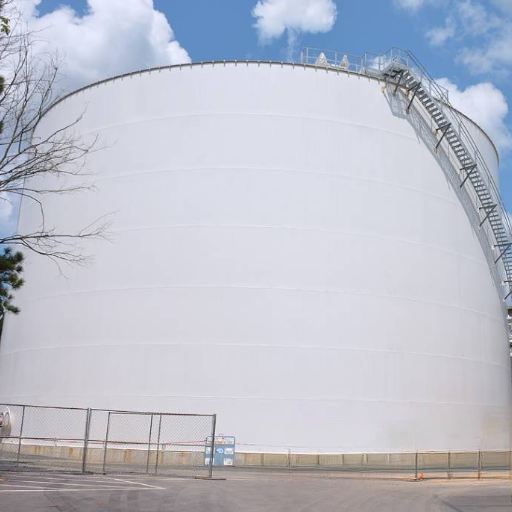
A chilled water storage tank is an insulated vessel that stores pre-cooled water so a plant can meet cooling demand later, usually during peak hours. It stores cooling — it never generates it. A chiller charges the tank overnight or during off-peak hours; the tank discharges that stored cooling when demand spikes.
This distinction matters. A tank is a battery, not a generator. It shifts when your cooling happens; it doesn’t create capacity from nothing. Engineers on the operations side often call it a “chilled water battery,” and that’s the right mental model: charge cheap, discharge expensive.
The concept is built on sensible heat. Water is chilled to a low temperature, held, then returned to the loop when needed. Because the tank stores energy in the form of cold, not in the water’s chemistry, almost all the energy you put in can come back out — provided the tank is well insulated and stratified.
Two features separate a purpose-built chilled water storage tank from a plain water tank:
- Diffusers at the top and bottom that let water enter gently without stirring the tank
- Insulation and a vapor barrier that keep ambient heat and moisture out
Because discharge is nearly instantaneous, these tanks are used for short-duration demand spikes as well as daily load shifting. Data centers treat that instant response as a resilience feature, not just a cost play.
Where does this fit among tank types? A chilled water tank is one of the cooler-side thermal energy storage tank designs, distinct from a thermal store vs. buffer tank, which handle heating and short-cycling duties.
Not sure which vessel your project needs? Talk to our engineering team, and we’ll help you specify it.
How Stratified Chilled Water Storage Works
The whole trick is thermal stratification: keeping warmer, lighter water floating on top of colder, denser water, with a thin boundary between them called the thermocline. Water is most dense at about 39.2°F (4°C), so in the normal chilled water range, colder water sinks. That natural behavior is what makes stratification possible.
For the full physics, see our guide to thermal energy storage tank design. Here, focus on the criteria that decide whether your tank actually works.
The diffusers are the contract. Water must enter and leave the tank slowly and evenly so it doesn’t create turbulence that mixes the layers. Design guides converge on a few governing numbers:
- Inlet velocity kept below about 0.9 ft/s (0.27 m/s)
- Froude number at or below 1.0, and ideally 0.5, at the diffuser
- Reynolds number low enough for stable flow, often targeted near 250
- Thermocline thickness of roughly 1 to 2 feet (12 to 36 inches)
When these hold, the usable cold energy is nearly the full theoretical amount. That ratio is measured as a figure of merit (FOM) — stored energy usable at discharge divided by energy put in at charge. Good designs hit FOM of 90% or higher. Below that, you’re paying to chill water you can’t recover.
The consequence isn’t academic. A tank built with a poorly designed diffuser can lose 15 to 20% of its rated capacity to mixing, silently, for the life of the plant. One horizontal 50 m³ tank fitted with a single inlet released only about 65% of its cold energy after a 15-minute discharge — the cold water had already mixed with the warm.
Commissioning is the sleeper risk here. Controls that aren’t tuned to the actual stratification behavior routinely under-deliver — a finding the National Renewable Energy Laboratory (NREL) has documented across real installations. A tank is only as good as the flow control around it.
How to Size a Chilled Water Thermal Storage Tank
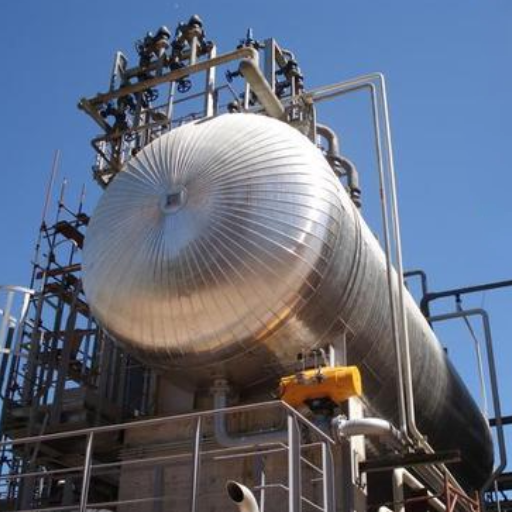
Here’s the mistake that costs the most money: sizing a tank in gallons. Gallons tell you how big the tank is. They don’t tell you how much cooling it stores. Two tanks of identical volume can differ by 40% or more in usable capacity, because capacity depends on the temperature spread across the tank, not its water content.
Size in ton-hours. A ton-hour is the cooling delivered by one ton of refrigeration (12,000 BTU/hr) for one hour. To convert from a tank’s usable volume to ton-hours:
Ton-hours ≈ (usable gallons × ΔT in °F) ÷ 1,439
That factor accounts for the density of water and the BTU content of one 2,000-pound (short) ton of refrigeration. (For metric users: ton-hours ≈ (litres × ΔT in °C) ÷ 3,024.)
A worked example. Suppose your plant needs to shave 500 ton-hours off its peak, and your system runs a 16°F ΔT (say, 42°F supply returning at 58°F):
- Tons-hrs needed: 500
- Gallons required ≈ (500 × 1,439) ÷ 16 ≈ 45,000 gallons
That 45,000-gallon tank can carry a 1,000-ton load for 30 minutes, or a 250-ton load for two hours. Now run the same tank at an 8°F ΔT — a common sign that flow is too high or coils are fouled: usable capacity collapses toward 250 ton-hours. Same steel, half the cooling.
This is the “tank that stored less than it held.” Marta, a plant engineer retrofitting an older campus chiller plant, ordered a replacement tank matched to the old one’s 200,000-gallon footprint. The original had already been running at a wide ΔT. Her new tank, delivered and correctly installed, underperformed from day one — because the design ΔT was set at 38-44°F supply, but her coils only returned 6°F warmer, not 16°F. The volume was right. The usable gallons were far lower.
The lesson: define ΔT first, then size volume.
Chilled Water vs Ice Storage
Chilled water and ice both store thermal energy, but they trade space against temperature. Ice stores far more energy per gallon; chilled water needs far more gallons but runs at a higher evaporator temperature, which keeps chillers efficient and discharge instant.
| Metric | Chilled water storage | Ice storage |
|---|---|---|
| Storage density | ~10–20 kWh/m³ | ~100 kWh/m³ |
| Rough volume per ton-hour | ~90 gallons | ~10 gallons |
| Charge/discharge temp | Supply 38–44°F (4–7°C); wide ΔT | Near 32°F (0°C) freeze/thaw |
| Round-trip efficiency | 70–90% (well-insulated >90%) | 80–90% |
| Installed cost band | ~$28–57/kWh | ~$40–57/kWh |
| Chiller impact | Normal evaporator temp | Evaporator ~10°C lower; capacity ~70% |
| Discharge speed | Near-instant | 12–15 min lag to thaw |
| Footprint | Large | ~1/8 the volume |
The decision rarely comes down to which stores “more.” It comes down to what your site constrains:
- Choose chilled water when land or a large tank is available, when you want peak-shaving over daily cycles, and when instant discharge matters for resilience. Also when you want to avoid the chiller derate that low freezing temperatures impose.
- Choose ice storage when floor space is the binding constraint, when you need high capacity in a tight footprint, or when existing chillers can be run at night at low temperature.
- Hybrid systems are common: ice for the dense fast-response block, chilled water for the longer load shift and the wider ΔT window.
Density is the headline trade — roughly a 5-to-10× gap in energy per unit volume, which is exactly why ice tanks are small and chilled water tanks are large.
Neither wins on paper. The site wins. If you’re weighing the two for a specific project, our engineers can model the footprint, the chiller derate, and the bill impact before you commit — request a comparison.
Chilled Water Storage Tank Applications
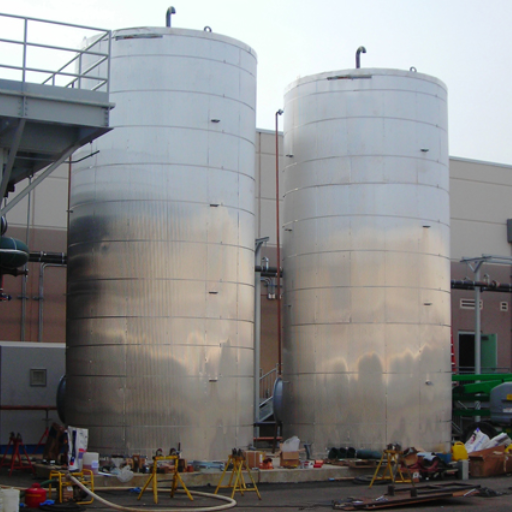
Three application families drive most chilled water thermal energy storage projects today, and each leans on a different benefit.
Data centers. Cooling is the second-largest load after the servers themselves, and mechanical systems can exceed 30% of IT load at peak, with cooling alone consuming 30-40% of facility power. A chilled water tank lets a data center shift that load off-peak, but the bigger driver is resilience: near-instant discharge supports ride-through during chiller trips or utility interruptions, buying time before generators and full load come online — a reliability theme Uptime Institute tracks across the industry. For operators, the tank is a capacity strategy as much as a cost strategy. See how these fit with other site infrastructure in our guide to fuel storage tanks.
District cooling. Central plants serving campuses, airports, and mixed-use districts use large stratified tanks to decouple production from demand. The plant charges at night on cheap power and discharges into the peak, flattening both the electrical profile and the chiller sizing. Because district systems already run wide ΔT to keep pumping energy down, they’re a natural fit for chilled water storage.
Industrial and fire-water dual use. In some jurisdictions, a chilled water tank’s stored volume can serve as a fire-water reserve under NFPA 22, giving the vessel a second duty. That dual-purpose design has to be settled before fabrication, because the nozzle layout and inspection access differ from a pure cooling tank.
Common to all three: the system pays back fastest when there’s a demand charge or a time-of-use rate to arbitrage. If your utility bill is flat-rate, a chilled water storage tank is a resilience and capacity tool, not a savings tool.
Vapor Barriers, Insulation, and Corrosion Under Insulation
This is where most guides stop, and where the performance actually lives or dies. A chilled water tank is a sub-ambient vessel — its contents are colder than the surrounding air, often by 20°F or more. Ambient heat leaks in through the shell. But the more destructive enemy is moisture.
Water vapor always moves from warm, humid air toward cold surfaces. On a chilled tank, that means vapor drives into the insulation. If it condenses, performance drops. If it keeps condensing, you get corrosion under insulation (CUI) — hidden rust eating the steel from underneath a layer of damp insulation, invisible until it fails.
The controlling spec is the vapor retarder, and the number to hold is a permeance of about 0.10 perm-in or less. Vapor retarders matter most when ambient relative humidity exceeds 80%, which is exactly the condition in most tropical and summer-peak climates where these tanks are busiest.
Design rules that follow:
- Continuous vapor barrier on the outside of the insulation, with sealed joints and penetrations — no gaps, no unsealed nozzles
- Closed-cell insulation that resists moisture and doesn’t wick
- Insulation thickness sized for the surface temperature and humidity, not copied from a warm-tank spec
- Coating strategy matched to CUI risk — see our guide to carbon steel tank corrosion protection for the coating and lining options
- Inspection access so the barrier can be checked over the asset’s life
Real plants fail here in ways that don’t show up on commissioning reports. The chilled water system at Dallas’s Interfirst Plaza — a 2-million-square-foot complex — ran for years and famously reported no lost operating hours, but its operators eventually traced pump problems to plaster slough: material shedding off internal surfaces and clogging strainers. It was a filtration and internal-condition issue, not a shell failure, but it makes the point — the internals and the water treatment matter as much as the steel.
Materials, Codes, and Fabrication
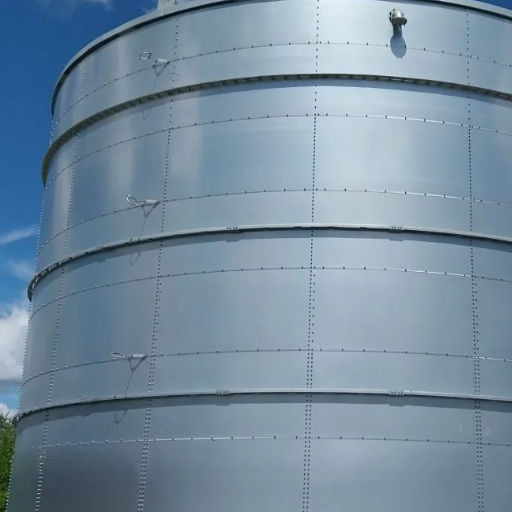
A chilled water storage tank is usually a fabricated steel vessel, and the code path depends on its pressure rating. Get the classification wrong and you either overpay for a pressure vessel you don’t need or fail inspection on one you do.
Atmospheric vs. pressure. Most chilled water storage tanks operate at or near atmospheric pressure and can follow atmospheric-tank rules. But when the tank sits within a closed, pressurized loop, it may be classified as a pressure vessel. The distinction changes design, inspection, and cost substantially — our guide to atmospheric vs pressure storage tanks covers the split.
Standards that apply:
- ASME Section VIII, Division 1 and 2 for pressure vessels; the U-stamp and National Board registration are the marks buyers should look for. A typical pressure rating runs around 125 PSI, with common sizes from 200 to 30,000 gallons.
- API 650, AWWA D100, and NFPA 22 for various atmospheric and fire-water duties.
- GB/T 150 for projects specifying Chinese pressure-vessel standards, common on export orders.
- ASHRAE design and commissioning guidance for thermal storage systems, which anchors the stratification and control criteria referenced above.
Freeze the nozzle layout before fabrication. This is the differentiator that saves projects. Diffuser positions, inlet/outlet elevations, temperature-sensor ports, and any fire-water connections must be finalized on the drawing before steel is cut. Moving a diffuser or adding a sensor port after fabrication means re-insulating, re-testing, and often field-welding on a finished vessel. For related fabrication practice, see our guide to carbon steel fuel storage tanks.
Because we fabricate to these standards, we can also resolve the atmospheric-vs-pressure question in the quote stage rather than after award. If your specification is still open on code path, send it to us early.
Cost and Selection
Installed cost per ton-hour falls sharply with scale, which is why storage economics change completely between a small plant and a district system. The figures below are directional planning bands, not quotes — actual cost depends on pressure rating, insulation, site work, and diffuser design.
| Scale (ton-hours) | Indicative installed cost |
|---|---|
| ~1,000–2,000 TR-hr | ~$200–300 / ton-hr |
| ~5,000–10,000 TR-hr | ~$80–200 / ton-hr |
| Medium (~10,000–20,000 TR-hr) | ~$60–170 / ton-hr |
| Large (>20,000 TR-hr) | ~$30–85 / ton-hr |
Real projects bracket these bands. A 24,500 TR-hr chilled water system in Dallas was reported under roughly $70 per ton-hour, while a 52,000 TR-hr university system landed near $100 per ton-hour — the difference reflecting site conditions, not just size. At the very large end, TICA’s electric-equivalent cost per kWh dropped from about $404/kWh at 3,600 TR-hr to $24–27/kWh at roughly 268,000 TR-hr. Scale, not cleverness, drives the curve.
An 8-step selection sequence:
- Quantify the peak you need to shave, in tons.
- Fix the ΔT your coils and chillers actually deliver.
- Convert to ton-hours using the formula above.
- Confirm the charge window — enough off-peak hours to refill the tank.
- Check the space and structure for a tank of the required volume.
- Decide the code path — atmospheric or ASME pressure vessel.
- Specify the barrier and insulation for your humidity and surface temperature.
- Model the payback against your utility’s demand and time-of-use rates.
Payback is where storage earns its place. Amara, an energy manager at a regional hospital, put the case in front of her finance team as a pure cost argument: the tank shaved the monthly demand charge, and the demand charge alone covered the tank in under four years, before any energy-rate savings. The resilience benefit — riding through a chiller trip without losing the surgical wing’s cooling — was the argument that closed the deal, but the demand charge paid for it.
When you’re ready to price a specific project, request a quote and we’ll work from your real load profile.
Frequently Asked Questions
How many gallons per ton-hour does a chilled water storage tank need?
It depends on ΔT. At a 16°F spread, budget about 90 gallons per ton-hour. At 8°F, you need roughly 180. Always size from the formula ton-hours = (usable gallons × ΔT) ÷ 1,439, using the ΔT your system truly holds.
Should I choose chilled water or ice storage?
Choose chilled water when you have space, want instant discharge, and want to keep chiller evaporators efficient. Choose ice when footprint is tight, and you need high capacity per unit volume. Ice stores roughly 5-10× more energy per gallon, but chilled water needs no chiller derate.
Why does my chilled water storage tank deliver less cooling than its rated capacity?
Usually mixing at the diffusers or a narrower ΔT than designed. Poor diffuser design alone can cost 15-20% of capacity. Check inlet velocity (keep it below ~0.9 ft/s), thermocline thickness, and whether the controls are tuned to real stratification behavior.
Does a chilled water storage tank need to be an ASME pressure vessel?
Only if it operates within a closed, pressurized loop. Many sit near atmospheric pressure and follow atmospheric rules like API 650 or AWWA D100. When pressure classification applies, look for an ASME Section VIII U-stamp and National Board registration, often rated around 125 PSI.
Can a chilled water storage tank double as a fire-water reserve?
In some jurisdictions, yes, under NFPA 22. But the dual-use design — nozzle layout, inspection access, and water treatment — must be settled before fabrication. Retrofitting fire-water duty onto an existing cooling tank is rarely practical.
Conclusion
A chilled water storage tank is a battery for cooling, and like any battery, what matters is usable capacity, not nameplate size. Get the ΔT and stratification right, and the tank does everything you bought it for. Get them wrong, and you’ve paid for water you can never recover.
Five things that decide the outcome:
- Size in ton-hours, not gallons. Define ΔT first; volume follows.
- Protect the thermocline. Diffuser design governs whether you keep the cold you paid for.
- Match storage to the site. Ice for footprint; chilled water for space, speed, and chiller efficiency.
- Never skip the vapor barrier. Sub-ambient tanks fail from moisture and CUI, not from the shell.
- Freeze the nozzle layout before fabrication. Post-build changes cost far more than early decisions.
This week, pull your peak cooling load and your actual ΔT — those two numbers set the whole design. This month, model the payback against your demand charge and time-of-use rate. That’s the analysis that turns a tank from an expense into an asset.
Ready to specify one? Talk to our engineering team about your load profile, code path, and climate, and we’ll help you size a chilled water thermal energy storage system that delivers what it promises. Pair it with fuel storage tanks, and you have the core of a resilient, cost-controlled plant.