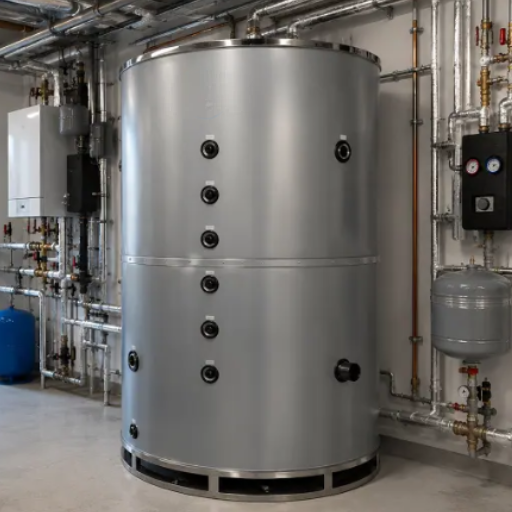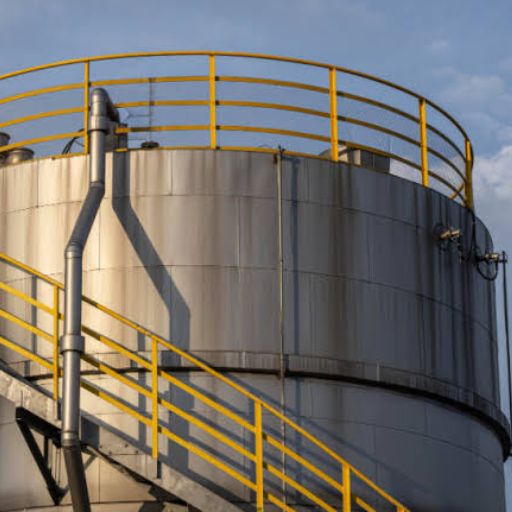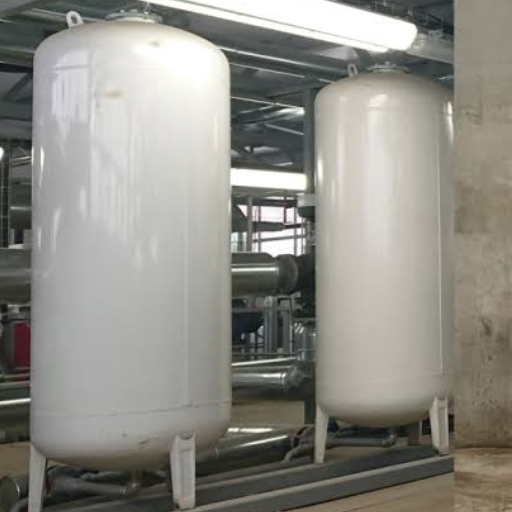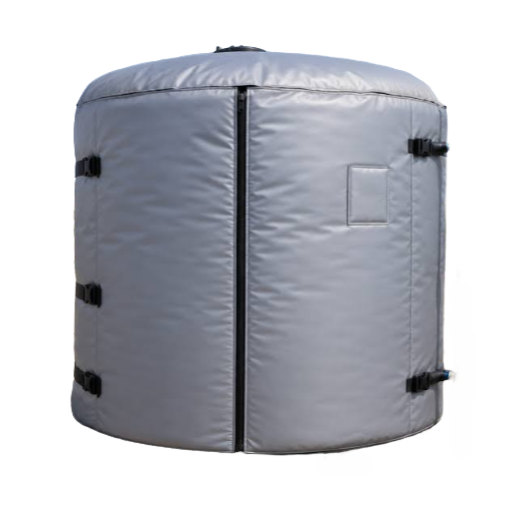
Two fabricators quote the same 20 m³ thermal store. The prices are 40% apart, and both proposals say “ASME certified.”
The gap isn’t markup. One is a Section VIII Division 1 vessel with a Form U-1, a National Board registration number, and a welding package. The other is an atmospheric tank with a heavier shell and a stamp-shaped logo on the datasheet. The buyer can’t tell them apart, and won’t find out until an inspector, an insurer, or a welder asks.
An ASME thermal storage tank is a pressure boundary, a material choice, and a fatigue life — all decided in the first few weeks, all expensive to reverse. This guide covers the code, the shell, the lining, where fatigue concentrates, and how to verify what you were sold. For the wider picture, start with our thermal store tank guide.
What Does “ASME Thermal Storage Tank” Actually Mean?
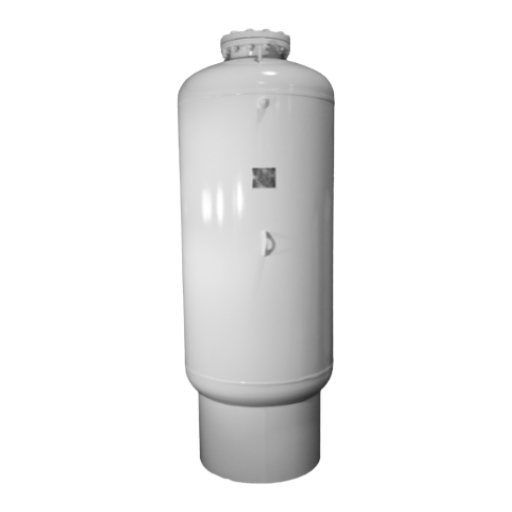
An ASME thermal storage tank is a thermal energy storage vessel built to the ASME Boiler and Pressure Vessel Code, normally Section VIII Division 1 or 2, because its design pressure exceeds 15 psig. It carries a U-stamp, a Manufacturer’s Data Report (Form U-1), and National Board registration. Below that threshold, vessels follow atmospheric-tank standards instead.
The phrase bundles three claims buyers conflate. The pressure boundary is a coded pressure vessel. The fabricator holds a valid U-stamp. The vessel is registered with the National Board.
All three should be true. Often only the first is.
ASME also governs construction, not performance. A stamped tank can still stratify badly, lose heat through a bare top, or crack at a nozzle. The code doesn’t make it good — only legal.
Which Code Applies to a Thermal Storage Tank?
Design pressure decides the class, not operating pressure — the most misapplied rule in this category. A tank running at 5 psig is still a Section VIII vessel if its maximum allowable working pressure sits above 15 psig.
| Service | Design pressure | Governing code | Mark and documentation |
|---|---|---|---|
| Atmospheric or vented store (chilled water, district heating) | ≤ ~2.5 psig, vented | API 650, AWWA D100, or EN 14015 | No U-stamp; fabrication and NDE records to the chosen standard |
| Potable hot water above any threshold | Low to moderate | Section IV Part HLW, or Section VIII | HLW or U-stamp as applicable |
| Pressurised thermal store | Above 15 psig | Section VIII Division 1 | U-stamp, Form U-1, Authorized Inspection Agency countersignature, National Board registration |
| Severe cyclic duty or high pressure | Above 15 psig | Section VIII Division 2, Part 5 design-by-analysis | U-stamp with a Division 2 design report |
Below every threshold, potable hot water sits outside the stamped regime in many jurisdictions: the manufacturer’s own QA applies, and local rules decide. US mechanical codes commonly require ASME construction once any one of three is exceeded: 120 gallons of nominal capacity, 210 °F, or 200,000 Btu/h of input. Hence the visible price break at 120 gallons — and why exempt tanks are built at 119.
The exemption is not free
An array of tanks, each below the threshold, reaches large volume without U-stamped vessels — legitimate, and Caleffi’s hydronic storage handbook works the trade-off honestly.
Four 119-gallon tanks have a surface-to-volume ratio of 0.33 ft²/gal. One 480-gallon tank sits at 0.207 ft²/gal. With equal insulation, the array loses roughly 58% more heat — before the extra piping and valves. You trade code burden for thermal performance and pipework.
One caveat: the Code’s reliefs are permissive, but jurisdictions, insurers, and engineers of record may not accept them. Confirm locally. Insulation: thermal storage tank insulation. Pressure class: atmospheric vs pressure storage tanks.
Thermal Storage Tank Shell Materials Compared
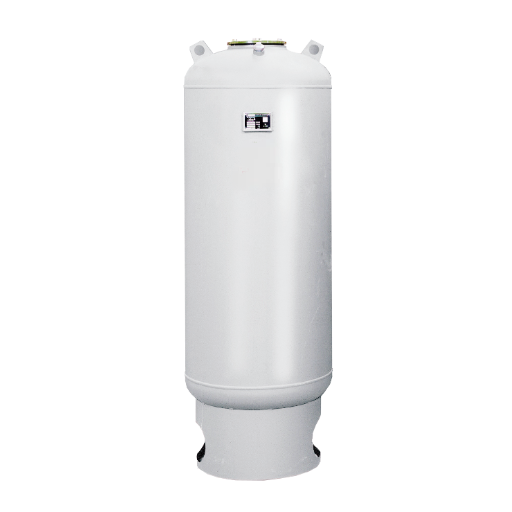
Shell material is a water-chemistry decision more often than a temperature one. Closed, deaerated, inhibited loops are easy on carbon steel; open or oxygen-replenished loops are not.
| Material | Temperature | Corrosion basis | Lining? | Best fit | Watch-outs |
|---|---|---|---|---|---|
| A516 Gr. 70 / SA-516-70 | Stress holds to ~650 °F, then declines | Carbon steel; pits in aerated water | Yes, in water service | Baseline for pressurised hot and chilled stores | Bare steel is not a water-side material |
| A516, glass lined | Limited by the lining | Inert glass barrier | Integral | Potable hot water; stock DHW vessels | Adds cost; brittle at nozzles |
| 304 / 304L | Moderate | Austenitic; chloride cracking | No | Cool, low-chloride loops | Wrong default for hot water |
| 316 / 316L | 316L caps carbon at 0.03% | Molybdenum; better pitting resistance | No | Aggressive chemistry, elevated chloride, 30-year life | Delays cracking, does not remove it |
| Chromoly P11 / P22 / P91 | High temperature | Alloy steel | Duty-dependent | Power and process heat | Not a water-storage material |
| Clad plate | Duty-dependent | Cladding is the barrier | Integral | Large vessels where solid stainless is uneconomic | Needs a qualified clad-weld procedure |
A516 Gr. 70 is the baseline: 70–90 ksi tensile, 38 ksi minimum yield, at least 21% elongation in 2 inches, 0.25% maximum carbon (SSAB datasheet).
304 is the wrong default for hot water. Austenitic stainless cracks under chloride stress corrosion, driven by temperature, chloride concentration, and residual stress together — and a weld heat-affected zone is residual stress by definition.
316L is the usual stainless answer. Two to three percent molybdenum buys better pitting and crevice resistance, and delays chloride cracking without removing the risk. The rule: chemistry and loop type first, temperature second, price third.
Expansion makes the choice structural too: carbon steel moves at roughly 11 µm/m·°C, 304 at 17.2, 316 at 15.9. On a tall stratified vessel, that gap feeds the fatigue discussion below. For cooling duty, see chilled water storage tanks.
Linings: Epoxy, Glass, and When to Skip Both
Epoxy lining is the workhorse for carbon steel in water service: cheap relative to stainless, adequate for a closed loop, and a maintenance item with a finite life. Quality is decided before the coating goes on — SSPC-SP10 near-white blast, a specified dry film thickness, and a holiday test across the whole wetted surface.
The failure mode is pinholes at welds, supports, and baffle attachments: invisible from outside, and they become shell pitting. A plant engineer once described finding one at a baffle weld three years after handover. The exterior was perfect. The shell behind it was not.
Glass (vitreous enamel) lining is the potable-water standard: inert, long-lived, and why stock domestic hot-water tanks last as they do. It adds cost and is usually unnecessary in a closed hydronic loop, and being brittle, it fails at thermal shock and nozzle damage. Cement lining and galvanising do not belong in thermal duty.
When to skip the lining: go unlined 316L when water chemistry can’t be guaranteed, when the loop is open or oxygen-replenished, or when the owner won’t run a coating inspection programme. A lining you won’t inspect is a deferred failure, not a saving.
Specify the water chemistry, not just the material. Dissolved oxygen, chloride, pH, and inhibitor regime belong in the specification; if they are absent, the fabricator is guessing, and the owner inherits the guess. For potable zone design, see stratified hot water storage tanks. Send us the water analysis, and we will tell you which route we would build.
Thermal Fatigue: The Failure Mode Daily Cycling Creates
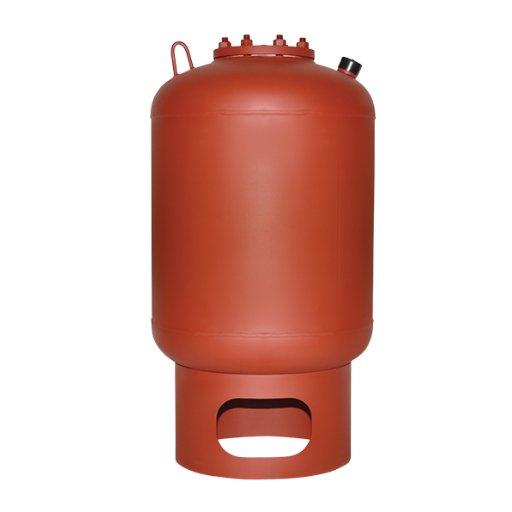
Fatigue damage is driven by stress range and cycle count, not absolute temperature. A store swinging between 40 °F and 180 °F daily sees roughly 6,500 cycles in eighteen years — an illustration of magnitude, not a design calculation. Most competitor pages barely mention it.
The stratification problem nobody connects
Here is the part that rarely gets said: a better-stratified tank is a harder-working tank.
A well-stratified store holds a steep vertical gradient. The shell then expands differently top to bottom, producing bending stress at the transition zone and restraint at any attachment bridging it. Tune the diffuser for a razor-thin thermocline, as our guide to thermal energy storage tank design describes, and the structural demand on the shell rises with it.
Where damage concentrates
| Location | Why damage concentrates there | What to specify |
|---|---|---|
| Nozzle-to-shell weld toe | Geometric discontinuity, piping loads, cyclic ΔT; a sharp toe raises stress | Full-penetration weld, toe grinding, cyclic reinforcement, piping flexibility analysis |
| Shell-to-head transition | Change of stiffness; peak bending stress under pressure plus gradient | Correct head profile, full-penetration weld, NDE on the seam |
| Support, skirt, or leg attachment | Restrains the shell where it wants to move thermally; also a thermal bridge | Insulated support detail, thermal break, weld profile control |
| Internal baffle and diffuser welds | Highest-velocity, highest-ΔT zone; small welds, real cyclic load | Full-penetration where possible; no intermittent welds in the flow path |
| Hot inlet nozzle | Local ΔT at the injection point, worst while charging | Thermal sleeve; inlet velocity controlled at the diffuser |
What to specify, in fabrication language
Two details decide more than the rest. Freeze the nozzle schedule early — a nozzle added late is a weld added late, in the highest-stress zone. And run the piping flexibility analysis before fabrication, so nozzle loads are known inputs.
Post-weld heat treatment belongs where thickness and material require it — with a caveat. Stress relaxation cracking is documented, and field PWHT on thick walls is hard to control. POWER Magazine’s report on molten-salt tank weld failures describes 347H weldments cracking near 565 °C.
Water storage runs far below that, but the lesson transfers: weld metallurgy, not base metal, governs. Where cyclic duty is severe, Division 2’s design-by-analysis route is the defensible path.
None of it is inspectable afterwards. Insulation goes on within weeks, and every location in that table disappears behind cladding. You get one chance, before the jacketing.
Lifespan
A correctly specified, correctly lined, correctly cycled vessel is a 25-to-40-year asset — an industry range, not a warranty. Lining failure and uninspected fatigue end life early; the steel is rarely the problem. Phase-change tanks cycle differently — see PCM thermal storage tanks.
For a detailed cost breakdown, see our thermal storage tank cost guide.
Verifying the Stamp and the Paperwork
A vessel without this package is not an ASME vessel, whatever the nameplate says.
- Confirm the fabricator holds a valid U-stamp. Check independently — the National Board keeps the records, and a stamp claimed in a brochure is not a stamp.
- Demand the Form U-1 for this vessel, signed by the manufacturer and countersigned by the Authorized Inspection Agency.
- Check the National Board registration number on the nameplate against the record.
- Collect the material certificates — CMTRs or EN 10204 3.1 for European supply, traceable to the plate heat numbers.
- Collect the welding package — WPS and PQR to ASME Section IX, welder qualifications, and the weld map.
- Collect the NDE reports — method, extent, acceptance criteria, technician certification.
- Collect the hydrotest record — typically 1.3 times MAWP, with test pressure, hold time, and water temperature.
Run this against every quote. It costs nothing and separates the two proposals above in about ten minutes.
Export Compliance: ASME, PED, and GB/T 150 Together
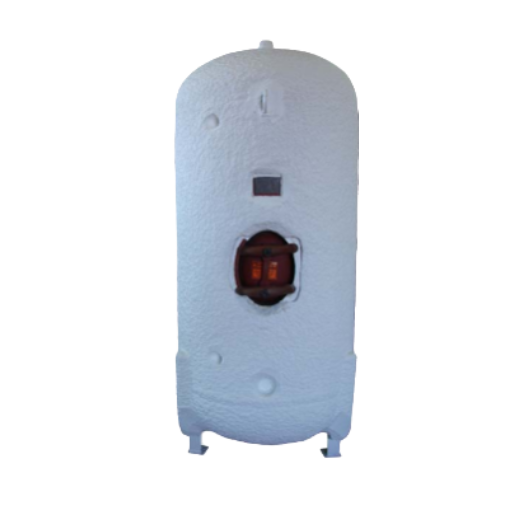
Export compliance is additive, not alternative. One vessel can need three paperwork sets.
In the European Union, the Pressure Equipment Directive (PED 2014/68/EU) applies above 0.5 bar. Vessels are categorised under Annex II by fluid group and pressure-volume; Category II and above require Notified Body involvement and CE marking. The harmonised design standard is EN 13445, with EN 12897 covering indirectly heated unvented storage water heaters.
In China, GB/T 150 is the design code and TSG 21 the safety regulation, with Q345R the common plate grade. The allowable-stress basis differs — GB/T 150 derives it from yield over 1.5 and tensile over 2.7, while Section VIII Division 1 uses tensile over 3.5 and yield over 1.5. Different margins mean the two are not interchangeable without re-checking the design; verify against GB/T 150.2.
One finding almost nobody publishes: an ASME-hosted comparison paper cites a European Commission review concluding that Section VIII permits a substantially larger number of design fatigue cycles than EN 13445 for welded vessels. If your duty is heavily cycled and your market is European, that is a design decision, not a footnote.
Ask which code set the fabricator is building to, and get it in writing. “Meets international standards” is not a code basis.
FAQ
Do I need an ASME tank for thermal storage?
Only above 15 psig design pressure, or above the potable hot-water thresholds. Atmospheric and vented stores follow API 650, AWWA D100, or EN 14015 — many chilled-water stores need no stamp.
What ASME section applies to a thermal storage tank?
Section VIII Division 1 covers most pressurised thermal stores. Division 2 applies to higher pressure or fatigue-sensitive designs. Potable hot water commonly falls under Section IV Part HLW.
What is the 119 gallon ASME exemption?
The threshold is 120 gallons, so exempt tanks are built at 119. An array, each below the limit, reaches large volume without U-stamped vessels — at the cost of roughly 58% more surface area.
Carbon steel vs stainless steel for a thermal storage tank?
Choose from water chemistry and loop type first. A closed, deaerated, inhibited loop suits lined A516 Gr. 70. Aggressive chemistry, elevated chloride, or a 30-year-plus life points to 316L.
Does a thermal storage tank need a lining?
Carbon steel in water service does, usually epoxy with a holiday test and an inspection programme. Unlined 316L does not, if the chemistry supports it.
What is thermal fatigue in a storage tank?
Cumulative damage from the stress range of repeated charge and discharge cycles, concentrated at weld toes, nozzle-to-shell junctions, and support attachments — invisible once insulated.
How do you verify an ASME U-stamp?
Check the stamp holder and registration number independently with the National Board, then demand Form U-1, material certificates, welding procedures, NDE reports, and the hydrotest record.
Conclusion
Five decisions decide whether your vessel is legal, insurable, and still sound in twenty-five years.
Fix the design pressure first. It decides the code, and it is not the operating pressure.
Confirm which threshold applies locally. The 15 psig rule, or the potable limits of 120 gallons, 210 °F, and 200,000 Btu/h. Insurers can require more than the code does.
Choose the shell from water chemistry and loop type, not the price list. Lined A516 Gr. 70 for a clean closed loop; 316L when the chemistry is aggressive.
Treat the lining as an inspected maintenance item, or buy stainless instead — and specify the water chemistry in the same document.
Design the welds and nozzles for the cycle count, not just the pressure. Do it before the insulation goes on, because after that nobody can check.
An ASME thermal storage tank is a code basis, a material, and a fatigue life. We fabricate and document thermal storage vessels to ASME, PED, and GB/T 150, singly or as a dual package, and will tell you which one your project needs. Talk to our engineers about your specification.