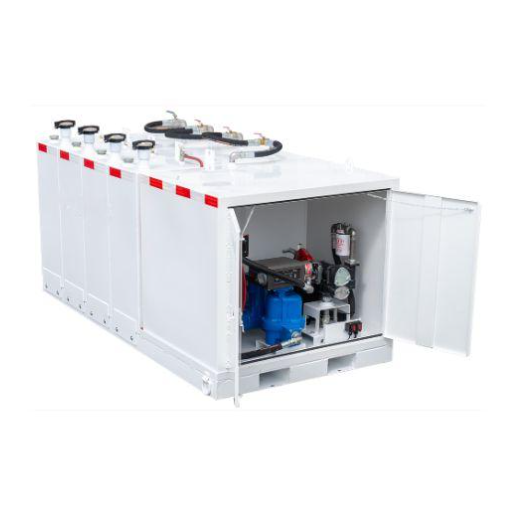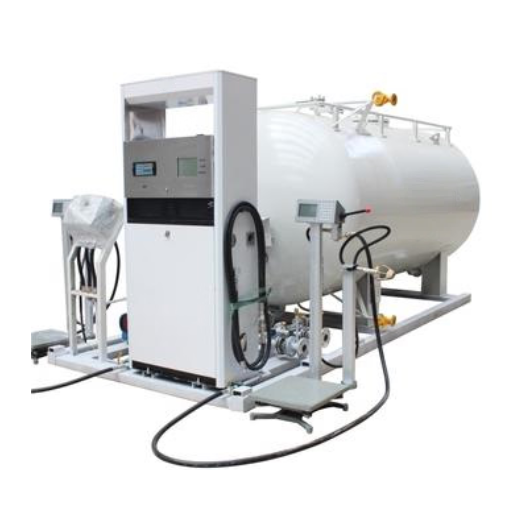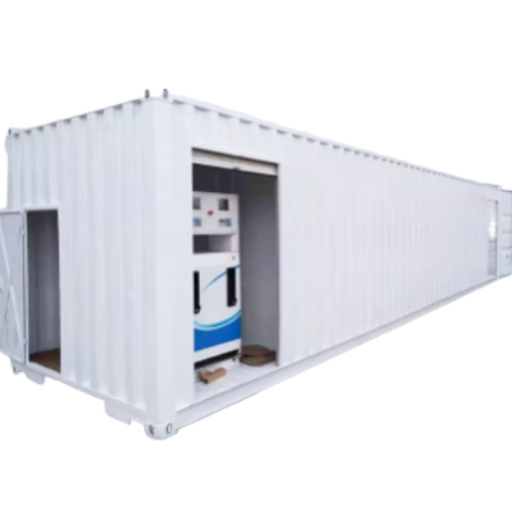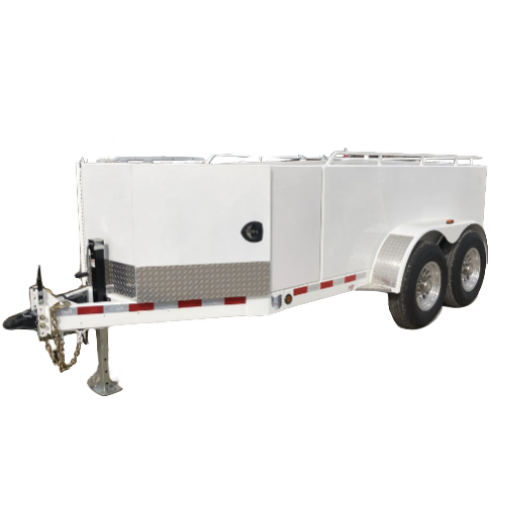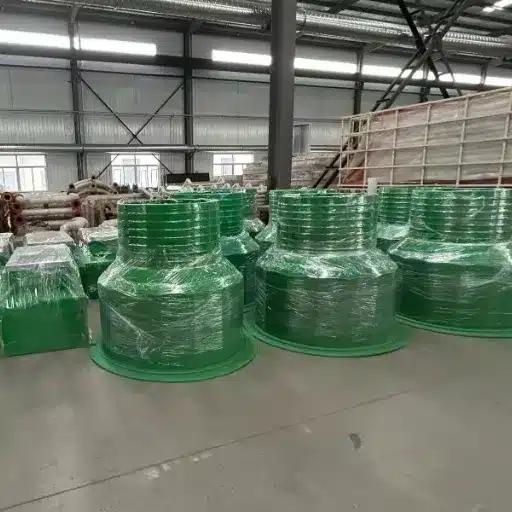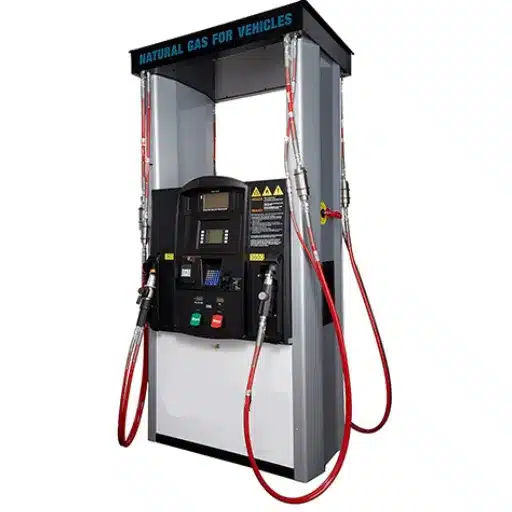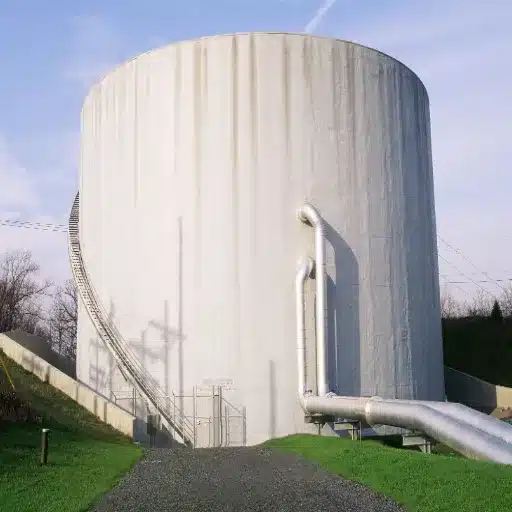
A marina fuel station is the shore-side or pier-side facility that stores, filters, and dispenses fuel to vessels. A 20ft skid station packs that boat fueling station into one relocatable ISO-frame unit, with tank, containment, pump, meter, and safety controls tested before delivery.
The pump is the easy part. The site is not. The hard parts are where the unit may legally sit, how high above the water it must be, and what a spill does with water two metres below the nozzle.
This guide takes the decisions in the order they arrive on a real project. If you’re still choosing a format, see what a 20ft unit contains.
Key Takeaways
- NFPA 30A puts marina fuel tanks on shore or on a solid-fill pier, with a pier exception capped at 1,100 gallons.
- PEI/RP1000 covers fixed onshore tanks only, so floating, pier-mounted, and truck-mounted tanks fall outside it.
- Design elevation is high water plus storm surge plus wave plus freeboard, not the mean high water line.
- A double-wall, self-bunded unit turns an over-water spill into a contained leak inside a steel box.
- Pump rate on a datasheet isn’t the rate at the nozzle, so size the nozzle from the run and work back to the pump.
What a Marina Fuel Station Is and How It Differs From a Forecourt Station
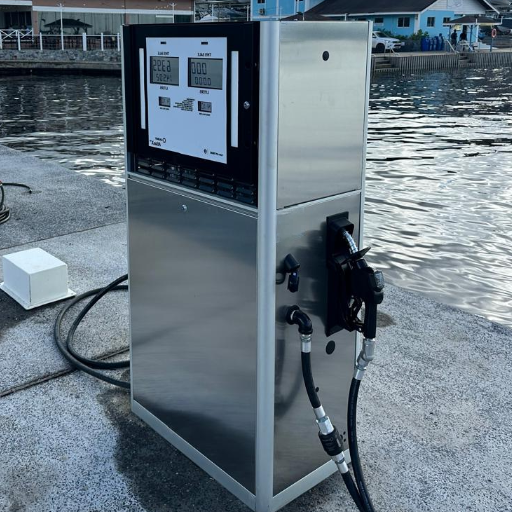
A marina fuel station serves vessels rather than road vehicles. It stores fuel on shore or on a solid-fill pier, moves it through a pump, meter, and filter, and delivers it to a vessel’s deck fill. Containment is the third function, and at the water it matters most.
A forecourt and a marina station look similar in a photograph and behave nothing alike. A car sits on a sealed pad and fills 50 to 80 litres. A boat moves with the tide, the fill is a deck fitting, and the surface below the nozzle is water.
| Requirement | Road forecourt | Marina fuel station |
|---|---|---|
| Tank location | Underground or aboveground on site | Shore or solid-fill pier, with a narrow pier exception |
| Dispensing point | Nozzle into a vehicle filler neck | Nozzle into a deck fill while the vessel moves |
| Spill path | Pad and interceptor drain | Directly to surface water unless contained |
| Attendant | Attended or self-service per code | A supervisor with a clear view of the fill and shut-off |
| Corrosion exposure | Ambient, usually inland | Salt air, splash zone, dissimilar metals |
A marina fuel dock can be built in place with a shore tank and pipe to the berth. It can be containerised on a pad or solid-fill pier. It can also be supplied by mobile delivery. This article covers the second, which adds dockside fueling without running pipe under a pier.
The Siting Decision: Tide, Surge and the Pier Rule
The first decision on any marina fuel station is where the tank goes, and the answer is usually not where the operator wants it.
Why the tank belongs on land
NFPA 30A covers marine motor fuel dispensing in its own chapter. That chapter requires tanks supplying marine service stations to sit on shore or on a solid-fill pier. Where a shore location would need very long supply lines, the authority having jurisdiction may permit a pier-mounted tank. That exception tops out at 1,100 gallons, and state rules often add a double-wall condition.
Read that as a design constraint, not a technicality. Our guide to permit requirements for a skid station covers the approval path; this section covers the water. One advantage of a 20ft ISO-frame unit: it can be lifted off a pier before a named storm. That is an option, not a substitute for elevation.
A hypothetical case, to show how it goes wrong. A harbour proposes a 15,000-litre tank on an open pier to shorten the run to the berths. The fire authority applies the marina chapter: tanks go on shore or solid-fill, and the pier exception stops at 1,100 gallons. The design moves to a shore pad, and the run gets solved with pipe instead of with the tank.
What PEI/RP1000 covers, and what it leaves out
The installation practice for marina fueling systems is PEI/RP1000, and its scope is narrower than most buyers assume. It applies to fixed, onshore tanks using submersible or suction pumps. It excludes tanks in, on, or over water, including floating tanks and tanks on piers or floating docks. Truck-mounted tanks are excluded too.
A containerised unit on a shore pad or solid-fill pier sits inside RP1000. The same unit on a floating dock doesn’t, and the two scopes imply different designs.
Elevation is a calculation, not a line on a chart
Design elevation is high water plus storm surge plus wave plus freeboard. The 50-year event, the 2% annual chance flood, is the usual basis; the 25-year event is the minimum where accepted.
NOAA’s hurricane guidance for marinas adds two points that catch people out. Pumps should clear expected high tide and surge, not just normal high water. And an empty tank in saturated soil can float, so anchorage or counterweighting belongs in the design.
| Check | Question to answer | What fails if you skip it |
|---|---|---|
| Land tenure | Do we control the shore or solid-fill footprint? | A design built around a pier tank nobody will permit |
| Flood elevation | What are MHHW, design surge, and wave run-up? | Unit submerged, containment flooded, access lost |
| Utility route | Are power and data above design flood? | A station unreachable after the event |
| Vehicle and crane access | Can a tanker and a crane reach the unit? | No resupply, no lift-off before a storm |
| Drainage | Where does the pad drain, and can it be closed? | A spill reaching water through a scupper |
Corrosion Exposure and Spill Containment Over Water
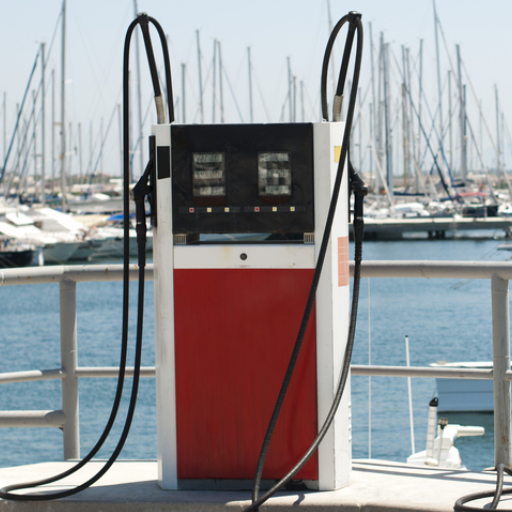
Salt air and water underneath are the two conditions that separate a marina station from a depot skid. Both show up in the specification, and both cost money.
Corrosion is a category, not a paint colour
ISO 12944 classifies atmospheric corrosivity from C1 to CX. C5 is “very high,” the category for coastal areas with high salinity, and the level a marina specification should be written against. The 2017 revision abolished the C5-M label, moving offshore environments into CX, so a datasheet quoting “C5-M” uses the older designation.
Our product page describes the finish as sandblasted to SA 2.5 with a Hempel C5-M marine-grade coating, plus a high-gloss upgrade for salt-spray exposure. Ask whether the coating system, surface preparation, and dry-film thickness are specified together. Premium paint over poor preparation fails at the same rate as cheap paint.
What corrodes at a dock is rarely the flat plate. It is the splash zone, welded seams, cable glands, and the underside of a bund that never dries. Any joint where stainless meets carbon steel without isolation corrodes too.
The page lists S235JR carbon steel with internal coating as standard, with optional S304 or S316. S316 resists chloride pitting. Our marine-grade tank materials guide compares grades, though it covers tanks inside vessels, not the station shell.
Containment in three layers
Containment at a marina isn’t one device. It’s three, and they fail independently.
- Primary tank inside a secondary shell. The page describes self-bunded, double-wall construction with 110% secondary containment.
- Detection in the annulus. Interstitial leak sensors should alarm, not merely indicate.
- The site. A kerbed pad or bunded deck with the pier’s scuppers closable.
A sensor wired to a lamp nobody watches is decoration. And that third layer is where federal transfer rules land. Under 33 CFR 156.120, containment must be accessible or deployed and drained to maintain capacity. Drains and scuppers must be closed before a transfer begins.
Here is the argument for a bunded unit. With one, the credible worst case is fuel inside a steel box on a pier. Without one, it is a sheen on the water. Our spill containment systems guide covers hardware.
Dispensing Hardware: Flow Rate, Hose Run and Nozzle Choice
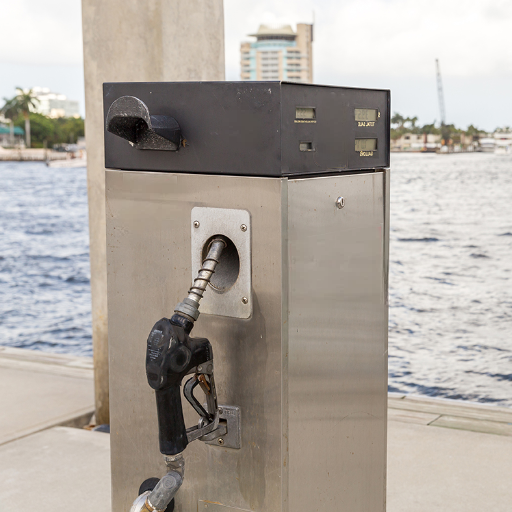
Dispensing is where marina projects most often under-specify, because the marine fuel pump rating on the nameplate isn’t the number the customer experiences.
The page lists the standard marine fuel dispenser at 50 to 80 litres per minute, with a heavy-duty 120+ LPM option. In gallons: 50 LPM is about 13 GPM, 80 LPM about 21 GPM, 120 LPM about 32 GPM.
Then subtract the run. Thirty to sixty metres of 1-inch hose costs real pressure at 20-plus GPM, and the nozzle adds back-pressure. The pump curve sets the delivered rate, not the nameplate.
So work backwards from the berth. Pick the turnaround, convert it to flow at the nozzle, add friction loss, then choose the pump that still delivers it.
A hypothetical case, on the same point. A yard fits a 1-inch hose 40 metres down the dock and wonders why a 600-litre boat tank takes longer than the datasheet implies. The pump is fine. The run isn’t.
Nozzles are regulated, not just purchased
Marine dispensing uses an automatic-closing nozzle with no hold-open latch, plus a non-drip check valve. That is a code requirement. A latched nozzle left in a deck fill while the vessel moves is how docks catch fire.
OPW’s 11A is the common benchmark: 3/4-inch NPT inlet, 15/16-inch spout, around 17 GPM, UL/ULC listed, shipped without a hold-open clip since the UL 2586 change in 2015. Vendor specifications, not our recommendation.
| Pump setting | Approx. flow | Hose | Nozzle class | Fits |
|---|---|---|---|---|
| 50 LPM | 13 GPM | 3/4 in, short run | Standard automatic, 15/16 in spout | Tenders, small craft |
| 80 LPM | 21 GPM | 3/4 to 1 in | High-flow automatic | Cruisers, sportfishers, workboats |
| 120 LPM+ | 32 GPM+ | 1 in minimum | High-flow, large bore | Commercial fishing, tugs, patrol boats |
Metering, safety and the transfer overlay
The page lists a positive-displacement flow meter at plus or minus 0.2% accuracy, with a 10-micron water-absorbing filter ahead of it. Retail sale is a weights-and-measures matter, though. The metrology authority’s tolerance governs, not the datasheet.
It also lists an intrinsically safe electrical box, an overfill prevention valve, interstitial leak sensors, an emergency shut-off, and an IP65 panel described as Ex-proof and ATEX/IECEx compatible. Whether a certificate covers the enclosure alone or the assembled unit is a question for the supplier.
Then there is the overlay that surprises port projects. Facilities capable of transferring oil in bulk to or from vessels of 250 barrels or more fall under 33 CFR 154, per 154.100.
That brings an emergency shutdown stopping flow within 60 seconds, two-way voice communication on intrinsically safe radios, and fixed lighting of at least 5.0 foot-candles at transfer points. A small dock may sit outside it. A working harbour rarely does.
Fuel Quality, Inventory and Monitoring at a Salt-Water Site
Water is the enemy at a marina, and the site supplies it three ways: condensation in a partly empty tank, spray at the fill, and a deck fill left open. Ethanol-blended gasoline is hygroscopic and can phase-separate, which is why so many fuel docks advertise ethanol-free gasoline. The threshold varies with temperature and blend, so treat it as a principle rather than a number.
| Control | What it prevents | Where it sits |
|---|---|---|
| Full tanks, minimal headspace | Condensation build-up | Operating practice |
| Water-absorbing filter element | Water reaching the vessel | Dispenser inlet |
| Water detection in tank and filter bowl | Silent accumulation | Gauge and service point |
| Sealed, elevated fill point | Spray and runoff ingress | Fill assembly |
| Gauge-to-dispenser reconciliation | Unexplained loss | ATG plus transaction data |
Marina fuel is high-value and low-volume per transaction, the worst combination for spotting a leak: a few litres a day disappears into the noise. A marine fuel management system pairing tank gauging with dispenser reconciliation makes a small daily loss visible. The page lists cloud-based ATG as an option, with remote inventory tracking, leak alerts, and solar or battery power for a pier with no supply. Our remote monitoring guide covers the instrumentation.
Want a second opinion on your site before you commit? Send us the berth count, the tide range, and the intended location, and we’ll tell you where the format fits and where it does not.
Permits and Inspections for a Marina Fuel Station
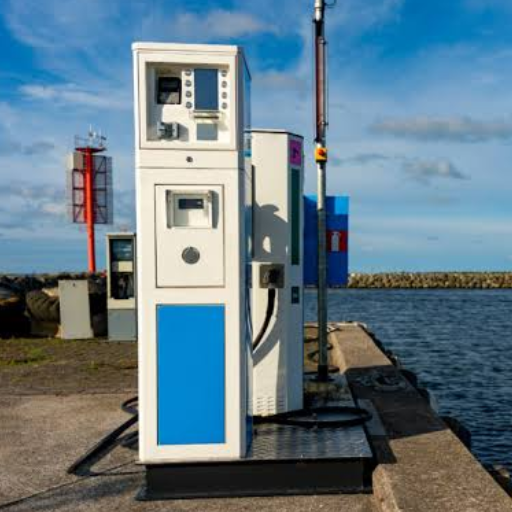
Approvals arrive in an order. Get it wrong, and a project loses a season.
| Instrument | What it governs | Trigger | Enforced by |
|---|---|---|---|
| Zoning and lease | Use and footprint on paper | Any new installation | Harbour authority, landlord |
| NFPA 30A, marine chapter | Tank location, dispensing, attendant, shut-off | Any marine dispensing facility | Fire authority (AHJ) |
| PEI/RP1000 | Installation practice, fixed onshore systems | Fixed onshore tanks only | Engineer or insurer |
| 40 CFR 112 (SPCC) | Spill plan and containment | Capacity thresholds plus discharge potential | EPA or state |
| 33 CFR 154 | Operations, ESD, communications, lighting | Bulk transfers of 250 barrels or more | US Coast Guard |
| 33 CFR 156 | Containment, scuppers, persons in charge | Oil transfer to or from a vessel | US Coast Guard |
| ATEX / IECEx | Equipment in explosive atmospheres | Equipment in a classified area | Certification bodies and installer |
The SPCC rule, under 40 CFR Part 112, applies above 1,320 gallons of aggregate aboveground capacity, where there is a reasonable potential to discharge to navigable waters. A single 20ft unit may sit below that on its own, so count the rest of the site.
The Coast Guard entries attach to operations, not equipment. Above 250 barrels, operating manuals, drills, and personnel-in-charge arrangements come with the facility. The NFPA 30A marine chapter also carries local amendments that override the model text.
Cost follows the same list: tank and containment, coating, material grade, dispensing rate, hose length, the containment pad, electrical classification, monitoring, permits, delivery, and lifting. Add what buyers forget, such as insurance sign-off for a lease. We don’t quote a marina price, because the site decides most of it. Our ten-year cost of ownership model shows which lines dominate.
Marina Fuel Station FAQ
Can a fuel tank be mounted on a pier over the water?
Usually not. NFPA 30A requires tanks on shore or on a solid-fill pier, with a narrow exception capped at 1,100 gallons that often carries a double-wall condition.
Does PEI/RP1000 apply to a floating dock?
No. RP1000 covers fixed, onshore tanks and excludes tanks in, on, or over water, plus truck-mounted tanks. A unit on a floating dock needs a different basis of design.
How high above the water should a marine fuel station sit?
High enough that high water plus design surge plus wave plus freeboard stay below the vulnerable equipment. Pumps and controls should clear expected surge, not just normal high water.
What flow rate does a marina fuel dispenser need?
It depends on the berth, not the pump.
A 50 LPM setting, about 13 GPM, suits small craft. Cruisers and workboats usually want 80 LPM or more. Commercial fishing and tugs want 120 LPM and up.
Can a marina fuel station operate unattended?
NFPA 30A expects an attendant supervising dispensing with a clear view of the fill and the shut-off. Some jurisdictions permit card-lock or self-service with conditions, which changes the dispenser, the monitoring, and the insurance.
What approvals does a new marina fuel station need?
Zoning and lease consent, fire-code approval through the AHJ, SPCC applicability and any coastal permit, Coast Guard obligations above 250 barrels, and electrical plus weights-and-measures sign-off.
The Decisions That Decide the Project
Three decisions carry most of the risk on a marina fuel station, and none is about the pump. Tank location comes first, on shore or on solid-fill, with the pier exception treated as the narrow allowance it is. Elevation comes second, calculated from surge and wave rather than read off a chart. Containment comes third: the unit plus annulus detection plus the deck.
After that, the work is ordinary engineering. Size the dispensing from the berth backwards, keep water out of the product, and run the approvals in order. A 20ft containerised fuel station makes that easier, because storage, containment and dispensing arrive as one documented assembly. Siting still decides everything.
A hypothetical case, on the storm plan. A forecast sends one operator looking for a crane the week before landfall. The unit is ISO-framed and CSC-rated, so it can be lifted, but the site plan never said who would do it. Put the lift plan and crane contact in the operations manual before the season.
If you’re early in the process, start with our 20ft skid station specification guide for the unit. Then come back here for the waterfront constraints.
Ready to test a site against a real configuration? Send us the location, the tide range, and the berth count. We’ll tell you what the format can and can’t do there, and what your engineer will need to submit.