A project engineer in Lagos needed 60,000 gallons of diesel storage on a plot barely wide enough for the pumps. She specified a tall vertical tank to save ground space, then discovered the containment dike she was required to build around it consumed every square meter she had saved.
The orientation was right. The containment decision, made three weeks later by someone else, quietly undid it.
That sequence is the single most common mistake in fuel storage planning. Vertical vs horizontal storage tanks isn’t a question about which shape is better. It’s a geometry question, and geometry interacts with pressure, transport, containment, and code in ways that only become visible when you look at the whole project.
By the end of this guide, you’ll be able to specify an orientation for your site, your volume, and your fuel, and know exactly which standards follow from that choice.
Here’s what we’ll cover:
- The real differences between the two configurations, in one comparison table
- Why footprint arguments often collapse once containment is added
- The fabrication and transport threshold that actually decides the question
- Codes and standards by orientation, including UL, API, NFPA, and GB 50156
- A 30-year cost view and a decision matrix by application
One clarification before we start, because it prevents a lot of wasted reading. This article covers orientation, meaning the physical geometry of the tank. Two other decisions are separate. Placement is whether the tank sits aboveground or underground, which we cover in our guide to aboveground vs underground tank placement. Wall count is whether it is single- or double-walled, covered in our comparison of single vs double-walled construction. Many projects need all three guides. None of them substitutes for another.
Vertical vs Horizontal Storage Tanks: The Short Answer
Vertical tanks win on footprint and cost per unit volume, and they are the natural geometry for large atmospheric storage. Horizontal tanks win on pressure capability, transportability, and stability, and they are the only practical choice for underground and skid-mounted fuel. Choose by capacity, fuel vapor pressure, site constraints, and containment strategy.
That is the whole decision in four sentences. Everything below explains why each clause is true, and where the exceptions live.
Use this table as your working reference. The ten factors are ordered roughly by how often they decide a real project.
| Factor | Vertical | Horizontal |
|---|---|---|
| Footprint per unit volume | Smaller base area, commonly cited at around 25% of an equivalent horizontal | Larger base area |
| Height profile | Tall, frequently 20 ft or more | Low, typically under 10 ft |
| Pressure capability | Atmospheric, about 2.5 psig with a flat bottom | ASME pressure vessel construction possible |
| Support structure | Flat bottom bearing on a ring beam or raft | Engineered saddles or skids on a pad or piers |
| Transportability | Poor at scale, often field erected | Good, shop fabricated and trucked |
| Shop fabrication ceiling | Large tanks must be field erected | Fits road limits up to roughly 13 ft diameter |
| Underground suitability | Impractical | Standard practice under UL 58 and UL 1316 |
| Containment geometry | External dike consumes footprint | Integral self-bunding available |
| Inspection access | Height access and confined space entry | Direct entry under about 3 m diameter |
| Cold climate heat loss | Lower surface area to volume ratio | Higher heat loss per gallon |
If you want to see how these configurations map onto real products, our fuel storage tank range covers both geometries across aboveground and buried builds.
How Vertical and Horizontal Tank Configurations Differ
The two shapes carry load in fundamentally different ways. That single fact explains most of the practical differences downstream.
Geometry and Shell Stress
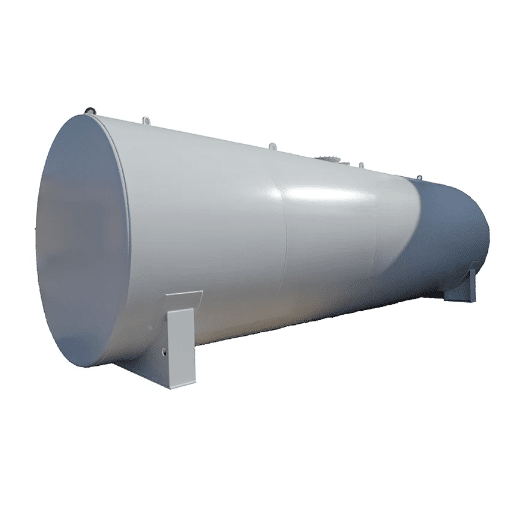
A vertical tank is a flat-bottomed cylinder standing on its base. Internal pressure rises with depth, so hoop stress increases from top to bottom. Fabricators respond by using shell courses of increasing thickness and reinforcing the bottom with an annular plate. A wind girder near the top resists buckling on tall, thin shells.
A horizontal tank carries the same hydrostatic load, but the critical stress is longitudinal bending between its supports. The shell must resist both internal pressure and the sagging load of its own contents. Where pressure matters, the ends are dished rather than flat, which is how a horizontal vessel becomes an ASME pressure container.
Support Structures
This is where the two configurations diverge most in installed cost, and it’s the part buyers most often underestimate.
A vertical tank is essentially its own support. The flat bottom bears directly on the foundation, and the foundation does the engineering work.
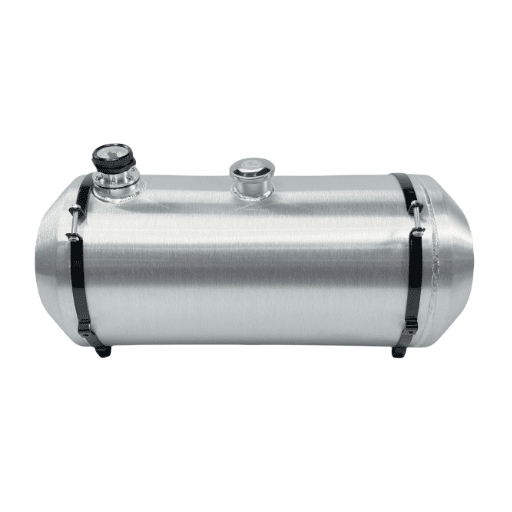
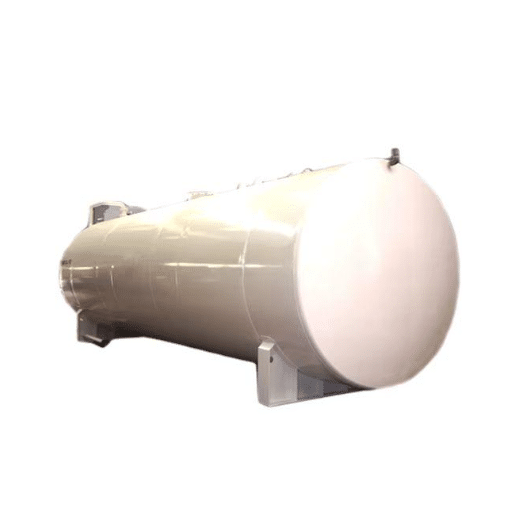
A horizontal tank can’t stand on its own. It needs engineered saddles or skids, usually a two-saddle design built to UL 142 standards for the specific tank diameter. Standard saddles provide 6 in. of clearance, and saddles are available up to 12 in. high. Anything above 12 in. must be protected with material carrying a two-hour fire rating.
The saddles bolt to a concrete pad or piers through four bolt holes, and the anchors must be sized to resist seismic and wind uplift.
Horizontal tanks also need to sit elevated 4 to 6 in. so the underside can be visually inspected.
Because the horizontal shell concentrates load at two points, the tank needs local reinforcement that a vertical tank does not. At small capacities this is trivial. At large capacities, it becomes a genuine cost line.
Footprint, Capacity, and Site Layout
Footprint is the argument that sells vertical tanks, and it’s a real advantage. It’s also routinely overstated.
Vertical tanks take less ground for the same volume. Manufacturers commonly cite a figure of roughly 25% of the base area of an equivalent horizontal tank, and the framing that “four vertical tanks fit in the ground space of one horizontal tank” is a standard industry shorthand. Both are directional, not measured, but the direction is correct.
Where the advantage is real: high volume terminals, refineries, and industrial sites where plot area is genuinely the binding constraint and where a tall structure does not create a sightline, shading, or aesthetic problem.
Where the advantage evaporates: almost anywhere you need secondary containment, and almost anywhere a local code or a neighbor places a height or visual restriction on you.
A vertical tank that requires a concrete dike gets a second concrete structure wrapped around its base. That dike isn’t decorative. It has to hold the contents of the largest tank, which means a substantial footprint of its own, and it typically must be kept clear of rainwater accumulation and inspected for integrity.
For a single tank, the dike can consume an area comparable to the tank’s own base. You’ve just paid for the footprint advantage and then given it back.
We have more on this in the containment section below, because it changes the recommendation for a large share of projects.
Site layout introduces a second constraint. Multiple tanks need spacing for fire truck access, and tank farm planning typically arranges vessels in no more than two rows so that every tank has an accessible face. Narrow footprints favor vertical geometry; accessible faces favor horizontal.
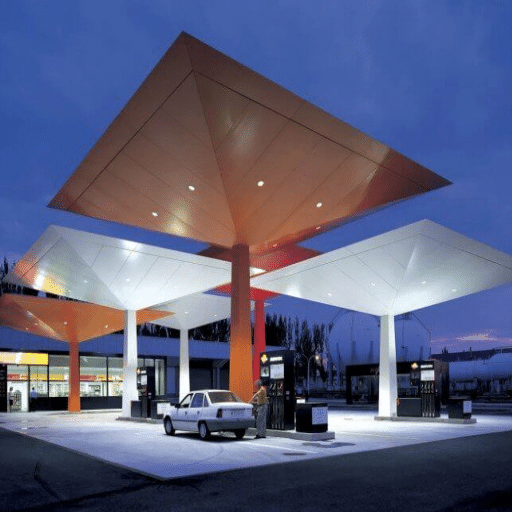
On a retail forecourt, height is usually the deciding factor. A tall tank beside a canopy creates conflicts with signage, drainage, lighting, and local planning rules, which is one of several reasons retail sites rarely use vertical geometry. Our gas station canopy design guide covers how forecourt structures interact.
Pressure Class and Fluid Behaviour
This section contains the single most useful correction we can offer, so we’ll state it plainly.
A vertical flat bottom tank is an atmospheric tank. It is designed for internal vapor space pressure of approximately 2.5 psig, which is the API 650 basis for vertical, cylindrical, welded steel tanks. That is roughly the pressure a column of fuel vapor develops, and nothing more.
A horizontal tank can be an ASME Section VIII pressure vessel. With dished ends rather than flat ones, a horizontal vessel can be designed for pressures orders of magnitude higher. This is why LPG, ammonia, and CNG storage almost always uses horizontal geometry.
The widespread online claim that “vertical tanks hold 80 psi” is wrong, and it causes real specification errors. If your fuel requires meaningful pressure, vertical flat bottom geometry isn’t a candidate regardless of how much space it saves.
For gasoline and diesel, atmospheric pressure is entirely adequate. Orientation then turns on everything else in this article.
Fluid behaviour adds a second consideration. Vertical tanks drain to a center sump and can be drawn down almost completely. Horizontal tanks hold a heel of product below the outlet unless they are sloped or fitted with a sump, which affects both usable volume and how often you need to deal with water bottoms.
One more note specific to fuel. Higher vapor pressure pushes you toward either a pressure-rated horizontal vessel or toward burial, where earth cover stabilizes product temperature and limits vapor generation.
Fabrication, Transport, and Site Erection

Here’s the section that actually decides most projects, and it’s the one no competing guide covers.
The real question behind orientation is not “which shape do I prefer.” It is “can this tank be built in a shop and delivered, or must it be erected in the field?” That threshold is driven by transport, and transport is driven by diameter.
The practical numbers matter:
- Road transport treats loads wider than 8 ft 6 in. as oversize, and many jurisdictions cap height at around 13 ft 6 in.
- For long hauls, the practical shop-built truck diameter is roughly 12 to 13 ft.
- API 650 Annex J caps shop-fabricated tank diameter at 6 m (20 ft), which reflects lifting and transport practicality rather than a design limit.
- API 12F production tanks, a common small tank standard, max out at 15 ft 6 in. diameter.
- Special permits widen the envelope. Alberta, for example, allows low bed trucks up to 24 ft wide, and some fabricators modify Annex J to reach roughly 23.5 ft diameter. Barge and ship transport removes the width constraint but adds cost and schedule.
Field erection has no API 650 maximum size. Field-erected tanks commonly start around 15 ft diameter and 45,000 gallons, with most falling in the 30,000 to 300,000 gallon range. The driver is site access and economics, not a code threshold.
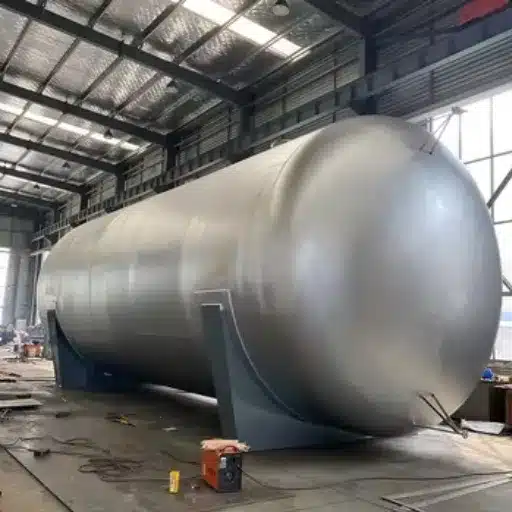
Now map that onto orientation. A horizontal tank is a shop-friendly geometry. It is short, it travels on a standard trailer, and it can be delivered complete with saddles, coatings, and appurtenances. A large vertical tank is the opposite. Its height means it ships in shell courses and gets welded together on site.
That’s why horizontal geometry dominates small and medium fuel duty. It fits the shop, and it fits the truck. And it’s why vertical dominates large atmospheric duty, where nothing needs to move because the tank is going to be built where it stands.
A note for China export projects. Horizontal tanks above 3.2 m diameter trigger escort vehicle requirements on Chinese roads, which affects route planning, permits, and delivery schedule. If you’re importing tanks from China, confirm the transport plan against your actual diameter before you finalize the specification.
This is a logistics variable that catches importers by surprise, and it’s worth raising with your supplier early. Our container vs skid-mounted fuel stations guide covers packaging choices that interact with these limits.
Want us to check whether your tank diameter will clear its route? Send us the destination and the capacity, and our engineering team will flag transport constraints before you commit to a design. Request a configuration review.
Codes and Standards by Orientation
Orientation doesn’t change which fuel storage standards apply to your site, but it absolutely changes which ones are relevant to your tank. This crosswalk saves you from chasing the wrong document.
| Scope | Vertical | Horizontal | Notes |
|---|---|---|---|
| Aboveground steel fuel tank | UL 142 | UL 142 | UL 142 covers both orientations as AST |
| Underground steel tank | Impractical | UL 58 | Burial effectively requires horizontal geometry |
| FRP underground | Not applicable | UL 1316 | Fiberglass USTs are horizontal |
| Fire-rated or protected AST | UL 2085, rarely | UL 2085 | Fire-rated builds are predominantly horizontal |
| Large atmospheric welded | API 650 / API 620 | API 650 / API 620 | API 650 is the native vertical geometry |
| Pressure vessels | Not normally | ASME Section VIII | LPG, ammonia, CNG |
| Transportable production tanks | Small vertical sizes exist | API 12F | Production tank standard |
| European | EN 12285-1 | EN 12285-1 / -2 | Part 2 covers horizontal double wall |
| US siting | NFPA 30 / 30A, EPA SPCC 40 CFR 112 | NFPA 30 / 30A, plus EPA 40 CFR 280 if buried | Orientation changes which table applies |
| China export projects | GB 50156 | GB 50156 | Siting standard, constrains geometry |
One relationship in that table deserves emphasis because it answers a question buyers ask constantly. A UST is not listed for aboveground service. Underground tanks are certified for burial, where backfill protects them and provides uniform support. They aren’t rated for fire exposure venting or for point loading on saddles.
Burial and horizontal geometry travel together, so “can a horizontal tank be installed underground” and “can a vertical tank be installed underground” have genuinely different answers. The first is standard practice. The second isn’t.
For certification structure across regions, our ATEX vs IECEx vs UL certification guide explains how the schemes differ. If you are building to a China standard, our underground fuel storage tanks guide covers the burial path in detail.
Code note: Siting and separation requirements are adopted and enforced locally. Every distance and classification in this article must be confirmed against the code your local authority having jurisdiction (AHJ) has actually adopted, and tank and foundation design must be reviewed by a licensed engineer for your site conditions.
Siting and Spacing by Tank Orientation

Orientation changes your setback math because it changes which surface faces which boundary, and because it changes how the tank interacts with fire exposure.
Separation distances come from NFPA 30 for storage and NFPA 30A for motor fuel dispensing facilities. Those codes set minimum distances between tanks, between tanks and buildings, between tanks and dispensers, and between tanks and property lines, scaled by capacity and by construction class. A vertical tank presents a tall, narrow profile to those distances. A horizontal tank presents a long, low one.
The practical consequences move in both directions. Vertical tanks concentrate the tank’s vapor space high above grade, which raises lightning and venting considerations and can matter for structures nearby. Horizontal tanks are low and long, which generally makes them easier to shield with fire-rated construction and easier to screen from adjacent property. That second point is a real advantage on tight urban sites.
Fire-rated construction is where a horizontal build can earn back cost. UL 2085 protected aboveground tanks and STI F921 designs are commonly cited as permitting separation reductions of up to roughly 50% in some US code paths. Treat that figure as code path dependent, not as a general rule. Whether you are permitted a reduction, and how much, depends entirely on your AHJ’s adopted code, and you should confirm it before you rely on it in a site plan.
If your containment strategy is external, our spill containment systems guide covers dike design and the freeboard and drainage details that decide whether the structure performs.
Secondary Containment for Each Orientation
This is the section that most often overturns an orientation decision made earlier, so it deserves careful reading.
There are two routes to secondary containment. One is integral, where the tank itself provides the containment volume. The other is external, where a concrete dike or bund is built around the tank.
Start with a distinction that buyers frequently get wrong, because it changes what you can claim to a regulator. Every self-bunded tank is double-walled, but not every double-walled tank is self-bunded. A double-walled tank has two shells. A self-bunded tank has an outer shell that is rated and documented to hold the full contents of the primary tank. The rating is the part that matters, and it must appear in the documentation.
Containment capacity regimes vary. 110% of the largest tank is the common requirement. Some jurisdictions use 120% or 133%. All three appear in real projects, so confirm your local figure rather than assuming.
Now the insight. A concrete dike around a vertical tank consumes floor area roughly comparable to the tank’s own base. This isn’t a minor addition. It’s a second structure, built from concrete, requiring its own drainage, its own inspection, and its own maintenance. And critically, it consumes exactly the ground area that justified choosing vertical geometry in the first place.
A self-bunded horizontal tank internalizes containment instead. The bund is the outer shell of the tank. It occupies almost no additional footprint; it arrives from the factory already built, and its integrity is verified by interstitial monitoring through a defined interstice with a monitoring pipe.
That’s the trade written plainly. If your site is tight enough that footprint drives the decision, and you need secondary containment, a self-bunded horizontal tank frequently beats a vertical tank plus a dike, even though the vertical tank has the smaller base. We manufacture both configurations, and we’ll tell you when the horizontal is the wrong answer, but this is the case where the footprint argument most often reverses.
Our SF double layer storage tanks are built to this integral containment principle.
Total Installed Cost and 30-Year Lifecycle
“Vertical costs more” is the most repeated sentence in this topic and the least useful. Cost depends on which line items you count, and the line items differ by orientation rather than simply by amount.
The cost lines that matter are equipment, foundation, installation labor, coating and corrosion protection, monitoring, inspection over life, and eventual removal or replacement.
The foundation line is the most asymmetric. A vertical tank needs a ring beam or raft foundation with settlement tolerances that a flat bottom can tolerate. A horizontal tank needs engineered saddles on a concrete pad or piers, plus anchors sized for wind uplift and seismic forces. Neither is free, and they fail in different ways. A vertical foundation failure is usually a settlement issue. A horizontal support failure is usually an anchoring or point load issue.
Rather than quote a single number that will be wrong for your site, here is how the two duties tend to resolve.
For a 10,000-gallon (about 38 m³) fleet depot, a horizontal self-bunded tank almost always wins. It is shop-fabricated, it fits a truck, it arrives with integral containment, and it needs minimal site work. A vertical tank at this capacity gains you nothing on footprint that justifies the foundation and dike.
For a 50,000-gallon (about 190 m³) terminal duty, orientation genuinely competes. The horizontal tank is now beyond comfortable shop fabrication and may force field erection, which erodes its cost advantage. The vertical tank’s per-gallon cost begins to pull ahead, provided you have the plot area and provided containment can be handled economically. This is the capacity range where the analysis deserves real engineering time.
End of life adds a final line. Horizontal tanks are easier to lift and relocate if a site is repurposed. Vertical tanks on a ring beam or raft have a larger demolition footprint. Buried horizontals carry the removal and possible remediation tail, which is the most expensive end-of-life outcome and which we cover in detail in our underground fuel tank cost and TCO guide.
Material selection interacts with all of it. Our comparison of carbon steel fuel storage tanks covers where coated carbon steel makes sense against stainless alternatives.
Not sure which orientation your volume actually favors? Give us your capacity and site constraints, and we will model both configurations for your case. Talk to our engineering team.
Maintenance, Cleaning, and Inspection Access
Orientation doesn’t change whether you need to inspect your tank. It changes what each inspection costs.
Vertical tanks place their inspection surface above the ground. Cleaning the shell, inspecting the roof, checking the wind girder, and verifying the shell courses all require scaffolding, rope access, or a work platform. Any internal work is a confined space entry with the permits and standby requirements that follow. Sediment settles evenly across a flat bottom, which makes mapping and removal reasonably straightforward once you are inside.
Horizontal tanks are generally more accessible at the small and medium end. Under about 3 m diameter, a person can often enter directly with minimal rigging. But the geometry creates its own duties. The tank must sit elevated 4 to 6 in. so the underside is visible, as noted earlier, and the curved bottom means water and sediment pool along the low line rather than spreading evenly. That pooling is exactly where internal corrosion begins, particularly in diesel service.
Coating maintenance differs too. On a vertical shell, the lower courses are reachable from ground level, but the upper courses are not. On a horizontal tank, the whole shell is typically reachable at working height, which makes touch-up cheaper.
The honest summary is that inspection cost tracks access, and access tracks geometry. Neither orientation is free to maintain. Our guide to carbon steel tank maintenance and lifespan covers the inspection intervals and what drives them.
Cold Climate, Heating, and Fuel Quality
Cold weather creates two fuel problems regardless of tank shape. Diesel waxes as temperatures approach its cloud point, and temperature cycling draws moisture into the tank, producing water bottoms that feed corrosion and microbial growth.
Orientation changes how hard those problems are to manage, and the mechanism is surface area.
Heat loss tracks external surface area, and surface area to volume ratio favors the more compact geometry. A tall vertical tank has less exposed surface per gallon than a long horizontal tank of equal capacity. That difference shows up directly in heating cost, trace heating requirements, and insulation and cladding expense. If you are heating product above ambient, vertical geometry is thermally more efficient.
There’s a counterargument that often wins anyway. A buried horizontal tank sits at a relatively stable ground temperature, roughly 50 to 55 °F (10 to 13 °C) in many climates. That stability does more for cold weather diesel than any aboveground insulation package, because the fuel simply doesn’t experience the temperature swings that cause waxing and condensation cycling.
Practical guidance follows from both facts. For aboveground storage in severe winters, insulate and trace heat the tank, and prefer the more compact geometry where the site allows it. Where burial is feasible, and code permits it, the ground does the work for you.
How to Size the Tank Before You Choose the Shape

Sizing comes before orientation. Volume first, then geometry. Getting this sequence wrong is how projects end up with the right shape in the wrong size.
The formula is simple:
(daily consumption × days between deliveries) + strategic reserve
Then apply the corrections that most guides skip, because each one changes the answer.
- Usable versus nominal volume. A tank’s nominal capacity is not what you can draw. Allow a fill ceiling around 95% to leave vapor space and accommodate thermal expansion.
- Operating fill band. Practical operation usually runs between roughly 70% and 80% of nominal, because you neither fill to the ceiling nor run to empty.
- Safety margin. Add 10% to 20% on top of calculated demand for demand growth, delayed deliveries, and seasonal peaks.
- Delivery truck capacity. A tank you cannot economically refill is oversized. Match tank volume to the volume your supplier can actually deliver in one drop.
- Peak month versus average month. Size on peak demand for fleet and seasonal operations, not on annual average, or you will run short every busy period.
- Containment thresholds. Cross certain capacity thresholds and secondary containment becomes mandatory, which loops directly back to the containment geometry decision above. A tank that is 5% larger may require an entirely different containment approach.
Work one example. A depot consuming 1,200 gallons per day with deliveries every 10 days needs 12,000 gallons of working volume. Add a 15% margin, and you are at 13,800 gallons. Divide by the 0.80 operating fill band, and the requirement is roughly 17,250 gallons nominal. You would specify a 20,000-gallon tank, not a 15,000. That difference was one step of arithmetic, and it is the difference between a depot that never runs short and one that does.
Decision Matrix by Application
If you want one table to take to a project meeting, this is it.
| Application | Recommended orientation | Why |
|---|---|---|
| Retail gas station | Horizontal, and buried | Burial forces horizontal geometry, and it fits dispenser piping and forecourt space |
| Fleet or truck depot | Horizontal, self-bunded aboveground | Shop-fabricated, truckable, integral containment, minimal site work |
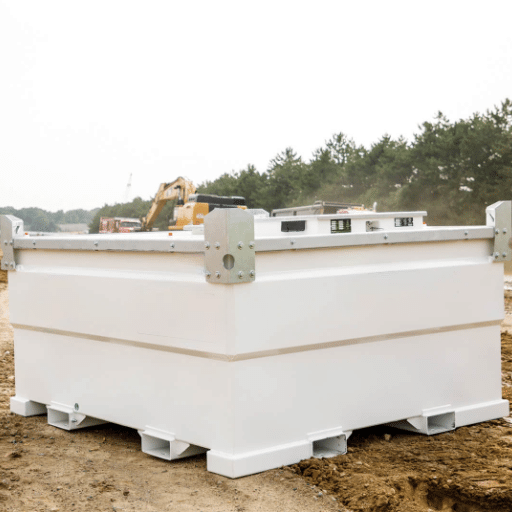
| Mining and construction | Horizontal on skid | Relocatable, and skids use horizontal tanks almost exclusively |
| Generator or backup power | Horizontal, small | Day tank duty, low volume, indoor or skid mounted |
| Aviation and jet fuel | Horizontal, or small vertical | Volume dependent, often horizontal for transportability |
| Marine bunkering | Horizontal | Vessel geometry suits a low profile |
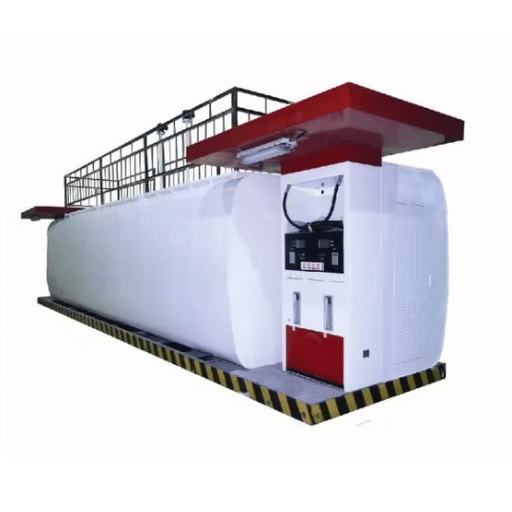
| Container or remote station | Horizontal | Must fit inside a container or skid envelope |
| High volume terminal or refinery | Vertical | Footprint economy and per-gallon cost at large atmospheric scale |
| Industrial process liquid | Either | Driven by pressure class and mixing requirements |
| LPG, ammonia, or CNG | Horizontal, ASME Section VIII | Pressure vessel geometry required |
The plain language version is this.
Choose horizontal when the volume fits a truck, the fuel requires pressure or burial, containment must be integral, or the unit has to move. That covers most fuel storage projects.
Choose vertical when the volume is large, the fuel is atmospheric, plot area is genuinely the binding constraint, and the tank will never move. That covers terminals and large industrial sites.
If both descriptions partly apply, you are in the range where the containment question decides it, and that is worth an engineering conversation rather than a coin flip.
Frequently Asked Questions
Which is better, a vertical or horizontal storage tank?
Neither is universally better. Vertical tanks are more space-efficient and cheaper per unit volume at large atmospheric capacities. Horizontal tanks handle pressure, transport more easily, and suit underground and skid-mounted builds. The right choice depends on capacity, fuel properties, site constraints, and containment strategy.
How much space does a vertical tank save compared with horizontal?
Manufacturers commonly cite a base area of roughly 25% of an equivalent horizontal tank, with the shorthand that four vertical tanks fit the ground space of one horizontal. Treat these as directional. The advantage shrinks or disappears once you add a containment dike, which can consume an area comparable to the tank’s own base.
Do vertical tanks need a different foundation than horizontal tanks?
Yes, and the difference is structural. A vertical tank bears on a ring wall or full raft foundation, because its flat bottom distributes load directly. A horizontal tank needs engineered saddles or skids on a concrete pad or piers, with anchors sized for wind uplift and seismic forces, because its load concentrates at two support points.
Are horizontal tanks cheaper than vertical tanks?
Not as a blanket statement. Horizontal tanks are usually cheaper at small and medium capacities because they are shop-fabricated and need minimal site work. At large capacities, where a horizontal tank may require field erection, vertical geometry often becomes cheaper per gallon. Foundation and containment costs then decide the rest.
Can a horizontal tank be installed underground?
Yes, and this is standard practice. Underground storage tanks use horizontal cylindrical geometry under UL 58 for steel and UL 1316 for fiberglass. Note the reverse is not true: an underground tank is not listed for aboveground service, because it is not rated for fire exposure venting or point loading on supports.
What is the maximum capacity of a horizontal fuel tank?
There is no hard-coded maximum, but transport creates a practical one. API 650 Annex J caps shop-fabricated diameter at 6 m (20 ft), and practical truck diameter is roughly 12 to 13 ft. Beyond that, tanks require special permits, barge transport, or field erection, at which point vertical geometry is often the more economical choice.
Why do gas stations use horizontal tanks?
Three reasons, and they reinforce each other. Retail station tanks are buried, and burial requires horizontal cylindrical geometry. Horizontal tanks fit the forecourt footprint and the dispenser piping layout. And horizontal geometry can be shop-fabricated and delivered, which keeps installation fast on a site that cannot afford a long construction window.
Is a vertical or horizontal tank better for diesel storage?
It depends on volume and climate. Diesel is atmospheric, so either geometry works in terms of pressure. For small and medium volumes, horizontal is usually better because of transportability and integral containment options. For large volumes, vertical wins on footprint and cost. In very cold climates, a buried horizontal tank benefits from stable ground temperature.
What is the difference between a self-bunded and a double-walled tank?
Every self-bunded tank is double-walled, but not every double-walled tank is self-bunded. A double-walled tank has two shells. A self-bunded tank has an outer shell that is rated and documented to hold the full contents of the primary tank. The rating and its documentation are the part that matters for compliance.
What is a saddle support on a horizontal tank?
A saddle is the structural support that carries a horizontal tank’s weight and holds it at the correct elevation. Standard practice is a two-saddle design built to UL 142 for the tank’s diameter, providing 6 in. of clearance and available up to 12 in. high. Above 12 in., saddles must be protected with two-hour fire-rated material.
Choosing Your Configuration with Confidence
Vertical vs. horizontal storage tanks comes down to geometry interacting with five practical forces, and the sequence matters more than the preference.
The key takeaways:
- Orientation is a geometry decision, not a quality ranking. Neither shape is safer or better in the abstract. Volume, pressure, and site drive the answer.
- Horizontal dominates fuel duty because it is shop-fabricable, truckable, and buryable, and because most fuel is atmospheric.
- Vertical wins at large atmospheric scale, until containment footprint erodes the space advantage that justified it.
- Containment can overturn the footprint math. A self-bunded horizontal tank often beats a vertical tank plus a dike on a tight site.
- Size the tank before you choose the shape. Getting the sequence backwards produces the right geometry at the wrong capacity.
The most common failure we see is not choosing the wrong orientation. It is choosing an orientation and then making the containment decision separately, weeks later, without checking whether the two decisions still agree.
If you would like that checked before you commit, that is exactly what we do. We manufacture both configurations across aboveground, buried, skid-mounted, and container builds, and we will recommend the one your project actually needs.
Request a tank configuration review, and our engineering team will model your capacity, site constraints, and containment requirements against both orientations.