A 40ft skid station typically holds 60,000 to 68,000 liters nominal, and you can cycle about 73% of that between deliveries. A 60,000-liter unit leaves roughly 43,800 liters of working stock. A 68,000-liter high-cube leaves about 49,640.
That gap is where capacity arguments start. A buyer reads 60,000 liters, plans a refill every six weeks, and learns in month two that the tanker comes every four.
The full 40ft specification and deployment guide covers configuration, ground loading, and permits. This article goes one layer down: from nameplate to the liters you can draw, then to delivery days and tanker trips.
Still choosing a frame size? Start with the capacity selection method and come back with a number.
Key Takeaways
- A 40ft frame holds 67.7 m³ internal volume in standard height and 76.4 m³ as a high-cube. A 60,000 liter tank uses 88.6% of the standard box.
- Four deductions separate nameplate from drawable fuel: a 95% fill limit, about 2% dead bottom, a 20% operating reserve, and compartment dead volume. That leaves about 73% cyclable.
- A 60,000 liter tank cannot share a standard frame with a service aisle. A 500 mm gap pushes the height needed past the frame’s 2.393 m.
- A 60,000 liter station on a 20,000 liter tanker needs 2.2 drops per refill cycle. Logistics scale with cyclable stock, not nameplate.
- Any capacity claim should come with a bund volume and the liters cyclable between deliveries.
The short answer: 40ft skid station capacity in three numbers
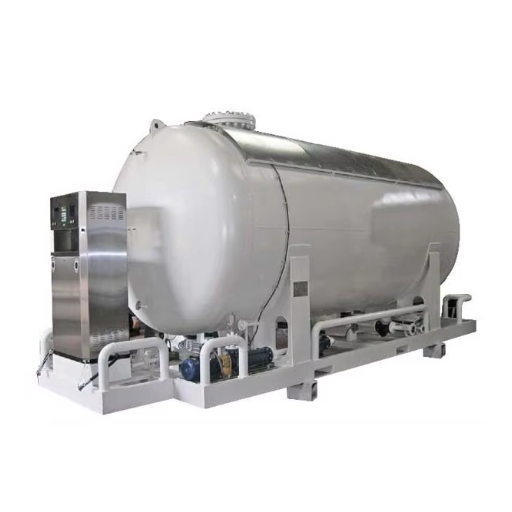
Every 40ft skid station capacity figure is one of three measurements using the same word. Separate them, and most of the argument disappears.
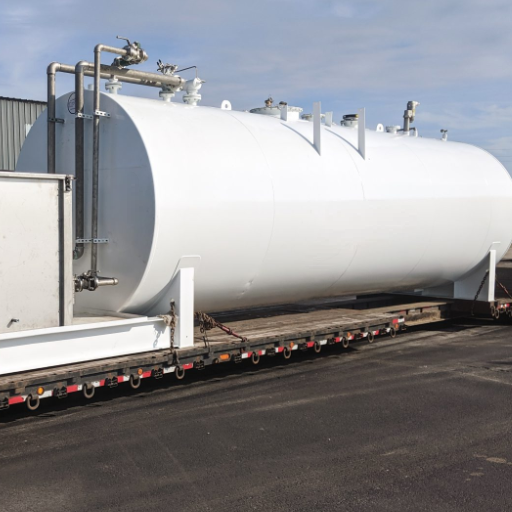
Nominal capacity is the geometric volume of the tank shell. When a page says 60,000 liters, this is almost always what it means. It is a manufacturing dimension, not a fuel quantity.
Usable capacity is what the tank accepts at its 95% fill limit. The top of a tank is not for fuel. It is tank ullage, the headspace that lets liquid expand with temperature and lets vapor reach the vent.
Cyclable capacity, which the pillar calls deployable capacity, is what you can draw between deliveries: usable capacity minus the dead bottom below the suction and the reserve kept for a late tanker.
The third number is the one your operation runs on, and almost nobody publishes it. Most buyers arrive here after searching for a 40000 liter fuel station, a 40ft fuel tank capacity figure, or a 40ft container fuel capacity table.
The same figures in gallons
A 60,000-liter tank is 15,850 US gallons nominal and about 11,570 cyclable. A 68,000-liter high-cube is 17,960 nominal and about 13,110 cyclable. A 40,000-liter unit, the size many suppliers quote as a standard 40ft, is 10,570 nominal and about 7,710 cyclable.
About three-quarters of whatever you were told is the fuel you can move.
The height budget: why 60,000 liters needs the whole box
ISO 40ft external dimensions are 12.192 m long, 2.438 m wide and 2.591 m high, or 2.896 m high-cube. Internal dimensions are 12.032 × 2.352 × 2.393 m and 12.032 × 2.352 × 2.698 m, giving 67.72 m³ and 76.35 m³, with 28.30 m² of floor in either frame.
Give the tank a volume and ask what height it needs. That calculation separates a real capacity claim from a brochure figure.
| Tank volume | Height if it uses the full floor (28.30 m²) | Height with a 500 mm service gap (22.28 m²) | Fits a standard frame (2.393 m)? | Fits a high-cube (2.698 m)? |
|---|---|---|---|---|
| 40 m³ | 1.413 m | 1.795 m | Yes, 598 mm spare | Yes, 903 mm spare |
| 48 m³ | 1.696 m | 2.154 m | Yes, 239 mm spare | Yes, 544 mm spare |
| 60 m³ | 2.120 m | 2.693 m | Only with no gap | 5 mm spare |
| 68 m³ | 2.403 m | 3.052 m | No | No |
Read the 60 m³ row twice. In a standard frame, 60,000 liters needs 2.120 m of the 2.393 m available, leaving 273 mm for roof structure, the top plate, stiffeners, and the fill and vent manifold. Tight, but buildable.
Add a 500 mm gap along one side so a person can reach the fittings, and the height needed jumps to 2.693 m. That is 300 mm more than the standard frame offers and 5 mm more than a high-cube offers.
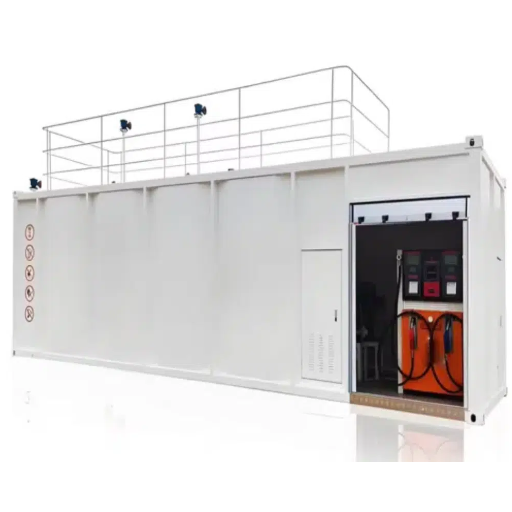
So at 60,000 liters and above, the tank is the box. The pump set, dispenser, control panel, and any standing room sit outside the tank envelope or in a short end bay. That is a legitimate design, and our 40ft container fuel station range is built that way. It is also why you ask for a general arrangement drawing rather than a photograph: a drawing shows where the tank ends and the accessible space begins.
A project engineer we will call Daniel was checking three quotes for a mining depot. Two showed a container exterior. The third showed a section through the frame: the tank stopped 1.2 m short of the rear doors, leaving room for the pump bay. He bought the third, because it was the only document that told him where he could stand.
The 40ft skid station capacity cascade: from nameplate to cyclable liters
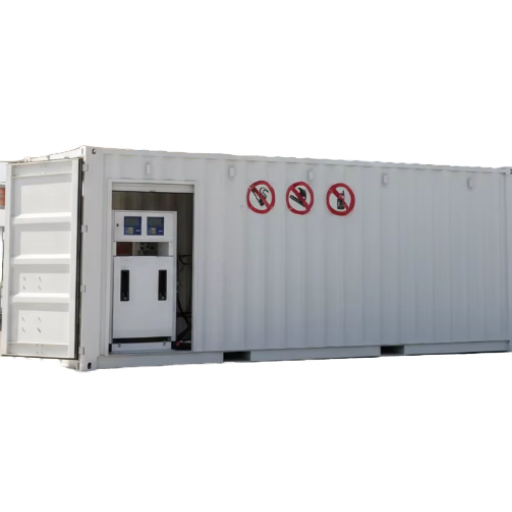
Now the arithmetic itself. Each step is an assumption you can change, and the result moves with it.
The assumptions, stated plainly:
- 95% fill limit. Overfill protection is the source of this figure. NFPA 30A, the code most US jurisdictions adopt for motor fuel dispensing, requires an alarm at 90% of capacity and either an automatic stop at 98% or a flow restriction at 95%. Our guide to NFPA 30A requirements covers the details.
- 2% dead bottom. This is the fuel below the suction that a well-designed tank cannot draw. It is what operators mean by a dead stock fuel tank: product that sits under the suction and never leaves. A poor layout loses far more, which is why suction position is a specification item.
- 20% operating reserve. You will not let a tank run to the suction. Twenty percent of nominal covers a late tanker, a demand spike, and a dipstick error.
| Step | 60,000 L standard | 68,000 L high-cube |
|---|---|---|
| Tank shell volume (nominal) | 60,000 L | 68,000 L |
| At 95% fill limit | 57,000 L | 64,600 L |
| Less dead bottom (2% of nominal) | 55,800 L | 63,240 L |
| Less operating reserve (20% of nominal) | 43,800 L | 49,640 L |
| Cyclable share of nameplate | 73% | 73% |
The 73% rule of thumb
The last row is the same for both frames, and that is no coincidence. Every deduction is a fixed percentage of nominal, so the ratio holds at any size, including a 40,000-liter unit at 29,200 liters.
Budget three-quarters of the nameplate as the fuel you can cycle. On any quote, multiply the headline number by 0.73 and check that the result still covers your delivery interval. If it does not, the quote is fine and the refill plan is wrong.
The reserve is the sensitive variable. Push it to 30% for a site with unreliable tanker access and cyclable stock falls to 63%. Cut it to 10% with a weekly delivery, and it rises to 83%.
The tank did not change. The operating policy did.
What each compartment takes off the top
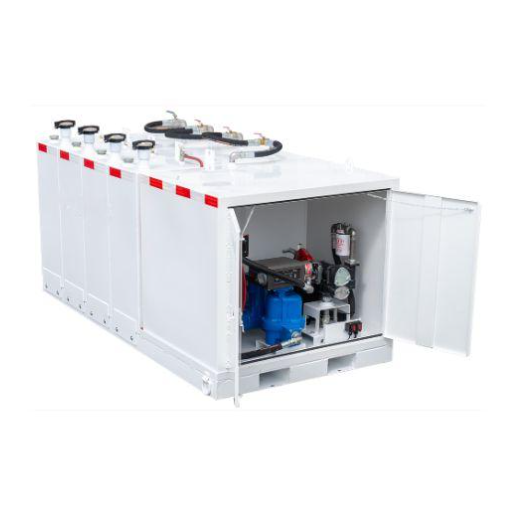
A 40ft skid station can carry one to three compartments, splitting diesel, gasoline, and AdBlue. Each bulkhead costs dead volume: the divider, its stiffener, and the unusable liquid either side of it.
The convention is 1% to 2% of nominal per added bulkhead. Take 1.5%: a two-compartment 60,000-liter tank holds about 59,100 liters of product space, and a three-compartment version holds about 58,200.
Run the cascade on those figures, and the cost in cyclable stock is about 700 liters per chamber. That is small compared to 43,800. The real cost is plumbing: each compartment needs its own fill point, vent, meter, overfill sensor, hose, and nozzle. Compare the double-wall versus single-wall tank options before you assume a compartmentalized tank is the cheaper route to a multi-product site.
What limits 40ft skid station capacity
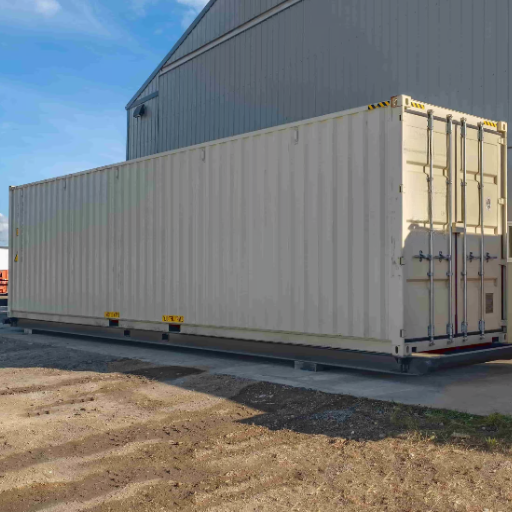
Three limits compete, and they give three different answers. Which one binds depends on the designer’s choice.
| Layout and containment choice | Capacity ceiling | Why |
|---|---|---|
| Double-wall tank with a monitored interstice, tank fills the frame, equipment in an end bay | 60,000 to 68,000 L | The tank is 85% to 89% of the envelope, so almost nothing else fits inside it |
| Tank plus a working aisle or pump room inside the frame | about 40,000 to 55,000 L | 40 m³ with a 500 mm gap leaves 903 mm of headroom; 55 m³ leaves about 170 mm |
| External bund sized at 110% of tank volume, inside the frame | about 32,000 L standard, 36,000 L high-cube | 67.72 ÷ 2.1 = 32.2 m³; 76.35 ÷ 2.1 = 36.4 m³ |
| External bund at 110% for a 60,000-liter tank | not possible in a 40ft frame | 60 × 2.1 = 126 m³ against a 76.35 m³ box |
The bund row is the one that corrects a common assumption. A 40,000-liter 40ft unit is not small or under-specced. It is close to the largest capacity that leaves room to work inside the frame. And even that unit cannot have a full external 110% bund, because the bund alone would need 84 m³, more than any 40ft frame provides.
That is why high-capacity units use a double-wall tank instead. The outer wall becomes the secondary containment, and the gap between the walls is monitored. It costs a few percent of volume rather than a further 110%.
Containment here is a regulatory question too. In the United States, a site large enough to trigger the SPCC rule under 40 CFR 112 needs a containment and inspection plan, with the tank’s bund volume as one input.
A monitored interstice detects a leak but does not hold a full release the way a bund does. Interstitial monitoring is what makes the design safe, because the gap is the detector. Both designs are legitimate. They are not the same purchase, and the datasheet should say which you are getting.
From liters to delivery days
Capacity matters through the delivery schedule it produces. With 43,800 liters cyclable, the interval falls out of your daily draw, and liters per delivery is that draw times the days in the first column.
| Daily draw | Days between deliveries (60,000 L unit) | Days between deliveries (68,000 L high-cube) |
|---|---|---|
| 1,000 L | 44 | 50 |
| 1,500 L | 29 | 33 |
| 2,000 L | 22 | 25 |
| 3,000 L | 15 | 17 |
| 5,000 L | 9 | 10 |
Compare that with the interval the nameplate suggests. At 1,500 liters a day, 60,000 liters looks like 40 days. The real figure is 29. At 2,000 liters a day, it looks like 30 days and delivers 22.
Tanker drops per cycle
There is a second consequence, and it hits site design rather than scheduling. A refill has to deliver the cyclable volume, and tanker compartments are smaller than the tank.
| Tanker compartment size | Drops to deliver 43,800 L |
|---|---|
| 20,000 L | 2.2 |
| 25,000 L | 1.8 |
| 30,000 L | 1.5 |
| 36,000 L | 1.2 |
A 60,000 liter station fed by a 20,000 liter tanker needs more than two drops per cycle. That changes three things a site plan has to absorb: vehicle movements, hose reach from the standing position to each fill point, and the delivery window. A 400 liter per minute pump set on a 20,000 liter drop takes about 50 minutes of transfer time on its own.
A depot manager we will call Ruth planned a single weekly tanker visit for a new 40ft unit serving 2,000 liters a day. The unit held enough for 22 days, so the schedule worked. The access did not: the tanker reversed 60 m to the fill points and blocked the only exit for 20 minutes per visit.
Her fix was not a bigger tank. It was a second fill point on the near side of the frame, which costs a fraction of a tank and removes the reverse. The tank is rarely the constraint once you know the cyclable number.
If the arithmetic points at a unit that cannot reach your site on the roads you have, the shipping and logistics guide covers road weight limits, crane selection, and oversize routing.
The weight that arrives with the liters
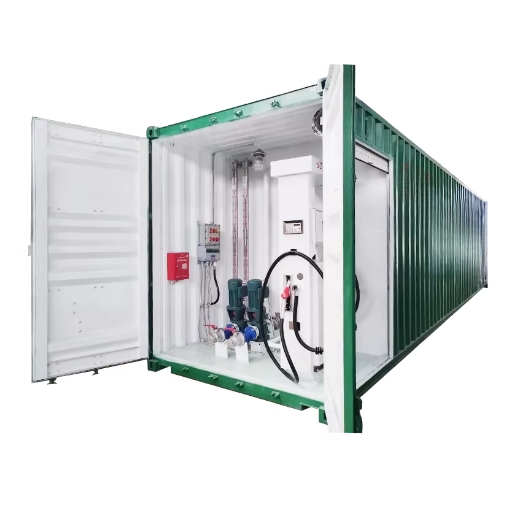
Capacity has a mass attached, and the mass is what the ground and the road carry.
Diesel runs about 0.835 kg per liter, within 0.820 to 0.845 depending on grade and temperature. At 95% fill, a 60,000-liter tank holds 47.6 tonnes of product. Add tank, frame, pumps, and panel, and the unit reaches the gross mass on our product page: about 65 tonnes standard, about 72 tonnes high-cube.
Ports, hauliers and crane operators read the plate, not the standard. On most 40ft containers in service, that plate reads 30,480 kg maximum gross mass. ISO 668 Amendment 2, published in 2016, raised the permitted maximum to 36,000 kg for standard containers other than 10ft units.
So a full 40ft skid station is not a container load. It travels empty, at about 13.4 tonnes for a 60,000-liter high-cube, and fills on site.
Spread over 28.30 m², a full unit puts 22.5 to 25.0 kN/m² on the ground on average, and far more under each skid beam. Road movement of even the empty unit is governed by federal truck size and weight limits. Foundation design for the full load belongs to the specification guide.
Five questions that test any 40ft skid station capacity claim
You do not have to do the arithmetic yourself. Make the supplier do it with these five questions; the answers are either checkable or conspicuously absent.
- What is the bund volume in cubic meters, and where is it? An external 110% bund and a monitored double wall are different products with different capacities.
- What is the measured tare weight, and what is the maximum gross mass on the plate? An unstated tare is a transport problem waiting to happen. A gross mass above the plate means the unit cannot travel loaded, which is normal, but it should be stated.
- What is the internal height, and where does the pump bay sit? If a 60,000-liter tank fills a standard frame, something has to be outside the tank.
- How many liters are cyclable between deliveries at 95% fill? A supplier who has not thought about it will answer with the nameplate.
- Where are the fill points, and what tanker size do they suit? A unit that needs three 20,000-liter drops per cycle needs the access and the time for them.
A distributor we will call Paul asked these five questions of four suppliers for a quarry. Three restated the nameplate. The fourth sent a section drawing, a bund volume, a tare weight, and a fill-point layout.
The fourth quote was not the cheapest. It was the only one he could check.
FAQ
How much fuel does a 40ft skid station hold?
A 40ft skid station typically holds 60,000 to 68,000 liters nominal. About 57,000 to 64,600 liters is usable at a 95% fill limit, and 43,800 to 49,640 liters is cyclable once dead bottom, and a 20% reserve comes off. Your refill schedule depends on the last figure.
Is 40,000 liters a small 40ft tank?
No. A 40,000-liter tank occupies 52% to 59% of the envelope, which leaves room for a service aisle and a pump room inside the frame. It is the practical ceiling for a unit you can walk into. Above about 55,000 liters, the tank uses nearly the whole high-cube envelope, and the equipment moves outside it.
Why do suppliers quote 45,000, 60,000 and 68,000 liters for the same frame?
Because they measure different things. A 45,000-liter figure often describes usable capacity in a frame with an internal aisle. A 60,000-liter figure describes a standard-height tank filling most of the box.
A 68,000-liter figure needs a high-cube, and even then the tank is 89% of the internal volume. Ask for the internal height and the bund volume to tell them apart.
How many liters can I draw before a refill?
About 73% of the nominal figure if you keep a 20% operating reserve: 43,800 liters on a 60,000 liter unit, 49,640 on a 68,000 liter high-cube. A 10% reserve lifts the share to 83%, but that is an operating decision, not a property of the tank.
Does a bigger tank always mean fewer deliveries?
Only if the cyclable volume rises faster than your consumption. A 68,000 liter unit holds 13% more cyclable fuel than a 60,000 liter one, which buys about four extra days at 1,500 liters a day. It also needs a high-cube frame, a heavier lift and, in many jurisdictions, a larger containment volume and fire separation. Check the delivery interval and the access before you check the nameplate.
Next step
The number that settles a 40ft skid station capacity question is not the one in the headline. It is the cyclable figure, and you can now apply its four deductions to any quote in about a minute.
Multiply the nameplate by 0.73. Compare the result with what your site burns between deliveries. Then ask the five questions and see which supplier answers them.
The 40ft containerized fuel station range lists the configurations we build, and the full 40ft specification and deployment guide covers the rest of the deployment. Send your daily draw and delivery access, and we will work the arithmetic for your site rather than quote a nameplate.