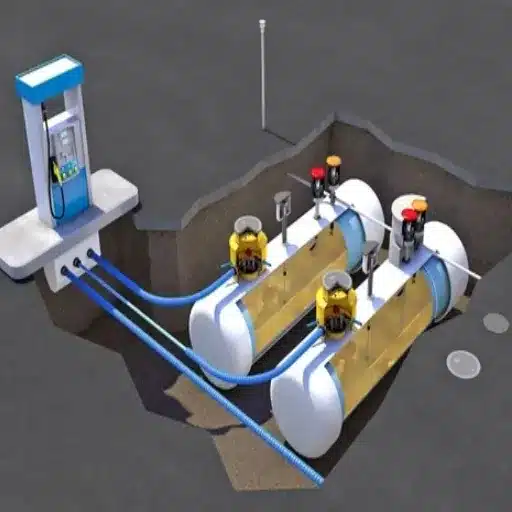
Ahmed had run his fuel station in Dubai for eleven years when the inspector delivered news that turned his stomach. Soil samples around his oldest underground storage tank showed elevated hydrocarbon levels. The steel shell, protected only by a basic coating that had long since degraded, was bleeding tiny amounts of fuel into the surrounding earth. The remediation quote exceeded $180,000. “If only the cathodic protection system had been tested annually,” the corrosion engineer told him, “this could have been prevented for less than the cost of a new sedan.”
If you own, operate, or engineer gas station infrastructure, Ahmed’s story is not a remote cautionary tale. It is the most common failure mode for steel underground storage tanks worldwide. Cathodic protection is not an optional accessory. In most jurisdictions, it is a legal requirement, and from a financial standpoint, it is one of the highest-return maintenance investments you can make.
In this guide, we will explain exactly how cathodic protection works, the two system types used in fuel storage applications, what regulatory testing you must perform, realistic cost figures, and how to decide between protected steel and fiberglass alternatives. You will finish this article knowing how to protect your investment, stay compliant, and avoid Ahmed’s nightmare.
Leakage is a very important safety incident for gas stations, and if you want to learn how to prevent it, please check out our article on Gas Station Leak Prevention.
What Is Cathodic Protection and Why Does Every Gas Station Need It?

Cathodic protection is an electrochemical technique that prevents steel from corroding by converting the metal surface into the cathode of an electrochemical cell. In plain language, it forces the steel tank to absorb electrons rather than release them. When steel loses electrons, it oxidizes, which is the chemical definition of rust. Cathodic protection stops that electron loss.
Underground storage tanks face relentless corrosion pressure. Soil contains moisture, dissolved salts, oxygen, and varying pH levels. These elements create natural batteries between different areas of the tank surface. The result is pitting corrosion that can penetrate a steel wall in as little as five to fifteen years if left unprotected, depending on soil aggressiveness.
The stakes extend far beyond equipment replacement. A leaking UST contaminates soil and groundwater, triggers regulatory enforcement, invites civil liability, and can force temporary or permanent station closure. According to the U.S. Environmental Protection Agency, corrosion is one of the leading causes of releases from steel USTs.
At Shandong Shengrui Intelligent Equipment Co., Ltd., we engineer underground storage tanks and fuel station infrastructure with corrosion resistance as a core design priority. Whether you operate a single retail site or a multi-station fleet, understanding cathodic protection helps you make smarter long-term capital decisions.
If you want to use a Double Wall Tank to prevent leakage, please refer to our article on Double Wall Tank Leak Prevention.
The Two Types of Cathodic Protection Systems for Fuel Storage
Every cathodic protection system falls into one of two categories: sacrificial anode (galvanic) systems or impressed current cathodic protection (ICCP) systems. The right choice depends on tank size, soil resistivity, site layout, and budget.
Sacrificial Anode Systems
A sacrificial anode system uses a more reactive metal, typically magnesium, zinc, or aluminum, connected directly to the steel tank. Because the anode metal is higher on the galvanic series, it corrodes preferentially. The anode “sacrifices” itself, so the tank does not.
These systems are passive. They require no external power, control panels, or complex wiring. Installation is straightforward: anodes are buried around the tank and connected with insulated copper cables. For small tanks, low-resistivity soils, and sites with limited electrical infrastructure, sacrificial anode systems offer a reliable, low-maintenance solution.
The tradeoff is limited current output. As soil resistivity increases, the driving voltage between magnesium and steel may not deliver enough protective current to cover large tank surfaces. Anodes also deplete over time and must be replaced, typically every ten to twenty years, depending on mass and consumption rate.
Impressed Current Cathodic Protection (ICCP)
An impressed current system uses an external DC power source, usually a rectifier connected to AC mains, to force current from buried anodes to the tank surface. The anodes in an ICCP system are called “inert” anodes because they do not corrode significantly. Common materials include mixed metal oxide (MMO) coated titanium and high-silicon cast iron.
ICCP systems can protect multiple tanks, large surface areas, and installations in high-resistivity soils where sacrificial anodes would fail. They are the standard for commercial fuel stations with several USTs, long pipelines, or sites where future expansion is likely.
The downside is complexity. Rectifiers require electrical power, routine inspection, and occasional repair. If the power fails and nobody notices, the tank loses protection until the fault is corrected. For this reason, ICCP systems need disciplined monitoring and a clear maintenance schedule.
Maria Rodriguez learned this distinction the hard way. She manages a four-pump station outside Mexico City where the original contractor had installed sacrificial anodes for a 50,000-liter tank in clay soil with resistivity above 10,000 ohm-centimeters. Within six years, tank potential readings showed the steel was no longer adequately protected. Switching to an ICCP system with MMO anodes solved the problem, but the retrofit cost her $12,000 more than if the correct system had been specified from day one.
Selecting the Right System
Use this framework to guide your decision:
- Single small tank, low-resistivity soil, remote site without reliable power: Sacrificial anode is usually the most cost-effective choice.
- Multiple tanks, high-resistivity soil, urban location with grid power: ICCP delivers better coverage and flexibility.
- Future expansion planned: ICCP systems scale more easily than adding new sacrificial anodes.
- Maintenance capacity limited: Sacrificial anodes demand less ongoing attention, though they still require periodic testing.
If you are unsure which system suits your site, our engineering team provides site-specific assessments that factor in soil conditions, tank geometry, and regulatory requirements.
Regulatory Requirements and Testing Protocols

Cathodic protection is not a set-it-and-forget-it system. Regulatory bodies worldwide mandate periodic testing to verify that protection levels remain within acceptable ranges.
The -850 Millivolt Criterion
The universally accepted standard for adequate cathodic protection is a structure-to-soil potential of at least -850 millivolts (-850 mV) relative to a copper-copper sulfate reference electrode. This measurement, called the “instant-off” potential, tells you whether the tank surface is polarized enough to suppress corrosion.
To obtain an accurate instant-off reading, the technician must interrupt the protective current and measure the potential within approximately one second, before the tank depolarizes. This requires specialized equipment and trained personnel. A simple “on” potential reading is not sufficient because it includes the voltage drop across the soil and must be corrected.
Alternative compliance criteria exist under standards published by NACE International and ASTM International, including:
- A minimum negative voltage shift of 300 mV when current is applied
- A polarization shift of at least 100 mV over the natural potential
- Polarization decay not exceeding 100 mV over a defined period after current interruption
Your local regulator may accept any of these criteria if properly documented. Confirm which standard your jurisdiction recognizes before commissioning testing.
Testing Frequency
Most regulatory frameworks require cathodic protection testing at least every three years. However, the best practice for high-value fuel storage assets is annual testing. Annual surveys catch rectifier malfunctions, anode depletion, cable damage, and coating degradation before they expose the tank to corrosion risk.
Records must be maintained for the operational life of the tank. Inadequate documentation is a common citation during regulatory inspections. A professional test report should include:
- Date, time, weather conditions, and soil moisture
- Test equipment model, serial number, and calibration date
- Tank and test station identification
- Structure-to-soil potentials at multiple locations
- Instant-off values where applicable
- Rectifier output voltage and current for ICCP systems
- Anode resistance measurements were taken
- Technician signature and certification number
Installation and Operating Costs: A Realistic Breakdown
Cost transparency helps station owners budget accurately. The following figures represent typical ranges for commercial fuel station installations in North American and Middle Eastern markets. Local labor rates and import duties will shift these numbers.
Sacrificial Anode Systems
- Materials: 800 to 2,500 per tank, depending on anode mass and quantity
- Installation labor: 1,500 to 4,000
- Initial testing and commissioning: 500 to 1,200
- Annual inspection: 300 to 600
- Anode replacement (every 10-20 years): 1,000 to 3,500
Impressed Current Systems
- Rectifier and control panel: 2,000 to 5,500
- Inert anodes and backfill: 1,500 to 4,000
- Installation labor: 3,000 to 7,000
- Initial testing and commissioning: 800 to 1,500
- Annual inspection and rectifier maintenance: 500 to 1,000
- Major component replacement (rectifier, 15-25 years): 2,500 to 6,000
For a typical two-tank retail station, the total first-cost difference between sacrificial anode and ICCP is often 3,000 to 8,000. Over a thirty-year tank life, however, the cumulative operating cost gap narrows because sacrificial anodes require replacement while ICCP anodes do not.
James Patterson operates three stations in the American Midwest. When he built his second location in 2019, he opted for an ICCP system despite the higher upfront quote. “The first site had sacrificial anodes,” he explained. “By year fourteen, I was replacing them, and the labor to excavate around the tank added four grand I had not budgeted. The ICCP rectifier at the new site just sits there humming. I check the voltage quarterly and sleep fine.”
Common Cathodic Protection Failures and How to Prevent Them

Even well-designed systems fail when neglected. Understanding failure modes helps you build a preventive maintenance program.
Rectifier Malfunction
ICCP rectifiers can fail due to lightning strikes, power surges, component aging, or moisture ingress into the enclosure. A failed rectifier means zero protective current. Install surge protection, inspect enclosures for seal integrity, and check output voltage and current monthly.
Anode Depletion or Consumption
Sacrificial anodes eventually exhaust their active mass. If your three-year test shows tank potentials drifting toward the non-protected range, anode replacement is likely needed. Do not wait for complete depletion. Schedule replacement when remaining life drops below twenty percent.
Cable and Connection Corrosion
The cabling that connects anodes to the tank is a frequent failure point. Insulation damage from installation trauma, rodent activity, or soil chemicals exposes copper to corrosion. Open-circuit conditions eliminate protection entirely. Use high-quality direct burial cable with proper mechanical protection and test circuit continuity during annual surveys.
Coating Degradation
Cathodic protection and protective coatings work together. A high-quality coating reduces the total current demand on the CP system. As coatings age and holidays develop, current demand rises. If your ICCP rectifier output has crept upward over the years without any adjustment to the system, coating deterioration may be the cause. Plan for coating assessment and possible recoating during major tank rehabilitation.
Interference from Foreign Structures
Nearby pipelines, other USTs, or DC transit systems can introduce stray currents that distort your potential readings or accelerate corrosion in unintended locations. If you observe erratic potentials or localized corrosion, a qualified corrosion engineer should conduct a stray current interference study.
Cathodic Protection or Fiberglass? Choosing the Right Tank Material
A question we hear frequently from station owners and project integrators is whether to specify steel tanks with cathodic protection or fiberglass-reinforced plastic (FRP) tanks that do not require CP at all.
Steel tanks with cathodic protection remain the dominant choice globally for several reasons. Steel handles higher structural loads, tolerates wider temperature ranges, and is easier to modify in the field if future piping changes are needed. The initial material cost is also lower. When combined with a well-maintained cathodic protection system, a steel UST can deliver a service life exceeding forty years.
Fiberglass tanks eliminate the corrosion risk because the material is electrically non-conductive and chemically resistant to petroleum products. They require no cathodic protection, no potential testing, and no anode replacement cycles. For sites with highly corrosive soils, aggressive groundwater, or where long-term maintenance capacity is limited, fiberglass can offer a lower total cost of ownership despite the higher purchase price.
The decision matrix usually comes down to three variables:
- Site soil conditions: Highly aggressive soils favor fiberglass or ICCP-protected steel.
- Maintenance discipline: If your operation struggles with scheduled inspections and record-keeping, fiberglass removes an entire compliance category.
- Capital constraints: Steel plus sacrificial anode offers the lowest first cost. Fiberglass offers the lowest lifecycle cost in corrosive environments.
At Shandong Shengrui Intelligent Equipment Co., Ltd., we manufacture and supply both steel and fiberglass-reinforced underground storage tanks. Our engineering team helps clients model the total cost of ownership based on site-specific data rather than generic assumptions. Contact us for a tailored tank specification that matches your soil, fuel type, and operational requirements.
2026 Compliance Updates Every Owner Should Know

Regulatory standards for underground storage tanks continue to tighten. Two developments in 2026 deserve your attention.
California’s updated UST regulations now require third-party certification for all cathodic protection testers, with specific training on instant-off measurement techniques. If you operate in California, verify that your testing contractor holds a current certification under the new program. Test reports prepared by uncertified individuals may be rejected during compliance audits.
Indiana Senate Bill 277, enacted in early 2026, mandates electronic submission of all cathodic protection test results to the state environmental agency within thirty days of testing. Paper-only recordkeeping is no longer acceptable. Other U.S. states are evaluating similar digital reporting requirements, so even if you operate elsewhere, migrating to electronic documentation is prudent preparation.
Internationally, the Gulf Cooperation Council has adopted harmonized UST standards that align cathodic protection testing intervals with EPA guidance, replacing the previously inconsistent national schedules in member states. If you operate in the UAE, Saudi Arabia, Qatar, or neighboring markets, confirm that your testing schedule meets the new three-year maximum interval.
Staying ahead of these changes protects you from fines and demonstrates environmental stewardship to your community and regulators.
Frequently Asked Questions About Cathodic Protection
How do I know if my existing tank has cathodic protection?
Check your original installation documentation or contact the tank manufacturer with the serial number. A visual site inspection can also identify CP components: rectifier boxes on walls or fences, buried anode beds, or test stations protruding from the ground near the tank.
Can I add cathodic protection to an older tank?
Yes. Retrofit installations are common and effective. A corrosion engineer will assess coating condition, soil resistivity, and tank accessibility to design an appropriate system. Retrofit costs are typically ten to twenty percent higher than new-construction installation because of limited working space.
What happens if I fail a cathodic protection test?
A failed test means your tank is not adequately protected and corrosion may be occurring. You must correct the deficiency within a timeframe specified by your regulator, usually sixty to ninety days. Corrections may include anode replacement, rectifier repair, cable replacement, or tank recoating. Document all repairs and schedule a follow-up test.
Does cathodic protection protect the tank interior?
No. Cathodic protection only protects the external surface of the tank in contact with soil. Internal corrosion from water accumulation, microbial growth, or incompatible fuel chemistry requires separate management, including fuel filtration, water bottom removal, and interior coating systems where applicable.
How does ethanol-blended fuel affect tank corrosion?
Ethanol is hygroscopic, meaning it attracts water. Water separation in UST bottoms creates an environment where microbiologically influenced corrosion (MIC) can accelerate both internal and external degradation. Tanks storing E10 or higher ethanol blends should receive more frequent internal inspections and meticulous water removal protocols.
Conclusion
Cathodic protection is the invisible shield standing between your steel underground storage tanks and the corrosive forces that destroy them. Whether you choose a sacrificial anode system for its simplicity or an impressed current system for its power and flexibility, the principle remains the same: controlled electrochemistry prevents uncontrolled rust.
The financial and environmental stakes are too high to treat cathodic protection as an afterthought. Schedule your next test. Verify your potentials meet the -850 mV standard. Maintain meticulous records. And if you are specifying new tanks or evaluating a retrofit, choose a solution matched to your site conditions and maintenance capacity.
At Shandong Shengrui Intelligent Equipment Co., Ltd., we engineer fuel storage and gas station infrastructure that protects your investment for decades. From certified underground storage tanks to complete turnkey fueling solutions, we help station owners worldwide build safer, compliant, and more durable facilities.
Ready to protect your tanks and stay ahead of regulators? Request a custom quote from our engineering team and get site-specific cathodic protection guidance tailored to your project.