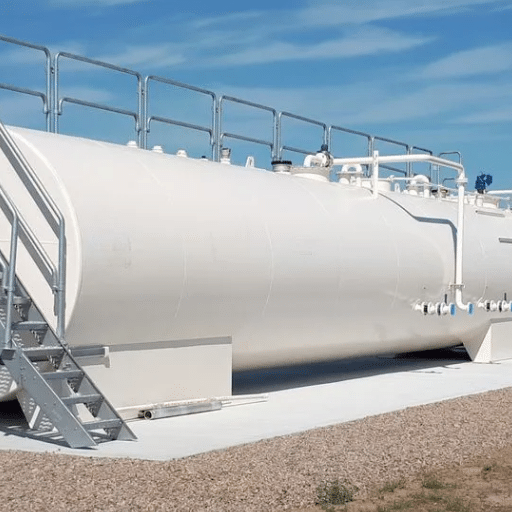
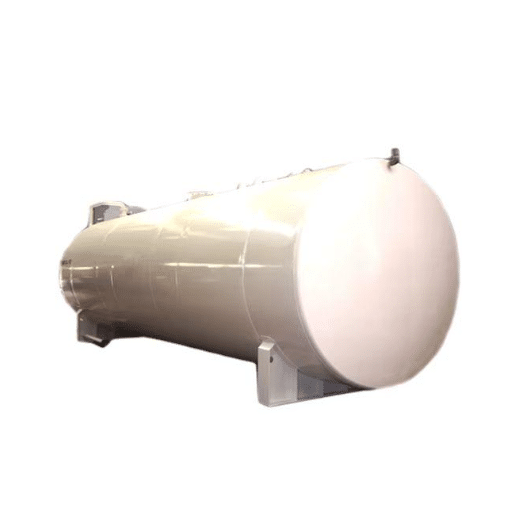
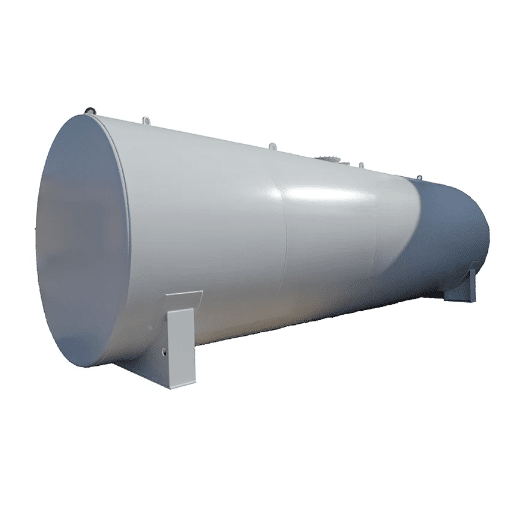
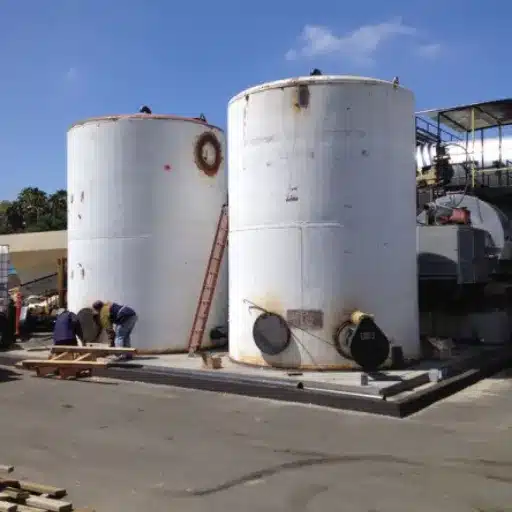
Three weeks before a regional airport was due to receive its first Jet A-1 delivery, the new fuel farm failed commissioning. The sample pulled from the tank bottom was cloudy instead of “clear and bright,” and the white-bucket check showed rust-colored specks. The culprit was an unlined carbon steel tank whose interior had scaled during a humid build season. The owner drained the tank, requalified the lining, and started asking what a stainless steel jet fuel storage tank would have cost from the start.
Jet fuel is the most contamination-sensitive product most facilities will ever store. A few parts per million of free water, a trace of rust, or a colony of microbial growth can ground aircraft, trigger filter bypass warnings, and fail the strict visual checks that govern aviation fuel quality. Yet the aviation fuel storage tank that holds it is often chosen on capital cost alone.
This guide explains how to specify, procure, and verify a stainless steel jet fuel storage tank for airport or depot service. It builds on our complete stainless steel fuel tank buyers’ guide, covering the buying decision across fuel types. You’ll learn which standards actually apply, how stainless compares with coated carbon steel, what design features protect fuel quality, and exactly what to demand from a manufacturer.
In this guide, you will learn:
- Why jet fuel chemistry drives tank material selection
- Stainless steel vs epoxy-lined carbon steel: the honest trade-off
- The standards map: EI 1540, EI 1541, JIG, and API 650
- Design features that prevent water and microbial contamination
- A 10-step procurement inspection checklist for manufacturers
Need help matching a standard to your project? Our engineering team reviews site conditions and target market certifications every week. Request a specification review and get a tank recommendation tailored to your fuel, environment, and compliance needs.
Why Jet Fuel Storage Tanks Demand Stainless Steel

Aviation turbine fuels, Jet A-1, Jet A, Jet B, and military JP-8, must meet strict purity requirements at every point of the supply chain. The governing checks are deceptively simple. Fuel must appear “clear and bright” under ASTM D4176 inspection: free of haze, suspended water, and visible particulate. In practice, that means the storage tank cannot introduce rust, scale, metal ions, or microbial growth into the product.
Stainless steel answers this requirement structurally rather than through a coating. Its chromium oxide surface is inert, so it does not leach metal ions or surfactants into fuel. It does not rust and scale, so it cannot shed particulates into a passing fuel stream. And its smooth, non-porous finish gives bacteria and fungi far fewer footholds than a blasted steel surface waiting for a liner.
That last point matters more than most buyers realize. EI 1541, the Energy Institute’s standard for internal protective coatings in aviation fuel systems, explicitly notes that stainless steel or aluminum may preclude the need for an internal coating altogether. A bare carbon steel tank, by contrast, requires an aviation-grade epoxy lining that must be applied, cured, and recoated on a strict schedule, and any lining failure puts rust directly into the fuel.
To be fair, coated carbon steel remains the industry default for very large bulk storage. Stainless earns its place when fuel purity, corrosive environments, and long-horizon operating costs matter most: precisely the demands of an airport fuel storage tank. Our carbon steel vs stainless steel tank comparison walks through the full decision.
Stainless Steel vs Coated Carbon Steel for Jet Fuel Storage
For most jet fuel service, the practical choice comes down to two options: a stainless steel tank with no internal coating, or a carbon steel tank protected by an EI 1541-qualified epoxy lining. The table below captures the difference.
| Factor | Stainless steel (304/316L) | Epoxy-lined carbon steel |
|---|---|---|
| Upfront cost | 2–4× more than carbon steel | Baseline |
| Internal coating | Not required (per EI 1541) | Required; recoated every 3–5 years |
| Typical design life | 20–30+ years | 10–15 years (to ~20 with maintenance) |
| Annual maintenance | ~0.8% of equipment value | 2–5% of equipment value |
| Fuel cleanliness risk | Smooth, non-reactive surface | Lining failure sheds rust scale |
| Best fit | Coastal/humid, high-purity, long-horizon | Large bulk storage, dry inland, budget-driven |
The lifecycle math explains why stainless is rarely the “expensive” option in the end. A 316L tank costs two to four times more upfront, but it avoids repeated recoating downtime, lining repairs, and the contamination events that force fuel rejection. Over a 20-year horizon, stainless frequently lands at or below the total cost of ownership of a lined carbon steel tank, especially in humid or salt-air environments.
One engineering caveat deserves attention: per API 650, carbon steel (such as A516 Grade 70) carries higher allowable design stresses than stainless, roughly 25,300 PSI versus 21,000 PSI for 316L. At very large capacities, a stainless tank may need thicker shell plates than a carbon steel tank of the same size. That narrows the cost gap at airport-fuel-farm scale and is one reason very large tanks are usually lined carbon steel.
Stainless Steel Jet Fuel Storage Tank Standards: EI 1540, EI 1541, JIG & API 650

Aviation fuel storage is governed by a distinct layer of standards that most industrial tank buyers never encounter. Understanding which one applies at each stage is the fastest way to avoid a costly rework.
| Standard | Scope | Why it matters |
|---|---|---|
| EI 1540 | Design, construction, commissioning of aviation fueling facilities | Master guide for fuel farms; supersedes API 1500 |
| EI 1541 | Internal protective coating systems | Stainless may eliminate the coating requirement |
| EI/JIG 1530 | QA for manufacture, storage, distribution of aviation fuel | Supply-chain quality control |
| JIG 1/2/4 | Fuel quality control and operating standards | Airport depot operations |
| API 650 (App. S) | Welded steel tanks; austenitic stainless appendix | Tank construction code |
| NFPA 30 / 407 | Flammable liquids; aircraft fuel servicing | Fire safety, grounding, spill control |
| UL 142 | Shop-fabricated aboveground tanks | Small and mid-size tank compliance |
| ICAO Doc 9977 | Manual on Civil Aviation Jet Fuel Supply | Global reference for civil aviation |
EI 1540: The Aviation Fueling Facilities Standard
EI 1540 is the primary standard for new and refurbished aviation fueling facilities. It covers fuel classification, depot location and separation distances, tank type and fitting selection, and commissioning. Jet A-1 has a minimum flash point of 38°C, which places it in a specific classification that drives both spacing and venting requirements. EI 1540 superseded API 1500 and is now published by the Energy Institute.
EI 1541: Internal Coatings, and Why Stainless May Not Need One
EI 1541 sets performance requirements for the internal protective coating systems used in aviation fuel handling. Two points matter here.
First, coatings that can trap water are prohibited, because trapped moisture feeds microbial growth. Second, the standard explicitly recognizes that stainless steel or aluminum may eliminate the need for an internal coating. For a stainless steel jet fuel storage tank, this is the section of the code that validates the design.
API 650 Appendix S & Related Codes
For welded field-erected tanks, construction follows API 650, with Appendix S covering austenitic stainless steel. Supporting codes include API 2000 for venting, API 575 for inspection, NFPA 30 for flammable-liquid storage, and NFPA 407 for aircraft fuel servicing. Shop-fabricated tanks are typically certified to UL 142 or regional equivalents such as ULC-S601-14, AS 1940, or AS 1692, the same code path that governs stainless steel diesel storage tanks. For the broader storage picture, our guide to fuel storage tank solutions connects these standards to gas stations, depots, and industrial sites.
Stainless Steel Grades for Jet Fuel Storage
Jet fuel service calls for a specific subset of austenitic grades. In practice, the choice is between 304/304L and 316/316L.
- 304L is a sound choice for mild inland duty where chloride exposure is limited, and the tank is protected from the elements.
- 316L adds molybdenum, which improves resistance to chloride pitting and crevice corrosion. It is the safest default for jet fuel storage, particularly in coastal, humid, or tropical environments, the same conditions where aviation fuel farms tend to be located.
The “L” designation means low carbon. That matters at the welds: lower carbon content reduces carbide precipitation during welding, which preserves corrosion resistance in the heat-affected zone. For aviation service, specify 316L for wetted surfaces, insist on back-purged welds, and confirm the manufacturer’s passivation procedure. A full grade-by-grade comparison lives in our 304 vs 316 stainless steel fuel tank guide, and the same salt-air logic holds for the marine stainless steel fuel tank guide.
Designing a Stainless Steel Jet Fuel Storage Tank

Material is only half the equation. A jet fuel tank is a contamination-control machine, and its design features exist to keep water out and settled water away from the draw-off point.
- Floating suction: Draws fuel from the cleanest layer just below the surface, away from water and sediment that settle at the bottom. Single- and double-arm units, such as the PROTEGO SA/S, are standard for aviation service.
- Sloped floor and low-point sump: A floor falling roughly 1:50 to a central sump collects water and sediment in one place for daily draw-off.
- Desiccant breathers: Strip moisture from air drawn into the tank as fuel is dispensed, reducing condensation and the microbial growth it feeds.
- Internal floating roof: Sits directly on the fuel surface, eliminating the vapor space where humid air condenses. It also reduces evaporative loss and emissions.
- Double-wall or self-bunded construction: A 304/316L inner tank with a secondary outer wall provides integral secondary containment and interstitial leak monitoring, a common configuration for shop-fabricated tanks.
- Venting and overfill protection: Free vents for Jet A-1, pressure/vacuum vents for avgas, and SIL-rated independent high-level alarms with redundant grounding and bonding lugs.
- Prohibited materials: Galvanized steel, copper, and cadmium must never contact jet fuel. Zinc reacts with fuel to form gels that clog filters and can stop an aircraft engine. All fuel-contact piping, valves, and fittings should be stainless steel.
A field failure illustrates why piping detail matters. A fuel supplier traced microbiologically influenced corrosion back to stainless pipe fittings of mismatched wall thickness. The internal “steps” where a thin Schedule 5S pipe met a Schedule 10S fitting created pockets where water pooled, and pooled water is exactly what microbial contamination needs.
If stainless is specified, match every schedule or grind the internal steps flush. This is also the kind of fabrication detail that a dedicated stainless steel fuel tank line, kept free of carbon steel tools, gets right.
For a detailed cost breakdown, see our stainless steel fuel tank cost and pricing guide.
Surface Finish, Passivation & Fuel Cleanliness
The surface that touches jet fuel is a specification in its own right. For aviation service, stainless tanks are typically polished to Ra 0.8 µm or better. A smooth finish gives particulate matter nowhere to lodge, makes cleaning cycles far more effective, and leaves fewer surface features where biofilm can establish.
Every stainless tank also needs passivation after fabrication. Passivation removes free iron from the surface and restores the protective chromium oxide layer. It is carried out to ASTM A967 or ASTM A380, typically followed by a demineralized water flush and filtered-air drying. Weld discoloration must be removed before passivation. A welded joint that skips this step can shed contaminants into fuel for years.
Here is the detail most buyers miss: demand the passivation records. In a documented case, a tank failed cleanliness testing because weld discoloration and surface contamination were present, and the supplier had no passivation documentation at all. Re-passivation resolved the issue, but only after the fuel had been rejected. Plan to re-passivate after weld repairs, after contamination events, and on a preventive 5–10 year schedule. The full procedure is covered in our stainless steel fuel tank passivation and maintenance guide.
Water, Microbial Growth & MIC Prevention
If there is a single lesson to take from aviation fuel operations, it is this: free water is the root cause of nearly every storage failure. No fuel creates water. It enters through condensation, rain, and humid air drawn in through vents. It settles at the tank bottom, and there it becomes habitat.
Microbes, the jet fuel fungus Hormoconis resinae chief among them, live at the water-fuel interface. As Boeing’s FUELSTAT guidance explains, they consume the fuel and excrete carboxylic acids that corrode metal. Their biomass forms sludge that blocks filters, sets off filter bypass warnings, and corrupts fuel quantity systems. Research reviewed in the MDPI Energies journal confirms water is the main factor required for microorganism growth in jet fuel.
The design countermeasures are the ones already listed: internal floating roofs to stop condensation, desiccant breathers to dry incoming air, sloped floors and sumps for daily water draw-off, and cleanout procedures aligned with ATA 103. Stainless steel supports all of them by removing the coating that could fail, trap water, or shield an active corrosion site. The tank, not the fuel, is what fails first, and a stainless tank with disciplined water management can store jet fuel safely for decades.
For the fabrication standards behind these checks, see our stainless steel fuel tank fabrication guide.
How to Inspect and Procure from a Stainless Steel Jet Fuel Tank Manufacturer

Sourcing from China is common for jet fuel tanks, and the skepticism is fair. The rebuttal is not a promise; it is documentation. Here is the inspection checklist a serious buyer should run, and that a serious manufacturer should welcome.
- Verify API 650 and Appendix S design records, including the design calculations and stamped drawings.
- Request full material test reports (MTRs) with heat-number traceability for every plate and fitting, confirming chromium, nickel, and molybdenum content.
- Confirm qualified welding procedures (WPS/PQR) to ASME Section IX or ISO 3834, plus certified welder records.
- Require non-destructive testing: 100% radiographic testing on critical and T-joint welds, ultrasonic testing, liquid penetrant or visual testing, and vacuum-box testing on bottom lap welds.
- Witness hydrostatic testing at 1.3–1.5× working pressure and review the signed test certificates.
- Confirm a stainless-only fabrication line so carbon steel, iron, or copper contamination is impossible in the workshop.
- Require passivation to ASTM A967/A380, an Ra 0.8 µm finish where specified, and the passivation records.
- Arrange third-party inspection with SGS, Bureau Veritas, TÜV, or Intertek at witness points agreed in the contract.
- Check export references in regulated markets such as the EU, Middle East, and Southeast Asia.
- Confirm turnkey scope: piping and manifold design, filtration skids, venting, controls, and documentation, not just the tank shell.
Two signals separate a real aviation fuel tank manufacturer from a reseller. First, a dedicated stainless fabrication workshop with contamination controls. Second, a QA/QC data book that includes the material certificates, weld maps, NDT reports, and passivation records for every tank shipped.
FAQ
Is stainless steel good for jet fuel storage?
Yes. Stainless steel resists corrosion, does not leach metal ions, and needs no internal coating for aviation service. With a polished finish and proper passivation, it maintains the fuel purity that “clear and bright” tests demand.
What grade of stainless steel is used for jet fuel tanks?
304L suits mild inland duty; 316L is the safest default for a Jet A-1 storage tank, especially in coastal or humid environments. The “L” means low carbon, which prevents weld sensitization and carbide precipitation that reduce corrosion resistance.
Do jet fuel tanks need an internal coating?
Not if they are stainless steel. EI 1541 notes that stainless may eliminate the internal coating requirement. Bare carbon steel does need an aviation-grade epoxy lining, typically recoated every 3–5 years.
How is jet fuel stored at an airport?
In a fuel farm: aboveground tanks, often built to API 650, with floating suction, sloped floors and sumps, venting, and fire protection inside containment bunds. Storage and operating standards follow EI 1540, JIG, and IATA guidance.
What causes jet fuel contamination in storage?
Free water is the root cause. It enters through condensation and rain, settles at the tank bottom, and supports microbial growth such as Hormoconis resinae. Microbes excrete acids that corrode metal and form sludge that blocks filters.
How much does a stainless steel jet fuel storage tank cost?
Roughly 2–4× an equivalent coated carbon steel tank. But stainless needs no recoating and can last 20–30+ years, so total cost of ownership is often lower over the tank’s life.
Conclusion
A stainless steel jet fuel storage tank is a specification, not a product category. The decisions that matter are material grade, surface finish, passivation, contamination-control features, and the documentation you demand from the manufacturer.
- Jet fuel’s strict purity requirements make stainless steel a natural fit, and EI 1541 confirms it may eliminate the internal coating that carbon steel needs.
- Stainless costs more upfront but often wins on 20–30 year total cost of ownership.
- EI 1540, JIG, and API 650 form the standards map your project must satisfy.
- Design features, floating suction, sloped floors, sumps, desiccant breathers, and internal floating roofs are the first defense against water and microbial growth.
- A 10-step inspection checklist, led by material certificates and third-party witness points, separates a real manufacturer from a reseller.
If you’re specifying a tank for an airport, helipad, FBO, or military depot, our engineering team can review your fuel type, site conditions, and target standards. Request a custom 304/316L stainless steel jet fuel storage tank specification and quote. We’ll send a proposal matched to your project, not a catalog.