The cheapest tank on the quote sheet can become the most expensive asset on your balance sheet. When Ahmed sourced fuel storage for a coastal depot near Durban, he chose carbon steel to keep capital costs low. Within seven years, salt-laden soil had eaten through the external coating. The tank needed emergency relining, soil testing, and three weeks of downtime. A stainless steel option would have cost 40% more upfront. Over the project life, it would have saved him money, time, and compliance risk.
You have probably faced the same tension: pay less now or pay less later. This guide compares the carbon steel tank vs stainless steel tank decision across cost, corrosion, lifespan, fuel compatibility, and compliance. Whether you are building a retail gas station, an industrial depot, or a skid-mounted fueling site, you will get a clear framework for choosing the material that fits your project.
Here is what we will cover:
- The real material difference between carbon steel and stainless steel tanks
- How corrosion resistance affects total cost
- Upfront price vs lifecycle value
- Fuel and chemical compatibility
- Standards that govern tank material choice
- How to apply this to gas stations and skid-mounted stations
- A practical six-step selection checklist
What Is the Real Difference Between Carbon Steel and Stainless Steel Tanks?

A carbon steel tank is built from an iron-carbon alloy. Common grades include Q235B and Q345R in Chinese fabrication, and A36 or A516 in North American projects. Carbon steel is strong, easy to weld, and widely available. It is also the default material for most aboveground and underground fuel storage because it handles pressure and structural loads well at a lower price.
A stainless steel tank adds chromium to the alloy. Grade 304 contains at least 18% chromium and 8% nickel. Grade 316 and 316L add molybdenum, which improves resistance to chlorides, pitting, and crevice corrosion. The chromium forms a thin, self-repairing oxide layer on the surface. That layer is why stainless steel resists rust without coatings in many environments.
The core difference is corrosion resistance. Carbon steel relies on protective coatings, linings, and cathodic protection to survive contact with moisture, fuel contaminants, and soil. Stainless steel resists corrosion naturally because of its alloy composition. That single difference drives most of the cost, maintenance, and lifespan gaps between the two materials.
Want a deeper look at carbon steel grades and applications? Read our complete carbon steel tank buyer’s guide before making your final decision.
Carbon Steel Tank vs Stainless Steel Tank: Corrosion Resistance
Corrosion is the main reason fuel tanks fail early. Carbon steel tanks face two corrosion threats at once. Inside the tank, water, sulfur compounds, and microbial growth attack the metal. Outside, soil moisture, chlorides, and stray electrical currents cause external corrosion. In polluted or coastal environments, unprotected carbon steel can lose 0.1 to 0.2 millimeters of wall thickness per year.
Manufacturers fight carbon steel corrosion with several methods:
- Epoxy or phenolic internal linings to block fuel and water contact
- External coatings and wraps to separate the tank from soil
- Cathodic protection to redirect electrochemical corrosion away from the tank wall
- Double-wall construction with fiberglass-reinforced plastic outer layers
- Corrosion allowance, which means building the wall thicker so some loss is acceptable
Each method works, but each adds cost and requires inspection. If the coating fails in one spot, corrosion can concentrate locally and cause pinhole leaks or structural weakness faster than uniform surface rust.
Stainless steel resists corrosion through its passive oxide layer. Even if the surface is scratched, oxygen in the environment helps the layer reform. This makes stainless steel especially valuable in:
- Coastal or high-chloride environments
- Tanks storing ethanol blends, biodiesel, or fuel additives
- Applications where internal coating maintenance is difficult
- Installations requiring very long service life with minimal downtime
That does not mean stainless steel is invincible. In chloride concentrations above roughly 200 parts per million, or at temperatures above 60°C combined with chlorides, even 316 stainless steel can pit or suffer stress corrosion cracking. Selection still depends on the specific environment and fuel chemistry.
For gas station owners, corrosion protection is not optional. It is part of the compliance picture. Learn more in our guide to cathodic protection for gas stations.
Cost Comparison: Upfront Price vs Lifecycle Value

Cost is usually the first filter buyers apply, and it can point in opposite directions depending on the time horizon.
Carbon steel tanks cost 30% to 50% less upfront. For a typical 100 cubic meter tank, carbon steel might run 80,000 to 120,000 RMB, while stainless steel could run 150,000 to 200,000 RMB. The gap is even wider for grade 316 or duplex stainless steels. For buyers with tight capital budgets, that difference matters.
But upfront price is only part of the story. Carbon steel tanks carry higher lifetime costs:
- Annual maintenance typically runs 2% to 5% of equipment value
- Recoating every 3 to 5 years adds labor, downtime, and surface preparation costs
- Thickness testing, leak detection calibration, and corrosion monitoring require ongoing attention
- Over 15 years, cumulative maintenance can approach or exceed the original tank price
Stainless steel tanks cost more to buy but less to own. Annual maintenance is often around 0.8% of initial cost, mostly for cleaning and inspection. With no coating to repair and no cathodic protection system to maintain, lifecycle cost can be lower over 20 to 30 years, especially in aggressive environments.
Consider Maria, a procurement manager for a mining fleet in Southeast Asia. She compared two quotes for a diesel storage farm. The carbon steel option saved $35,000 on day one. Over 15 years, coating repairs, inspections, and one partial relining added $52,000. The stainless steel option would have cost more initially but required a fraction of the maintenance. In her case, the lifecycle math favored stainless steel, but only because she planned to keep the tanks in service for two decades.
The takeaway: choose carbon steel when capital cost is the main constraint, and you can commit to maintenance. Choose stainless steel when you are optimizing total cost of ownership over a long project life.
For full cost breakdown information, read our dedicated guide to carbon steel tank cost. For a deeper understanding, please read our carbon steel fuel storage tanks guide.
Service Life and Durability
Design life is where the material gap becomes concrete. Industry data shows a clear split between the two options.
| Factor | Carbon Steel Tank | Stainless Steel Tank |
|---|---|---|
| Typical design life | 10–15 years | 20–30 years |
| With excellent maintenance | Up to 20 years | 40–50 years |
| If neglected or poorly coated | 5–8 years risk of perforation | 20+ years typical |
| Maintenance requirement | High: coatings, inspections, corrosion monitoring | Low: cleaning and periodic inspection |
| Recyclability | Recyclable | 100% recyclable with high scrap value |
A well-maintained carbon steel tank can last 20 years. A neglected one can fail in under a decade. Stainless steel removes much of that maintenance dependency. For critical infrastructure where replacement is disruptive, that reliability premium is often worth the higher initial price.
Fuel and Chemical Compatibility

Most petroleum products are compatible with carbon steel when the tank is properly coated. Gasoline, diesel, kerosene, crude oil, and lubricating oils are routinely stored in carbon steel tanks worldwide. The risk arises when water, sulfur, or oxygen create conditions for internal corrosion, or when the protective coating degrades.
Stainless steel becomes the better choice for:
- Ethanol and biodiesel blends: A 2021 study in Frontiers in Energy Research found that stainless steel 316 had roughly 92% lower corrosion rate than mild steel in biodiesel-diesel blends.
- Fuel additives and high-purity chemicals: Stainless steel resists contamination and does not shed rust particles into the product.
- AdBlue (DEF) storage: 316L is commonly used because carbon steel would corrode quickly and contaminate the fluid.
- Food, pharmaceutical, or cosmetic applications: Hygiene and cleanability favor stainless steel.
If you are storing standard diesel or gasoline in a dry, inland environment, carbon steel with a quality lining is usually sufficient. If you are blending biofuels, operating near the ocean, or handling aggressive chemicals, stainless steel is the safer long-term choice.
For detailed information, please refer to our carbon steel chemical storage tanks guide.
Standards and Compliance for Fuel Storage Tanks
Material choice does not override code compliance. Both carbon steel and stainless steel tanks must meet the same regulatory framework, though the path to compliance differs.
For underground storage tanks in the United States, the EPA’s 40 CFR Part 280 sets the baseline. Tanks must have corrosion protection, spill and overfill prevention, secondary containment, and leak detection. Common standards include:
- UL 58 for steel underground tanks
- UL 1746 for external corrosion protection systems
- UL 142 for aboveground shop-fabricated tanks
- API 650 for welded steel atmospheric storage tanks
- API 653 for inspection, repair, and reconstruction of in-service tanks
- STI-P3, ACT-100, and F841 for corrosion-protected steel USTs
Carbon steel tanks meet these standards through coatings, cathodic protection, and double-wall construction. Stainless steel tanks often satisfy corrosion requirements more directly because of the alloy itself, but they still need proper design, welding, and leak detection.
For international projects, Chinese standards such as GB/T 150 for pressure vessels and GB50156 for fuel station design also apply. Buyers sourcing from Chinese manufacturers should verify that tanks are built and tested to the standard required by the destination country.
Our team engineers storage solutions to UL, ASME, ISO, and GB requirements depending on the project. If compliance is a concern, request documentation before purchase rather than after delivery.
Carbon Steel vs Stainless Steel Tanks for Gas Stations and Skid-Mounted Stations
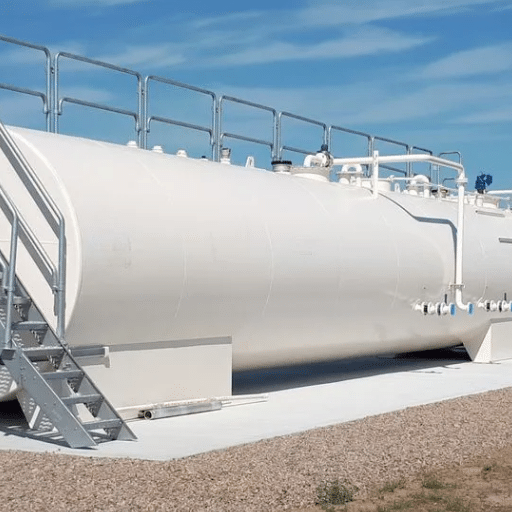
For most retail gas stations, the standard construction is a double-wall carbon steel tank with a fiberglass-reinforced plastic outer shell, often called an SF tank. The inner carbon steel wall provides structural strength. The outer FRP layer and interstitial space provide corrosion protection and leak detection. This design balances cost, safety, and regulatory compliance.
Stainless steel is less common for standard gasoline and diesel USTs because carbon steel with proper protection performs well at a lower price. Stainless steel becomes attractive when:
- The site has corrosive soil or high groundwater salinity
- The station stores ethanol blends or biodiesel in higher concentrations
- The owner wants maximum design life with minimal maintenance
- The project specifies stainless steel for environmental or insurance reasons
Skid-mounted and portable fuel stations add another layer to the decision. These units are often deployed temporarily or moved between sites. Carbon steel keeps the package light and affordable. Stainless steel is chosen when the skid will operate in harsh climates, handle biofuels, or remain in service for many years without relocation.
If you are comparing tank configurations, our guide to double wall vs single wall fuel tanks explains how the second wall affects safety and compliance.
How to Choose: A 6-Step Decision Checklist

Use this checklist to move beyond price and pick the material that fits your project.
- Identify the stored medium. Standard diesel or gasoline favors carbon steel with coating. Ethanol, biodiesel, additives, or high-purity products push toward stainless steel.
- Assess the environment. Coastal air, saline groundwater, acid rain, or high humidity increase the value of stainless steel or heavily protected carbon steel.
- Define the required service life. A 10-year project can accept carbon steel. A 25-year installation should consider stainless steel lifecycle cost.
- Calculate total cost of ownership. Include purchase price, coating, installation, annual inspection, maintenance, recoating, and expected replacement timing.
- Verify applicable standards. Confirm whether the project requires UL, API, EPA, ASME, GB, or local certifications, and ensure the manufacturer can provide documentation.
- Plan maintenance capacity. If your team cannot commit to regular coating inspection and repair, stainless steel reduces long-term risk.
To learn more information, please click to view our guide about carbon steel water storage tanks.
Frequently Asked Questions
What is the main difference between carbon steel and stainless steel tanks?
The main difference is corrosion resistance. Carbon steel is strong and affordable but needs coatings and maintenance to resist rust. Stainless steel contains chromium, which forms a self-healing oxide layer that resists corrosion naturally.
Which is cheaper, carbon steel or stainless steel tanks?
Carbon steel is cheaper upfront, often 30% to 50% less. Stainless steel costs more to purchase but usually requires less maintenance and lasts longer, which can make it cheaper over the full lifecycle.
How long do carbon steel tanks last compared to stainless steel?
Carbon steel tanks typically last 10 to 15 years, or up to 20 years with excellent maintenance. Stainless steel tanks commonly last 20 to 30 years and can reach 40 to 50 years under good conditions.
Is carbon steel safe for fuel storage?
Yes, when properly coated, lined, and maintained. Carbon steel is widely used for gasoline, diesel, and oil storage. Compliance depends on meeting standards for corrosion protection, leak detection, and secondary containment.
When should I choose stainless steel over carbon steel?
Choose stainless steel for coastal or corrosive environments, ethanol or biodiesel storage, high-purity products, long project life, or when minimizing maintenance downtime is critical.
Conclusion
There is no universal winner in the carbon steel tank vs stainless steel tank debate. Carbon steel wins on upfront cost and structural strength. Stainless steel wins on corrosion resistance, lifespan, and lifecycle value. The right choice depends on your fuel type, site environment, project timeline, maintenance capacity, and compliance standards.
For most standard gas station and diesel depot projects, carbon steel with quality coatings and double-wall construction delivers strong value. For coastal sites, biofuel terminals, and long-life installations, stainless steel often pays back its higher initial cost through lower maintenance and longer service life.
If you are unsure which material fits your project, contact our engineering team. We can review your fuel type, site conditions, and compliance requirements, then recommend a tank specification that balances safety, cost, and long-term performance.