AdBlue and DEF are one fluid: 32.5% technically pure urea in deionised water, to ISO 22241. Both need a dedicated tank in 304/316L stainless steel or additive-free plastic. What decides whether DEF storage works isn’t shell strength but the material of every wetted part, the temperature the tank sits at, and whether it is sized to the site’s consumption.
A driver tops up from a diesel can because the two fill points look alike, and the truck derates within the shift. The repair is a catalyst, not a filter.
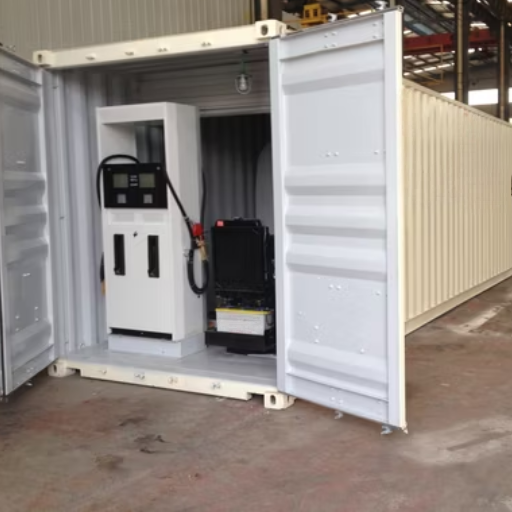
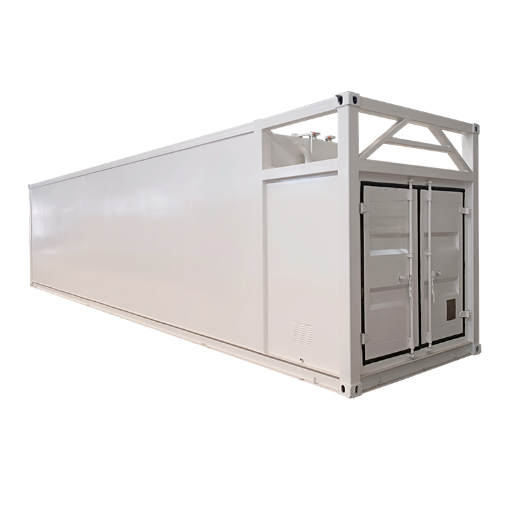
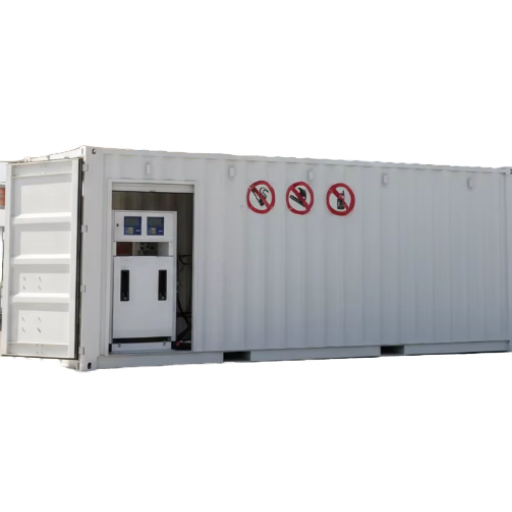
This guide covers failure modes, ISO 22241 materials, sizing from shelf life, freezing, dispensing hygiene, and site integration. The 40ft skid station shows how a dedicated DEF sub-tank fits a fuel frame.
Key Takeaways
- AdBlue, DEF and AUS 32 are one fluid: 32.5% urea, 67.5% deionised water, ISO 22241. AdBlue is the VDA trademark; DEF is the generic North American name.
- ISO 22241-3 recommends 304/316L stainless and additive-free PE or PP, and does not recommend carbon or galvanised steel, copper, brass, aluminium or magnesium.
- Shelf life falls from about 36 months at 10 °C to 6 at 35 °C. API treats 30 °C as six months, so design to the lower figure.
- Size the tank to consumption times the shelf life you can hold, cap stock near 75% of it, and leave up to 7% ullage for freezing.
- Dedicated tanks, pumps, hoses and nozzles are not optional. A Certificate of Analysis per load and a refractometer check are the only proof of spec.
AdBlue vs DEF: one fluid, three names
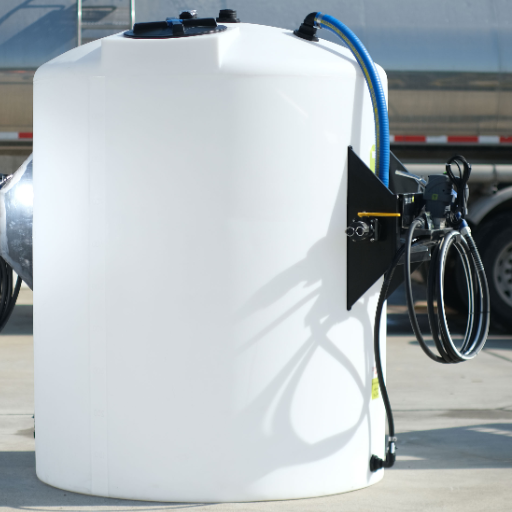
AdBlue and DEF are the same product, injected into diesel exhaust to turn nitrogen oxides into nitrogen and water. ISO 22241 calls it AUS 32. “AdBlue” is the registered trademark of the German Association of the Automotive Industry, the VDA; “DEF” is the generic North American name. An AdBlue storage tank and a DEF storage tank are the same vessel.
| Name | Market | What the label tells you |
|---|---|---|
| AdBlue | Europe and export markets | A VDA licensee produced it to ISO 22241 |
| DEF | North America | An API-licensed product that meets ISO 22241 and is sampled in the aftermarket |
| AUS 32 | ISO 22241 | The technical name for the 32.5% solution |
| Arla 32 | Brazil | The regional name for the same fluid |
A brand name is not a quality certificate. In the US, the American Petroleum Institute licenses DEF that meets ISO 22241 and samples it in the aftermarket. In Europe, the VDA licenses producers and audits distribution. The Certificate of Analysis follows the batch, so ask for one on every bulk delivery.
DEF isn’t a fuel or a fuel additive. John Deere’s data sheet lists its flash point as non-flammable, and MTU calls it a non-hazardous operating fluid. It lives in its own tank and never enters the diesel.
Three ISO parts matter: part 1 sets quality, part 2 the test methods, part 3 the storage rules that govern a tank.
For more information, see our article on 40ft skid station configurations.
The five ways DEF storage fails
Most DEF storage failures are designed in before the first delivery.
Fuel, oil, or water in the tank. A shared funnel, a repurposed drum, a hose that last carried diesel. The API storage fact sheet is blunt: dedicated bulk tanks and dispensing equipment, and no common funnels or hoses.
Metal ions. Copper, zinc, brass, aluminium, galvanised steel and nickel plating are attacked by the fluid, and the ions poison the SCR catalyst. MTU notes the tell: DEF turns blue on contact with copper.
Heat and sunlight. Degradation accelerates with temperature, and a tank in direct sun runs hotter than the air around it.
Freezing and expansion. DEF freezes at about −11 °C and expands by up to 7%. A brim-full sealed tank can split a fitting or a weld. The freezing reverses. The damage does not.
Slow turnover. A tank holding a year of stock in a climate with a six-month shelf life is a warehouse for out-of-spec fluid.
A quiet sixth: water leaves through an open vent, urea concentration climbs above 31.8–33.2%, and the batch drifts unnoticed. AdBlue contamination usually arrives as a lab result, not a symptom.
A quarry fitter we will call Daniel tops up from a diesel can because both fill points are black and close together. The truck derates within the shift. The lesson is about the interface, not the fluid.
DEF storage tank materials: what ISO 22241 allows
ISO 22241-3:2017 has two material tables. Table 1 recommends austenitic stainless steels including 304, 316 and 316L, plus titanium, nickel-molybdenum-chromium alloys, and additive-free polyethylene, polypropylene, PVDF and PTFE. Table 2 does not recommend carbon steel, zinc-coated steel, copper alloys, zinc, lead, aluminium, magnesium or nickel plating.
ISO 22241-1 caps copper, zinc, chromium and nickel at 0.2 mg/kg, and iron, aluminium, calcium, magnesium, sodium and potassium at 0.5 mg/kg, measured by the ISO 22241-2 Annex I methods. A galvanised tank or a brass fitting is a contamination source by construction.
| Material | ISO 22241-3 status | Use it for |
|---|---|---|
| 304 / 304L stainless | Recommended, Table 1 | Tanks, pipes, fittings |
| 316 / 316L stainless | Recommended, Table 1 | Tanks, sub-tanks, heat-traced service |
| PE, PP, PVDF, PTFE (additive-free) | Recommended, Table 1 | Moulded tanks, seals, hoses, liners |
| Titanium, Ni-Mo-Cr alloys | Recommended, Table 1 | Specialised wetted parts |
| Carbon and galvanised steel | Not recommended, Table 2 | Nothing in the wetted path |
| Copper, brass, zinc, lead | Not recommended, Table 2 | Nothing in the wetted path |
| Aluminium, magnesium | Not recommended, Table 2 | Nothing in the wetted path |
| Nickel-plated parts | Not recommended, Table 2 | Nothing in the wetted path |
Two choices dominate. A welded tank is normally 316L, because it can be insulated, heat-traced, and repaired. A moulded tank is normally HDPE, because it costs less and never rusts. Both need a full wetted-parts list covering pump body, seals, meter, and nozzle.
Fibreglass is the exception. Xerxes builds underground fibreglass DEF tanks up to 50,000 gallons and markets them as compatible, but ISO 22241-3’s Table 1 doesn’t list glass-reinforced plastic, so qualify it with the maker.
A coated carbon-steel chamber is not equivalent to stainless. A pinhole at a weld puts the fluid against steel. A former fuel tank can’t be converted either: residual fuel and oil contaminate the fluid, and a used tank cannot be cleaned reliably enough.
The stainless steel diesel tank and the stainless steel fuel tank buyer’s guide cover fabrication and passivation.
Temperature, shelf life, and how big the tank should be
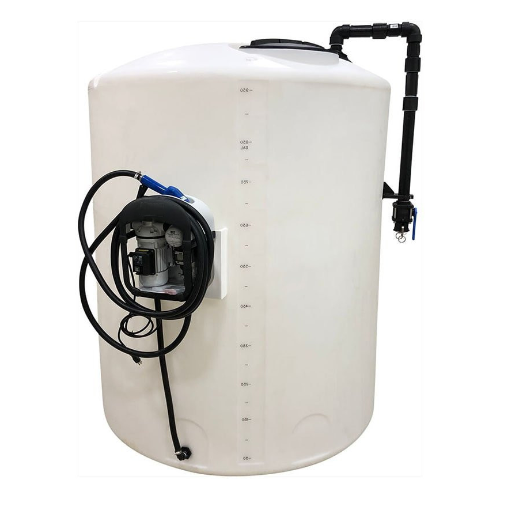
Shelf life decides tank size. API’s storage fact sheet gives these figures for constant ambient temperature:
| Constant storage temperature | Expected shelf life |
|---|---|
| Up to 10 °C (50 °F) | 36 months |
| Up to 25 °C (77 °F) | 18 months |
| Up to 30 °C (86 °F) | 12 months |
| Up to 35 °C (95 °F) | 6 months |
| Above 35 °C (95 °F) | Test before use |
API’s consumer guidance disagrees slightly, saying DEF stored at 86 °F (30 °C) or higher lasts about six months. The fact sheet allows 12 months at 30 °C. Design to the lower number.
ISO 22241-3 adds that prolonged storage above 25 °C should be avoided, which is the hot-climate design target.
Sizing takes five steps:
- Measure DEF use per day or week from purchase records.
- Pick the shelf life your climate and storage can hold.
- Multiply daily use by the days of supply you want, capped at about 75% of shelf life.
- Add freeze ullage, up to 7%, plus a working reserve.
- Check the result against delivery economics: full tanker, IBC or tote.
A depot burning 2,000 litres of diesel a day at 2.5% DEF uses 50 litres a day. Capped at nine months of a 12-month shelf life, the tank should hold no more than 13,500 litres, so 15,000 fits. A 30,000-litre tank would hold 20 months, and half of every fill would age out.
The ratio is only a cross-check. Fleet experience puts DEF consumption near 2–3% of diesel by volume, with OEM figures from about 1% to 6%. Measure the site rather than sizing diesel exhaust fluid storage on another fleet’s rule of thumb.
Underground tanks hold temperature steady but complicate inspection. Aboveground tanks are easier to shade and insulate, which beats active cooling.
A depot we will call Meridian buys a 20,000-litre DEF storage tank to match its diesel tank. Annual use is 6,000 litres, so the first batch is 14 months old before draw-down and fails the lab test. The tank was not too small. It was too large.
For a detailed comparison, please read our article on 40ft vs. two 20ft skid stations.
Freezing, heat and cold-climate design
DEF freezes at about −11 °C (12 °F). The 32.5% concentration has the lowest freeze point of the urea-water mixtures, so the fluid slushes and then freezes rather than separating.
Freezing is reversible: on-spec DEF thaws back to the right concentration without leaving solids. The expansion is the problem, up to 7%, with nowhere to go in a sealed full tank.
The response is ullage plus controlled heat: leave headspace, insulate, and heat only enough to keep the fluid liquid. Overheating accelerates degradation, so a def tank heater on a thermostat just above freezing beats one that runs flat out.
Insulation lowers winter heat input and slows summer warming. A heated enclosure or heat-traced sub-tank is the cold-climate answer. A black tank in full sun is the hot-climate mistake.
Cold-climate checklist:
- Insulation on the tank and the fill line.
- Thermostat-controlled heat, set just above the freeze point.
- Lagged, drainable transfer lines.
- Expansion space, with a maximum fill mark below the brim.
- A level sensor that still reads when the surface slushes.
- A written thaw plan, so a frozen tank does not become an emergency.
The 40ft skid station guide covers frame integration, and the 40ft product page lists the insulated 316L DEF sub-tank.
DEF dispensing and contamination control
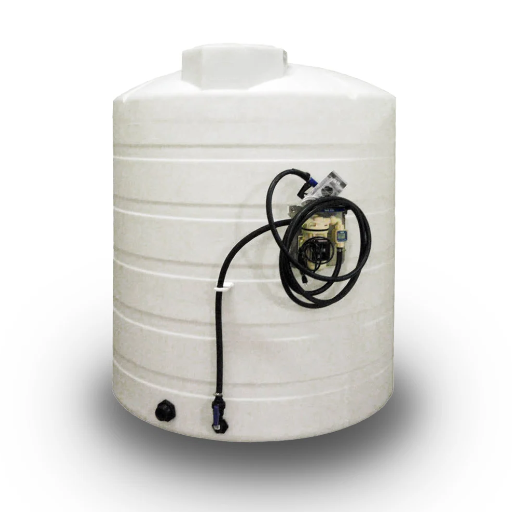
The tank is half the system. The other half is everything that touches the fluid between delivery and vehicle.
Use dedicated equipment end to end: pump, hose, nozzle, meter, and fittings for DEF and nothing else. API is explicit about no shared funnels, pitchers, or hoses. Clean with distilled or deionised water and a DEF rinse, never tap water, whose minerals are exactly what the standard limits.
The refilling interface is standardised in ISO 22241-4, so the fill point won’t accept a diesel nozzle. Specify the interface rather than relying on a blue cap.
A closed-loop transfer keeps dust and rain out: dry-break couplings, a sealed fill point, a pressure/vacuum vent against evaporation, and a filtered breather.
Quality evidence is the last line: a Certificate of Analysis with every bulk delivery, a refractometer check, a retained sample, and rotation so the oldest fluid leaves first. A supplier who can’t produce a CoA is telling you something.
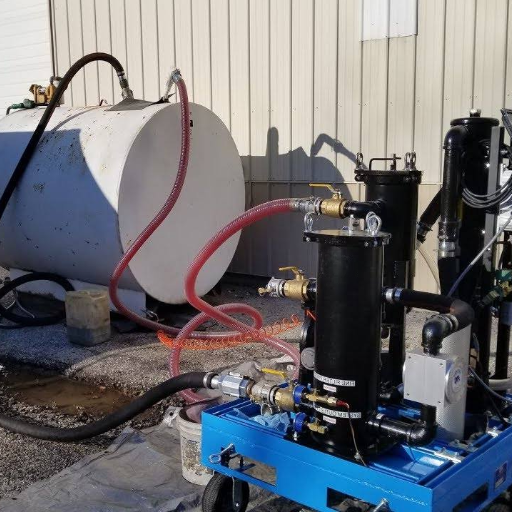
AdBlue crystallisation worries more buyers than it should. White crystals at a cap, thread, or vent are dried DEF, removed with warm water. Crystals inside the tank or at a dispenser seal point to a weeping joint or evaporation.
Misfuelling is the expensive version. Use a blue cap, label fill points by product rather than colour, and separate access where diesel and DEF points are close. A truck’s AdBlue tank draws from the site’s bulk tank, so one bad fill reaches the vehicle.
The spill containment systems page covers the containment side of the same site.
To learn more information, please click to view our guide to diesel fuel polishing.
DEF storage on a fuel site or skid station
DEF and diesel are stored together but governed differently. DEF is non-flammable, so the fire code governing the diesel tank doesn’t apply to it the same way. DEF storage is driven by quality and compatibility; fuel storage by flammable-liquid code, tank listing, containment and venting, as the NFPA 30A and 30 storage rules set out.
The systems still share a site, a delivery route, a bund, a drain and a team.
Keep the DEF fill point away from the diesel fill and the breather. Separate the bunds so a diesel spill cannot reach the DEF tank. Label every fill point by product, not colour alone. Give the DEF tank its own filtered pressure/vacuum vent, never the fuel tank’s vent path.
Containment is a local question. DEF isn’t a fire risk, but a release is a water-quality issue, and many authorities require containment near fuel or drains. Confirm with the authority having jurisdiction.
Monitoring turns a run-out into a reorder: level, temperature, a low-level alarm, a leak sensor on a double-walled tank, and a delivery log. Telemetry does it from a desk.
On our equipment, the live 40ft skid station page lists a DEF/AdBlue-ready configuration with dedicated 316L stainless sub-tanks, fully insulated and climate-controlled, heating optional. Each chamber has independent venting, interstitial leak detection, and a dedicated fill point. The 20ft page lists no DEF sub-tank, so this article makes no claim for it.
Ask a supplier in writing for the material grade and wetted-parts list, welding and passivation standard, vent and fill interfaces, insulation and thermostat range, instrumentation, containment and documentation pack. A DEF storage tank is bought on paper before it is bought on price.
A retail site we will call Calder accepts a coated mild-steel chamber to save cost. Eighteen months later the coating fails at a weld, iron climbs above the ISO limit, and the first symptom is a derate on a delivery truck. The cheapest substitution is the one the fluid punishes.
Specifying DEF storage: checklist and cost drivers
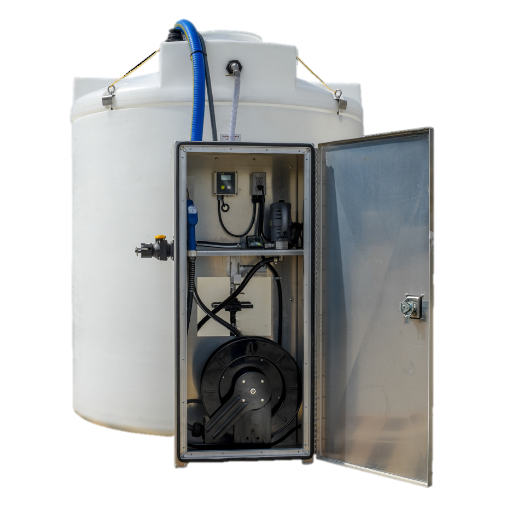
The specification fits on a purchase order. The fluid must meet ISO 22241 and, in the US, be API-certified. The tank must be 304/316L stainless or additive-free plastic, with a full wetted-parts list, and sized to measured consumption, shelf life, and freeze ullage. Add thermostatic heat where winters go below −11 °C, a pressure/vacuum vent, a standard refilling interface, level and temperature monitoring, containment where required, and a dedicated dispensing package.
Cost drivers are material, size, insulation and heating, the dispensing package, monitoring, containment, delivery format and installation. A heated, insulated 316L tank with pump, meter and nozzle can cost several times a bare HDPE tank of the same volume. That spread buys temperature control, service life and a documented wetted path.
Published listings show the market’s shape: a German supplier listed a 200-litre portable urea tank at about $700 and 2,000–3,000-litre tanks at about $3,600; John Deere sells DEF in 275- and 330-gallon totes; Bailiff lists HDPE bulk tanks from 550 to 10,000 gallons. These are market listings, not our prices.
Build or buy turns on volume. Mansfield estimates bulk DEF saves 25–50% per gallon, with break-even around 300–600 gallons a week. Below that, totes turn stock faster. Above it, a correctly sized tank wins on cost per litre, provided it is sized to turn over rather than symmetry.
Working out a DEF system for a new site? Send the daily use, climate, delivery method and layout. We will return a tank size, a material and a layout, not a catalogue number.
Frequently asked questions
Is AdBlue the same as DEF?
Yes. Both are the same 32.5% urea solution, and ISO 22241 calls it AUS 32. AdBlue is the VDA’s trademark; DEF is the generic name in North America.
How long can DEF be stored?
About 36 months at 10 °C, 18 at 25 °C, 12 at 30 °C, and 6 at 35 °C on API’s table. Its consumer guidance treats 30 °C as six months, so design to that.
At what temperature does DEF freeze?
About −11 °C (12 °F). It expands by up to 7%, so leave ullage and don’t fill a sealed tank to the brim.
Can DEF be stored in a steel tank?
In 304 or 316L stainless, yes. In carbon or galvanised steel, no: those metals migrate into the fluid, and the ISO limits are measured in tenths of a milligram per kilogram.
Can I use a diesel tank or drum for DEF?
No. Residual fuel and oil contaminate the fluid, and a used tank cannot be cleaned reliably enough. Use a dedicated tank from new.
How big should a DEF storage tank be?
Measured daily use times the days of supply you want, capped at about 75% of the shelf life your climate allows, plus up to 7% freeze ullage.
The storage decision that outlasts the tank
DEF storage is a chemistry problem wearing a tank. The fluid is one product under three names, and its quality is decided by what it touches and how warm it gets. Stainless or additive-free plastic, a dedicated wetted path, a shaded and insulated tank, a pressure/vacuum vent, and a fill point that cannot take a diesel nozzle do more than a thicker shell.
Shelf life then sets the size. Measure consumption, choose the conservative shelf life for the climate, cap stock at about three-quarters of it, and leave room for freezing. A tank sized that way is smaller than most buyers expect, and it keeps the fluid on spec.
The last decision is the site interface. DEF sits beside diesel under a different rulebook, sharing people and drainage. Separate fill points, separate bunds, clear labels, and one owner for both systems prevent the failure no material certificate can.
Planning a site that carries diesel and DEF? Send us the consumption, climate, and layout, or see how the 40ft skid station builds the DEF sub-tank into the frame.