Most buyers treat shop-fabricated vs. field-erected tanks as a price question. It is not. It is about whether the tank can physically get to your site; price only decides the outcome after that question is answered.
That matters because the fabrication route locks in three things at once: which standard you build to, how many inspections you file for the next thirty years, and how much of the work happens in your yard. Choose late, on a supplier’s preference, and you inherit a structure that was never the right fit.
This article gives you the two hard limits that decide the route, the crane-access gate most guides bury, the arithmetic behind the cost crossover, and the one situation that reverses the rule entirely. Scope is fabrication location only. Tank orientation is a separate question, covered in our vertical vs horizontal storage tanks guide, and packaging is separate again, covered in container vs skid-mounted fuel stations.
Shop-Fabricated vs Field-Erected Tanks: The Short Answer

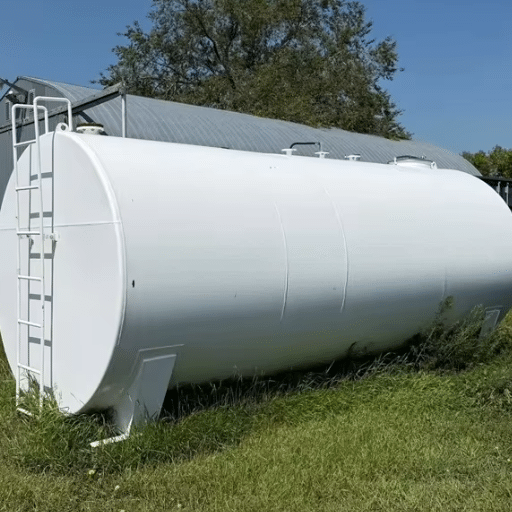
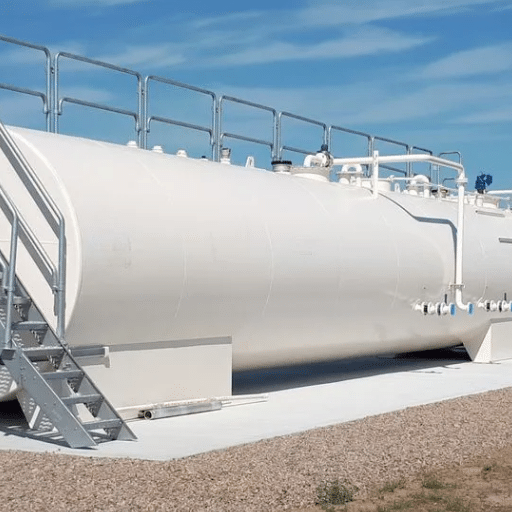
A shop-fabricated tank is welded, coated, and tested inside a controlled facility, then shipped complete. A field-erected tank is built plate by plate at the site. The deciding variables are capacity, shipping envelope, crane access, and total installed cost, in that order.
| Factor | Shop-Fabricated | Field-Erected |
|---|---|---|
| Build location | Controlled fabrication facility | Site, plate by plate |
| Typical capacity | Under ~1,000 bbl (42,000 gal) | Over ~1,500 bbl (63,000 gal) |
| Diameter | Up to ~15 ft; ~12–13 ft practical by road | 16 ft and up, no code maximum |
| Lead standard | API 12F; UL 142 / STI SP001 | API 650 |
| Welding environment | Controlled, often automated | Weather-dependent |
| Coating | Shop blast-and-paint, regulated cure | Field-applied |
| Quality documentation | Mill certs, NDT, hydro test in-plant | Site inspection regime |
| Transport cost | Freight, permits, escorts | Material only |
| Crane and site prep | Set, anchor, connect | Crane, scaffolding, laydown, power |
| Schedule risk | Low | Weather and labour dependent |
| Cost predictability | High | Lower |
The gap between those capacity rows is where the decision actually lives. Between roughly 1,000 and 1,500 barrels, a tank can go either way, and that band is the “cost line” buyers keep asking about.
For context, shop-fabricated tanks dominate this market by count: an API study cited in The Aboveground Steel Storage Tank Handbook counts roughly 625,000 shop-built against 75,000 field-erected across the United States. Field-erected units are about 11% of the population but hold most of the stored volume. Our fuel storage tank range covers the UL 142 shop-fabricated sizes where most fuelling projects land.
The Two Hard Limits: Capacity and the Shipping Envelope
A fabricator’s preference doesn’t decide this. Two physical limits do, and you have to satisfy both before cost is worth discussing.
Limit one is the code ceiling. Small shop-fabricated tanks are governed by API 12F. It covers shop-fabricated, vertical, cylindrical, closed-top, welded steel tanks. Nominal capacities run from 90 to 750 barrels, or roughly 3,780 to 31,500 US gallons, at approximately atmospheric pressure. Above that, the reference standard changes rather than the vendor.
For aboveground fuel storage, the practical ceiling is set by STI SP001, which defines a shop-fabricated tank as one fabricated in a manufacturing facility with a volume of 50,000 US gallons or less. UL 142 shop-fabricated listings run to the same figure. What you won’t find in any code is a hard “maximum size” for a shop tank; the limits arrive from the second gate.
Limit two is the shipping envelope. Oversize road loads begin beyond 8 ft 6 in in width. The practical diameter for a shop-built tank on a long haul is ~12–13 ft; past that, transport stops being cost-effective and permits, escorts, route surveys, and bridge or culvert checks multiply. API 650 Annex J reportedly caps shop-fabricated design at 6 m (20 ft) diameter, a code limit layered on top of the logistics one.
Five signs your tank must be field-erected:
- Diameter over the shop ceiling. If the geometry doesn’t fit the transport envelope, the question is closed.
- Volume past the crossover. Beyond ~1,500 barrels, one large tank usually beats many small ones.
- No viable haul route. Width restrictions, low bridges, or no barge access can rule out delivery.
- Crane access denied. If the site can’t land the load, shop fabrication isn’t the cheaper option; it is a re-order.
- Site-specific design required. Wind, snow, and seismic loads at the location can demand a custom shell.
For export projects, add one more variable. On Chinese roads, horizontal tanks over 3.2 m in diameter trigger escort-vehicle requirements, a real scheduling and cost line for anyone importing. Treat that figure as practice and confirm it with your logistics partner, not as a code citation.
Our skid-mounted station shipping and logistics guide covers the transport side in more detail.
Crane Access and Site Conditions
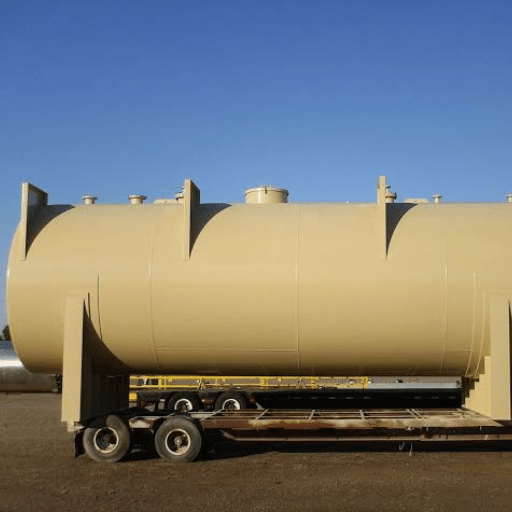
Most comparisons mention site access last, as a footnote. That is backwards. Crane access is a cost gate, because an unlandable shop-fabricated tank isn’t a cheaper tank; it’s a tank you can’t install.
A field-erection lift plan is not a single crane call. It includes:
- Crane capacity and reach
- A prepared crane pad and a laydown area for plates and equipment
- Haul-route verification, covering turning radii, grade, axle loads, and bridge or culvert capacity
- Welding power, scaffolding, and temporary utilities
- On-site supervision
On remote or congested sites, those line items can rival the tank itself.
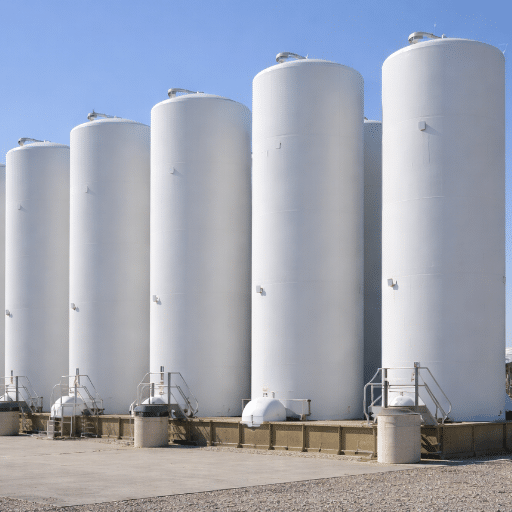
Where field erection earns its place on access: congested sites, indoor installations, and locations with no heavy-haul route at all. Where shop fabrication earns its place: no crane on site, no laydown area, minimal disruption to a live forecourt, or a facility that must stay operational throughout the build.
One clarification prevents a costly misreading: field-erected is not the same as field-welded. Bolted and modular field-assembled tanks reduce or eliminate on-site hot work, and bolted tanks are reported to take roughly one-third the time of field-welded construction. If welding restrictions or fire risk drive your decision, that third path may answer it. Whether the site can support the build at all is a separate question our aboveground fuel tank installation guide covers.
Quality, Welding, and Coating by Fabrication Route
The quality argument runs both ways, and the honest version is more useful than the sales version.
What the shop wins. Temperature and humidity are controlled. Welding can be automated where geometry allows, so fit-up and dimensional tolerance hold consistently. Surface preparation and coating cure happen in a regulated booth, which is why a shop blast-and-paint finish outlasts a field-applied one. Hydrostatic or pneumatic testing, non-destructive examination, and the documentation for all of it sit under one roof, with material traceability. Small and mid-size pressure vessels belong in the shop, too; the economics only invert at very large capacity.
What the field risks. Welding is restricted below 0°F, in rain, or in high winds unless adequate protection is provided, and preheat must follow the applicable code and the vendor’s welding procedure. Plate alignment and offset still have to meet code criteria on every circumferential and vertical seam, outdoors, on a schedule. Field-assembly studies document the consequences plainly. A refinery-site study of cylindrical steel tanks classified eight distinct classes of imperfection arising during field assembly. Among them:
- Seam misalignment on consecutive horizontal rows
- Non-parallel vertical edges
- Layers that are not vertical over the tank height
- Circumferential distortion from welding temperature
- Wind-induced troughs and bulges in the top course
That list is not an argument against field erection. It is an argument for competent field supervision, and it explains why the field-erection sequence has hard rules. Never weld a shell course’s horizontal seams before its vertical seams are complete: doing so locks the plates and produces peaking, banding, and high residual stress. Much of this work is done by hydraulic jacking from the top down, which keeps welding and roof assembly near ground level and reduces work at height.
What the field wins. Site-specific engineering. Field-erected tanks are designed for the actual wind, snow, and seismic loads of the location, and accessories are installed in place. Changing a 4-inch nozzle to a 6-inch nozzle before installation is inexpensive; discovering a misaligned pipe connection on a delivered shop tank is not, and corrective hot work can damage a factory coating.
For weld procedure detail (WPS, PQR, welder qualification, NDT methods), see our carbon steel tank welding and fabrication standards guide.
Shop-Fabricated vs Field-Erected Tank Cost: Where the Line Falls
Sticker price is not the comparison. Total installed cost is, and the two routes carry different cost structures and risk profiles.
Shop-fabricated structure: plate, shop labour, freight, oversize permits and escorts, crane set, foundation, connection. Fewer site variables, so lower and more predictable.
Field-erected structure: plate, site labour, crane and heavy equipment, scaffolding, temporary utilities, welding power, supervision, weather downtime, site preparation and foundations, connection. Higher, with more variance, and variance is the risk.
Published figures frame the range. A 1,000,000-gallon field-erected tank is cited at roughly $1 million, while matching that capacity with twenty 50,000-gallon shop-built tanks costs considerably more once freight, twenty foundations, interconnecting piping, dead space between vessels, and recurring inspections are included.
For LPG, a 400,000-barrel solution built from multiple shop-built pressure spheres was estimated at approximately three times a field-erected solution. A separate prefabricated-versus-field-installed study put total installation at roughly $92,000 against $354,000, about one-quarter the cost, at that scale. Treat every one of these as illustrative and scale-specific, not as a quote.
Here is the decision device those examples are groping toward, and the one no competing guide states:
The cost-parity ratio. Divide the ex-works, prefabricated total by the stick-built total. Below 1, prefabricated wins. Above 1, site-built wins. That single number is the decision, and it is how engineering teams actually frame the problem.
Two costs hide below the crossover line. First, recurring inspection: multiple small tanks mean multiple inspection files, multiple containment structures, and multiple monitoring systems, and STI SP001 intervals and SPCC obligations scale with tank count rather than total volume. Second, schedule: modular and prefabricated builds are cited at roughly 30% faster, which means earlier commissioning and earlier revenue.
If you want the ratio run against your own site and capacity, our engineers can price the two routes side by side. The line items behind them are broken out in our carbon steel tank cost analysis.
The Remote-Site Exception

The rule says large capacity means field erection. The exception says that if getting a crew to the site is the dominant cost, shop-built wins anyway.
This is the case that reverses the default, and it’s worth understanding rather than memorising. A remote Alaska fuel farm faced a capacity that appeared to require field erection. Cost analysis showed turn-key shop-built tanks were cheaper than mobilising a field crew.
The reason is the mobilisation stack. Crew travel, camp and accommodation, equipment mobilisation, a compressed construction season, and weather windows all land on the field-erected side of the ledger. When those dominate, the capacity rule stops deciding.
The generalisable test is straightforward. Where remoteness, mobilisation, and season length dominate, run the cost-parity ratio before assuming capacity decides. Marine and barge access can flip the outcome either way, and port-enabled modular projects are the established pattern. Plant is fabricated at a port and barged to site, with dock load-out, haul-route verification, and crane-pad planning as named line items.
The exception runs in the other direction too. Where local site-fabrication costs are prohibitively high, tanks as large as 9–13.5 m in diameter have been shop-fabricated and shipped, with careful transport planning and extra design provisions.
The capacity rule is a strong default. The ratio is the law.
Standards and Inspection Regimes by Fabrication Route
The fabrication route doesn’t just change how a tank is built. It determines which standard you build to and which inspection regime you live under for the life of the asset.
| Scope | Shop-Fabricated | Field-Erected |
|---|---|---|
| Small atmospheric welded steel | API 12F (90–750 bbl) | N/A |
| Large atmospheric welded steel | API 650 (Annex J reportedly caps design at 6 m) | API 650 |
| Low-pressure welded (≤15 psig) | N/A | API 620 |
| Repair and alteration | Replace or repair to code | API 653 |
| Flammable/combustible liquid AST | UL 142 (to 50,000 gal) | UL 2085 (fire-rated) |
| Inspection of aboveground ASTs | STI SP001 | STI SP001 (smaller field-erected) |
| Cathodic protection and linings | API RP 651 / API RP 652 | API RP 651 / API RP 652 |
| Fire and siting | NFPA 30 / NFPA 30A | NFPA 30 / NFPA 30A |
| Environmental | 40 CFR 112 (SPCC) | 40 CFR 112; 40 CFR 195 (breakout) |
STI SP001 reaches smaller field-erected tanks as well (up to roughly 30 ft diameter and 50 ft shell height, around 265,000 gallons), which matters when you are weighing inspection burden. Tank bottoms above 500 barrels built to API 12F, 620, or 650 need cathodic protection per API RP 651 and linings per API RP 652.
There is also a regulatory asymmetry few buyers consider, visible in New Zealand’s WorkSafe rules for stationary tanks. Workshop-fabricated designs can often be certified by a test certifier and registered, and reused on a repeat basis, with the fabricator certified for that specific design. Field-constructed tanks are generally one-off designs, assessed case by case, without separately certifying the design and the fabricator.
For a project on a tight approvals timeline, that difference shows up as lead time. Confirm this with your own authority.
Venting, grounding, and separation distances sit under NFPA 30 and NFPA 30A, with grounding per NFPA 70 and classified locations under NEC 501/514. Containment and integrity testing follow the SPCC rule, 40 CFR 112.
Every distance, listing, and inspection interval here is adopted and enforced locally. Treat this as a planning reference, not a substitute for your authority having jurisdiction or a licensed engineer.
Decision Framework: Shop-Fabricated or Field-Erected?

Work down this list; the first firm answer usually settles it.
| Criterion | Choose Shop-Fabricated | Choose Field-Erected |
|---|---|---|
| Capacity | Under ~1,000 bbl (42,000 gal) | Over ~1,500 bbl (63,000 gal) |
| Diameter and transport | Fits ~12–13 ft and the route permits | Over the shop ceiling or no viable route |
| Crane and site access | No crane, no laydown, live-site constraints | Crane, haul route, and laydown available |
| Quality priority | Highest documented in-plant quality | Site-specific design matters more |
| Schedule | Tight, weather-independent, parallel build | Longer window acceptable |
| Cost predictability | Fixed budget, low risk appetite | Can absorb field-side variance |
| Remoteness | Mobilisation dominates, so run the ratio | Local labour and infrastructure available |
| Site-specific loads | Standard design sufficient | Wind, snow, or seismic design required |
Two tie-breakers finish the job. When the table points both ways, the cost-parity ratio decides. If the ratio is close to 1, the crane gate breaks the tie: if the site can’t land the load, the economics are academic.
Frequently Asked Questions
What is the difference between a shop-fabricated and a field-erected tank?
A shop-fabricated tank is welded, coated, and tested in a controlled facility and shipped complete. A field-erected tank is assembled plate by plate at the site. Shop tanks suit smaller, transportable capacities; field-erected tanks handle large volumes and site-specific design loads.
What size tank can be shop fabricated?
API 12F covers shop-fabricated steel tanks from 90 to 750 barrels, about 3,780 to 31,500 US gallons. STI SP001 and UL 142 extend the aboveground fuel ceiling to 50,000 gallons. In practice, transport limits usually bind before code does, holding most shop builds under roughly 1,000 barrels.
When is a storage tank field erected instead of a shop built?
When it exceeds the capacity ceiling, when its diameter won’t fit the shipping envelope, when no crane can access the site, or when the location’s wind, snow, or seismic loads require a custom shell. Any one of those closes the shop-fabrication route.
Are shop-built tanks cheaper than field-erected tanks?
At small capacity, yes, and they are more predictable. At large capacity, no, because matching one large tank with many small ones adds freight, multiple foundations, interconnecting piping, and recurring inspections. Compute the ratio of prefabricated total to stick-built total: below 1 favours the shop, above 1 favours the field.
Is field-erected the same as field-welded?
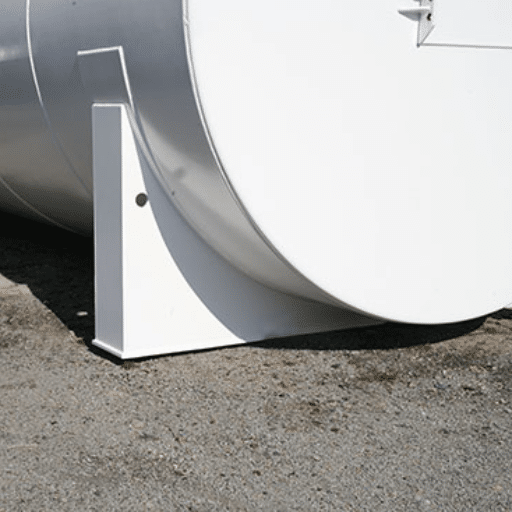
No. Field-erected describes where the tank is built. Bolted and modular field-assembled tanks are also field-erected but need little or no on-site welding, and bolted construction is reported to take about one-third the time of field-welded work. Our horizontal tank saddle support guide covers the structural side for smaller shop-built layouts.
Can a 50,000-gallon tank be shop fabricated?
Yes, 50,000 gallons sits exactly at the STI SP001 and UL 142 ceiling for shop-fabricated aboveground storage. Diameter still has to fit the transport envelope, which is often the tighter constraint at that volume.
The Line Is Worth Finding Before You Commit
Four things decide shop-fabricated vs. field-erected tanks, and only one of them is money:
- Two hard limits come first. Capacity and the shipping envelope close most questions before cost is relevant.
- Crane access is a cost gate. If the tank can’t land, the cheaper quote isn’t cheaper.
- The shop wins on quality, speed, and predictability; the field wins on size and site-specificity. Both are real advantages, and neither is universal.
- The remote-site exception means the ratio decides, not the rule.
The pattern across every project we quote is the same: buyers who identify the fabrication route early spend less, because the standard, the foundation, and the inspection regime all follow from it.
Send us your capacity, product, and site constraints, and our engineers will tell you which route applies, which standard governs, and where the cost line falls for your project. Request a fabrication-route review, and we will price both options.