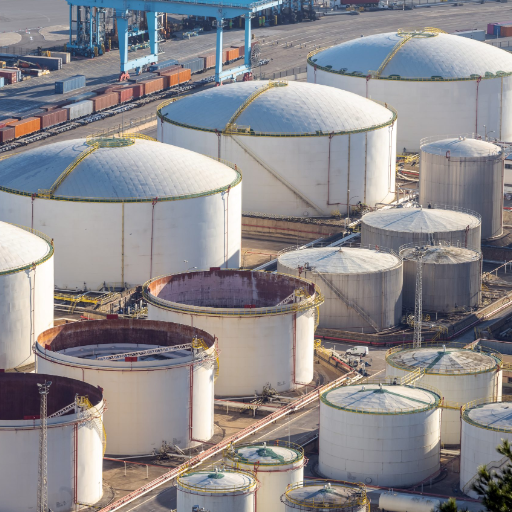
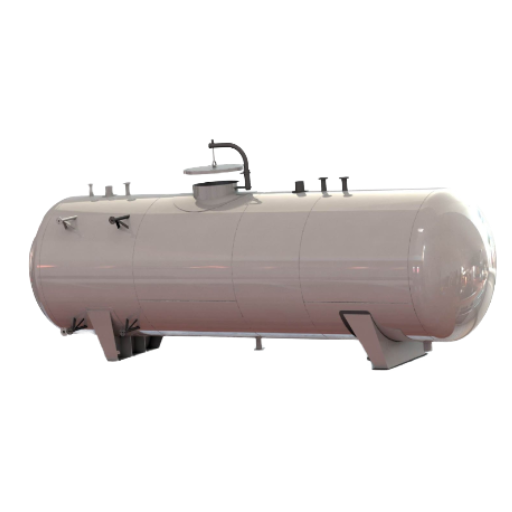
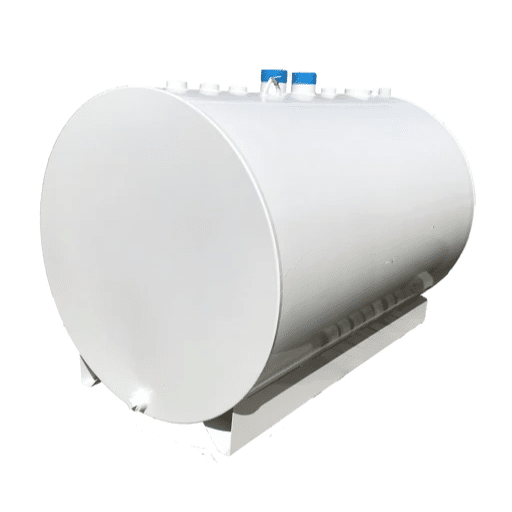
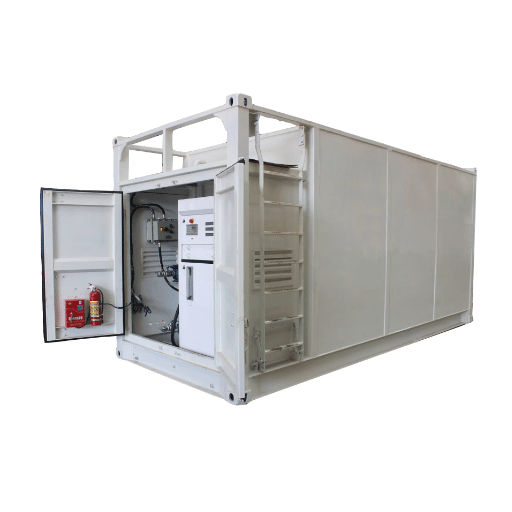
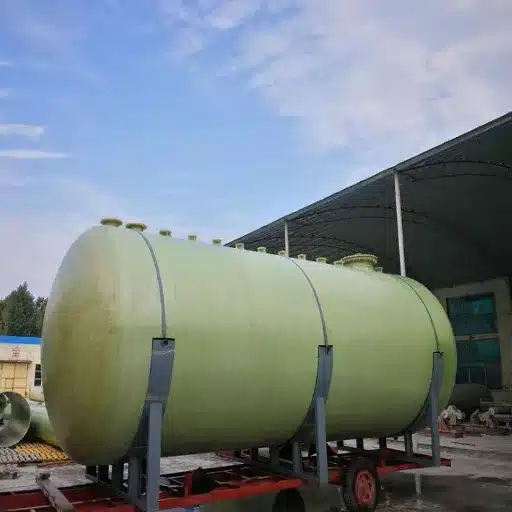
At −20 °F, the diesel in an unheated aboveground tank has not frozen. It has stopped being a liquid you can pump, and that is the problem a fuel tank heating system exists to solve.
Diesel waxes as it cools. The paraffin in it forms crystals, the crystals clump, and one morning a generator that ran all winter refuses to start. Water in the same tank freezes even earlier, at 32 °F, while the diesel is still flowing.
If you run a fleet depot, a generator day tank, or a remote station in a cold climate, you know the symptoms. What is harder to find is a straight answer on what fixes them, in what order, and what makes the fix legal to install.
This guide gives you that sequence. You will learn whether you need heat at all, which heater type fits your tank, how to size it, how insulation changes the math, and what certification a heater on a fuel tank requires. We also tie the cold-weather problem back to the tank geometry decision in our guide to vertical vs horizontal storage tanks.
Fuel Tank Heating Systems: The Short Answer
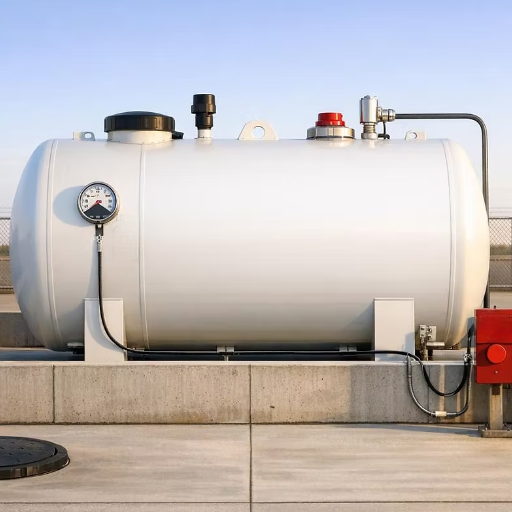
A fuel tank heating system maintains stored liquid fuel above its cold-flow limit, the temperature at which wax crystals stop it flowing. It combines a heat source, a control thermostat, and insulation that reduces the heat the source must supply.
The heat source is usually one of five types:
- Electric immersion heaters, mounted through the tank wall
- Electric heat tracing, run along the shell or pipes
- Steam or hot-water coils, where steam is available
- External wraps, blankets, and jackets
- Suction heaters, which warm only what is drawn out
One verdict comes before any of that. A buried tank sits near a stable ground temperature and usually needs no heat at all. An aboveground diesel tank in a severe climate often does. An aboveground gasoline tank effectively never does, because gasoline doesn’t wax and heating it is unsafe.
Planning a cold-climate build? Explore our fuel storage tank range to see the configurations that support insulation and tank heat tracing.
What Cold Does to Stored Fuel
Diesel gelling in cold weather follows three temperature thresholds, and they arrive in a fixed order.
The cloud point is where wax crystals first appear, and the fuel turns hazy, commonly cited at 4 to 14 °F for #2 diesel. The pour point is where enough wax precipitates that the fuel gels, typically 10 to 15 °F lower. Between them sits the metric that actually stops a fleet: the cold filter plugging point (CFPP), where wax crystals grow large enough to plug a filter.
| Property | What it means | Typical value | Test method |
|---|---|---|---|
| Cloud point (CP) | Wax crystals first form; fuel turns hazy | Commonly cited at 4 to 14 °F for #2 diesel | ASTM D2500 |
| Pour point (PP) | Fuel stops flowing and gels | Typically 10 to 15 °F below the cloud point | ASTM D97 |
| Cold filter plugging point (CFPP) | Wax blocks a fuel filter | Target below the expected winter low | ASTM D6371 |
| Water freezing point | Ice forms and can seal filters and lines | 32 °F, above diesel’s cloud point | Not a fuel property |
| Water and sediment | Free water and solids in the sample | Any measurable water is actionable | ASTM D2709 / D6304 |
| Microbial contamination | Bacteria and fungi at the fuel-water interface | Test wherever water is found | ASTM D6469 |
Read that table from the bottom up, and the priority changes. Water freezes at 32 °F, well above diesel’s cloud point, so ice is often the first thing to block a filter, not wax. Fleet Labs tests for all of it together, because a winter failure rarely has a single cause.
Then comes the safety gate that stops most bad designs: you heat diesel, not gasoline.
Diesel is a combustible liquid with a flash point of 100 °F or higher, so warming it to about 40 °F leaves a wide margin. Gasoline is a Class I flammable liquid with a flash point far below ambient, and warming it raises vapour pressure for no benefit. Never specify a heater for a gasoline tank. Our explosion-proof diesel storage tanks are built for exactly this diesel heating duty.
Water Bottoms and Condensation: The Problem Heat Does Not Solve
Sarah kept a generator day tank in northern Ontario. Every January the set refused to start, and every January the site added more anti-gel. The real fault was a water bottom. Ice, not wax, had sealed the filter, and no additive would move it.
Her case is common, because condensation is a separate problem from gelling. Warm days and cold nights cycle the headspace temperature, drawing moisture in through the vent. That moisture condenses on the cooler walls and settles as a water bottom, a cycle that fuel suppliers describe as one of the biggest winter threats to stored fuel.
Water bottoms do three expensive things. They corrode the shell from inside, build sludge, and feed microbial growth at the fuel-water interface, the “diesel bug.”
That growth carries its own cost. One EPA study cited by fuel-testing labs found that 83% of fuel tanks show corrosion or microbial growth. Warming that interface with a heater can speed the microbial activity rather than stop it.
Manage water before you buy hardware:
- Keep tanks as full as practical to cut headspace and condensation.
- Drain water bottoms seasonally, ideally after each delivery.
- Test for water with paste that turns bright pink on a gauge stick.
- Watch for a frost line on the shell, a visible sign of water inside.
- Replace fuel and water separator filters before the season turns.
Fuel Tank Heating System Types Compared
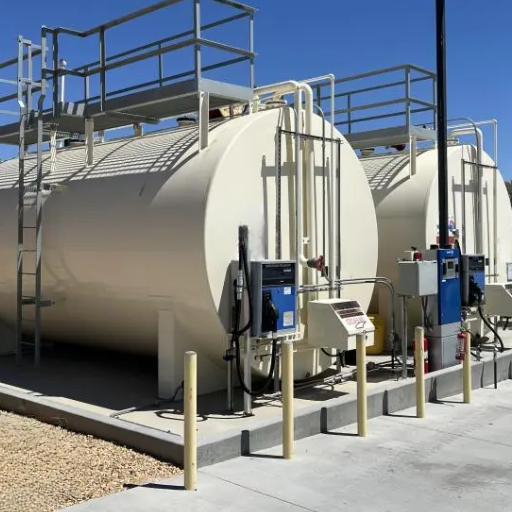
The framework is direct versus indirect, and internal versus external. Direct heating puts the element in the product, running near 100% efficiency with no thermal lag. Indirect heating uses a medium or the tank wall, which is slower because steel conducts heat poorly.
| System | Placement | Best for | Watch-outs |
|---|---|---|---|
| Flanged immersion heater | Direct, internal | Aboveground diesel depot and day tanks | Needs a nozzle; watt density must match the fuel |
| Threaded immersion heater | Direct, internal | Small day and generator tanks | Low power only; verify the gas group |
| Electric heat tracing | Indirect, external | Freeze protection and retrofit | Heat must pass through the wall; certify cable and controls |
| Steam or hot-water coil | Indirect, internal | Sites that already run steam | Maintenance may require draining; coils foul |
| External wrap or jacket | Indirect, external | Quick retrofit, small tanks | Load-limited; slow through the shell |
| Suction heater | Direct, internal | Intermittent viscous draw | Not a bulk-warming solution |
Electric immersion heaters are the workhorse for aboveground diesel. Flanged models cover roughly 1 to 25 kW and 4 to 240 kW in the small and large classes, and a flanged unit lets you change elements without draining the tank. Electric heat tracing uses self-regulating cable to about 400 °F, power-limiting cable to about 455 °F, and pads to about 200 °F. It suits retrofit because nothing touches the product.
Steam and hot-water coils are efficient where steam already exists but foul and may need draining. External wraps are quick and removable but suit small tanks only. Suction heaters heat only what leaves the tank, saving energy versus holding a whole tank warm.
As a rule of thumb, external heating suits tanks up to about 15 ft in diameter and 25 ft tall; larger tanks favour immersion.
Sizing a Fuel Tank Heating System
There is no universal watts-per-gallon rule for a diesel tank heater, and any guide offering one is guessing. Sizing depends on exposed surface area, insulation quality, the temperature difference, and how fast you need the fuel warm.
For maintaining a temperature:
kW = (A × (1/R) × ΔT × SF) / 3412A is the surface area, R the insulation R-value, ΔT the fuel temperature minus the design ambient, and SF a safety factor normally taken as 1.2. When the tank is bare steel, use R = 0.5. That single value is the difference between a small heater and a large one.
To raise temperature, add a heat-up term based on product mass and the hours allowed.
Then follow five steps:
- Set the target fuel temperature, commonly about 40 °F for diesel.
- Set the design ambient for the site’s coldest condition.
- Compute the exposed surface area.
- Choose R for the insulation you will actually install.
- Apply the 1.2 safety factor and round up.
A maintenance crew at a Chicago-area airport sized an 8,000-gallon aboveground diesel tank for −20 °F with a 10 mph wind, holding fuel at 40 °F. The solution was a 2 kW immersion heater, about 0.25 W per gallon for a maintenance case. Treat that as a sanity check against your own numbers, and remember a maintenance case costs far less than a heat-up case.
Volume, demand, and the seasonal peak behind any sizing decision belong to a separate method, and getting the tank volume right comes first.
Hazardous-Area Certification: The Step That Makes It Legal
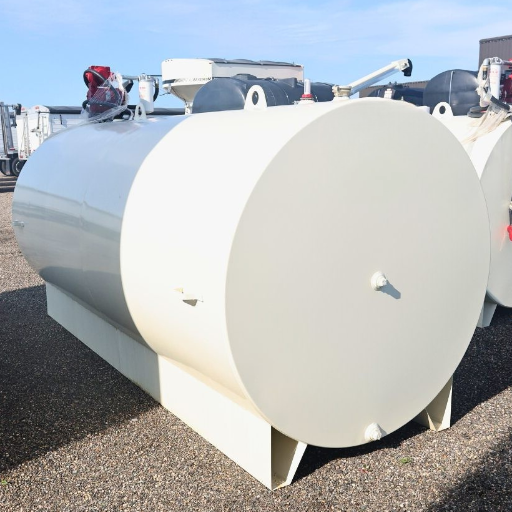
A heater bolted onto a fuel tank is electrical equipment installed in a classified area. Selecting on wattage alone is a compliance and safety failure.
The governing idea is simple. The heater’s maximum surface temperature must stay below the auto-ignition temperature of any vapour present. Temperature classes run T1 to T6, and T3 at 200 °C is a common catch-all, though over-specifying adds cost.
For export projects, ATEX and IECEx define the rules. Gas areas are split into Zone 1 and Zone 2, grouped by vapour as IIA, IIB, or IIC, with gasoline vapour in group IIA; dust areas use Zone 21 and 22. Protection concepts include Ex d (flameproof) and Ex e (increased safety), with thermostats usually inside flameproof enclosures.
One restriction determines feasibility first. For open systems, explosion-protected heaters are limited to non-flammable liquids, or flammable liquids with a flash point of 55 °C or higher, and never above that flash point. That is the diesel-not-gasoline gate restated in certification language. Our ATEX vs IECEx vs UL certification guide explains how those marks differ by market.
Insulation and Cladding: Cut the Load Before You Buy a Bigger Heater
Peter ran a fuel depot in Manitoba and could not keep his aboveground diesel tank from waxing. His first move was to specify a larger immersion heater. Cost and electrical demand jumped, and the gelling barely improved.
The fault was not the heater. The tank had no insulation and a corroded, poorly sealed jacket, so every extra kilowatt escaped into the wind. Peter spent more buying heat than he would have spent keeping it.
Storage tank insulation is usually the cheaper half of the answer. Each increase in R reduces the kilowatts you must buy, the electricity you pay for, and the load the control system carries. Engineer the heat loss down first.
| Material | Service range | CUI risk | Best fit |
|---|---|---|---|
| Mineral wool (rock or glass wool) | Up to ~600 °C | Higher if jacketing fails | Hot-service shells; common fuel-service choice |
| Cellular glass | Cryogenic to ~400 °C | Low; closed-cell, non-wicking | Wet, load-bearing, high-durability duty |
| Polyurethane or PIR foam | Up to ~120 °C | Low when sealed | Ambient and moderate-temperature tanks |
| Aluminum cladding | Any | The shield and the risk | Preferred metallic weather jacket |
Mineral wool is the hot-service workhorse, fireproof and commonly specified at 140 kg/m³ or higher with chloride held to 20 ppm or lower to limit corrosion, normally installed at 50 to 150 mm under sealed metal cladding. Cellular glass is closed-cell and non-combustible, chosen where moisture resistance and load-bearing matter most. Polyurethane and PIR foams are closed-cell with good vapour resistance for moderate temperatures. Aluminum jacketing is the preferred weather shield, commonly to ASTM B209 Alloy 3003 or its equivalent, with stainless or galvanized steel where fire protection demands it.
Then watch the counter-risk. The same jacket that keeps water out will hold it in if it fails. Wet insulation sits against the shell and accelerates corrosion under insulation, which is why cellular glass is chosen for wet duty. Inspect the jacketing at every maintenance cycle.
Installed cost is directional but useful. Public government estimating rates put urethane foam at roughly $56 to $86 per square meter for 25 to 76 mm, and fibreglass with metal cladding at roughly $110 to $123 per square meter for 50 to 76 mm. Tank insulation is usually excluded from the tank supply price, so budget it separately.
Building for a cold site? Request a tank and insulation configuration review, and we will size the system to your winter conditions.
Cold Climate, Geometry, and Placement
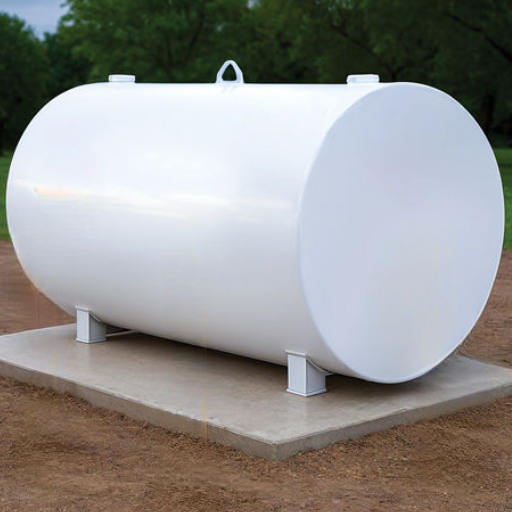
Heat loss tracks external surface area, so surface-area-to-volume ratio decides your heating bill. A tall, compact tank exposes less shell per gallon than a long, low tank of equal capacity, which makes it cheaper to keep warm. That is a real advantage for vertical storage tanks whenever you heat product above ambient.
Placement can beat insulation entirely. A buried horizontal tank sits near a stable ground temperature of roughly 50 to 55 °F in many climates, so it rarely needs heat and avoids the temperature swings that drive condensation. Where burial is feasible and code permits, the ground does the work.
Two interactions are worth flagging. Base heat loss on a heated tank depends on that foundation’s design and insulation, which our vertical storage tank foundation guide covers. And how you can insulate a tank depends on whether it is buried or bunded, which our self-bunded fuel tanks guide explains.
Frequently Asked Questions
Do I need to heat my diesel storage tank?
Only aboveground tanks in genuinely severe climates usually need heat. Buried tanks sit at a stable ground temperature and rarely qualify. If your aboveground diesel sees sustained temperatures near or below your grade’s cloud point, plan for insulation at minimum.
Can you heat a gasoline storage tank?
No. Gasoline is a Class I flammable liquid with a flash point far below ambient, and it does not wax, so heating it adds danger without benefit. Explosion-protected heaters are limited to non-flammable liquids or liquids with a flash point of 55 °C or higher, never above that flash point.
How many watts per gallon do I need to heat a fuel tank?
There is no fixed rule. Size from surface area, insulation R-value (use R = 0.5 for bare steel), the design temperature difference, and a 1.2 safety factor. For reference, an 8,000-gallon tank holding 40 °F at −20 °F needed about 2 kW, roughly 0.25 W per gallon.
Does a tank heater need to be explosion-proof?
Yes, if the tank sits in a classified area. The heater is electrical equipment in a hazardous zone. Its surface temperature must stay below the vapour’s auto-ignition temperature, and it must carry the right ATEX, IECEx, or UL listing for the zone, gas group, and temperature class.
Do underground fuel tanks need heating?
Usually not. A buried tank sits near a stable ground temperature of roughly 50 to 55 °F, well above diesel’s cloud point, so it rarely needs heat and sees fewer temperature swings than an aboveground tank.
What temperature should diesel be stored at in winter?
Holding diesel near 40 °F is a common maintenance target. It sits far below diesel’s flash point, so it is safe and achievable, and it keeps the fuel above typical cloud and pour points.
Always confirm the final selection with your authority having jurisdiction and a qualified engineer.
Cold-Weather Fuel Integrity Comes Down to Sequence
Cold stops diesel in two stages. Wax forms at the cloud point and seizes a filter at the CFPP, while water freezes first at 32 °F. Fuel quality and water management come before any hardware you buy.
The engineering order that works is consistent. Insulate to cut the heat load, manage water with full tanks and seasonal draining, treat or blend the fuel for the season, size the heater from surface area and R-value, and certify the installation for the hazardous area. Skip a step, and you pay twice.
A fuel tank heating system that’s oversized but sits on bare, wet steel wastes money every night it runs, and one that’s uncertified is a hazard regardless of how well it works. The right system is the smallest one that holds your fuel in its safe flow range, on insulation that keeps it there.
Our team designs cold-climate fuel storage, insulation, and fuel tank heating system packages for depots, generators, and remote stations, and documents them for the market you build in. Talk to our engineers about your site, or review the aboveground diesel storage tanks we build for cold-weather duty.