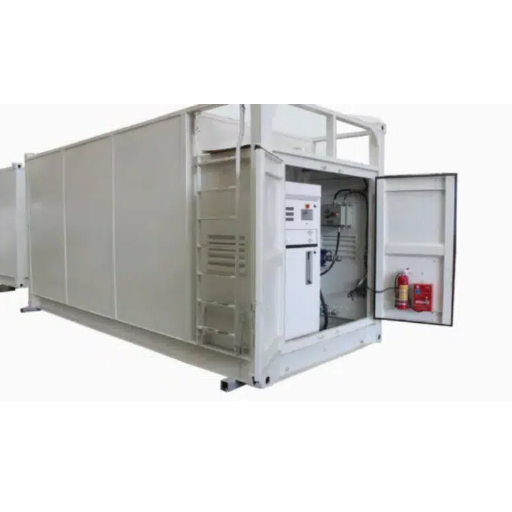
A skid-mounted fuel station usually needs site approval even when the unit itself is certified. Skid station permit requirements depend less on the equipment than on the land use, the fuel storage, and the dispensing activity. The approval path changes with throughput, fuel type, and whether the site is public retail or private fleet use.
The rejection rarely comes from the tank. It arrives when the fire authority asks for a containment calculation the supplier never issued, or when planning says the site is zoned for something else.
You picked a unit with a tank listing, an Ex-rated dispenser, and a transport plate, and assumed the paperwork was finished. It usually isn’t. A certificate proves a component meets a standard. A permit proves a place and an activity are allowed.
This guide separates the four approvals that decide whether a station opens, explains why a certificate is not a permit, and shows how rules change by market and calendar.
Key Takeaways
- A CSC plate, UL listing or ATEX certificate is not a permit. It is evidence inside a fire, planning, environmental or petroleum-licence application.
- Four approvals run in parallel: land use, fire and hazardous substances, environment, and petroleum market licence. Passing one doesn’t pass another.
- “Temporary” is a permit category with a clock, usually 90 days, 180 days, one year or 24 months, not an exemption.
- Public retail is the hardest category. Private fleet or industrial own-use is usually a lighter permit, often for the same equipment.
- The two documents that fail most often are the containment calculation and the fire-rated listing for gasoline.
Do skid stations need permits? The short answer
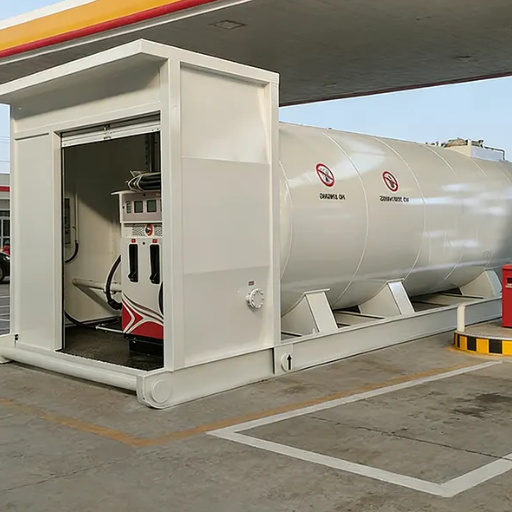
Yes. Skid station permit requirements apply in most jurisdictions: a skid-mounted fuel station needs site approval before it can store or dispense fuel. The permits attach to the land use, the stored volume and the dispensing activity, not to the skid itself. A certified unit can still be refused an operating licence.
A skid is a delivery format, not a regulatory category. The regulator sees an aboveground tank, a dispensing point and hazardous material at a specific address, and asks who may keep fuel there, how much, for whom and for how long.
Two identical units can face different paths. A 25 m³ diesel skid at a private mine is usually a lighter case than a 20 m³ gasoline unit selling to the public. The equipment can be identical; the land use and licence category are not.
The covers the unit itself. This article covers the approvals around it. If you already have a site, send the plan and the use case to our team.
Why the equipment certificate is not the permit
A certificate is evidence. A permit is permission. Mobile fuel station permits sit with the site, not the product. Suppliers sometimes blur the two, and buyers pay for the confusion in delay. That distinction drives most skid station permit requirements.
| What a supplier may say | What the instrument actually covers |
|---|---|
| “CSC certified, so it can be installed anywhere” | The CSC plate is a transport credential for a freight container, not fire safety, planning, or fuel licensing. |
| “UL 142 tank, so the fire authority will accept it” | UL 142 covers steel aboveground tank construction but gives no fire rating. Gasoline often needs a UL 2080 or 2085 protected tank. |
| “ATEX certified, so the station is approved” | ATEX 2014/34/EU certifies equipment for explosive atmospheres. ATEX 1999/92/EC imposes workplace duties. Neither is a site permit. |
| “Self-bunded, so no bunding permit” | Self-bunding can reduce civil works. It doesn’t remove planning, fire, environmental, or petroleum-licence approvals. |
| “We handle all local permits” | A manufacturer can supply drawings and certificates. It can’t issue a planning consent, EIA licence, fire certificate, or retail licence. |
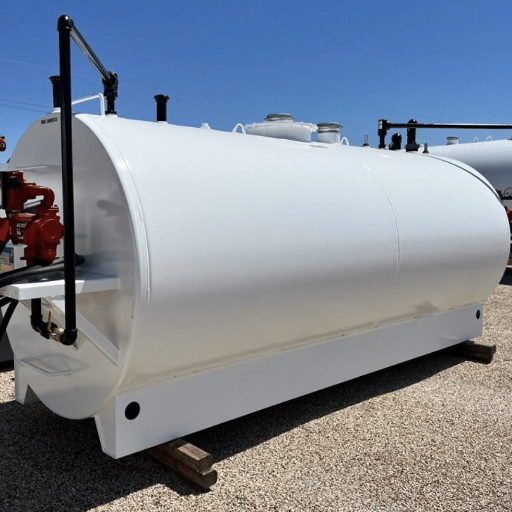
Aboveground fuel tank permit requirements often go beyond the tank listing. A UL 142 tank is a legitimate aboveground steel tank, but gasoline at a retail or fleet site often needs a protected tank with a fire rating, which UL 2080 and UL 2085 cover. The . UL 142 alone answers a construction question, not a fire question.
NFPA 30A Chapter 14 covers on-demand mobile fueling vehicles and safety cans, not a stationary skid. A skid at a fixed site is treated as a fixed aboveground tank system under the and the local fire code, and from a portable service station.
Three permit claims to test before you sign
Test any permit claim by asking which authority issues it, under which instrument, for which use, and for how long. If the answer is a certificate, the claim is wrong. Three claims come up more than any others.
- “Permit-free” or “no permits required.” No jurisdiction in this research allows unpermitted fuel storage and dispensing at a fixed site.
- “Temporary, so exempt.” Temporary is usually a permit with an expiry date, a volume cap, or a non-retail condition.
- “We handle all local permits.” A manufacturer can support an application. It cannot issue a regulator’s approval.
The four approvals that decide skid station permit requirements
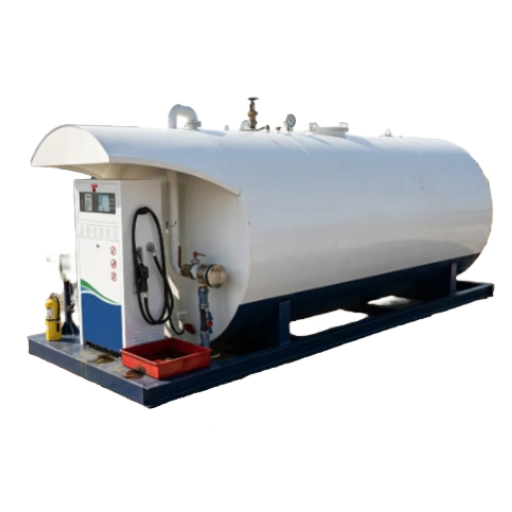
The approvals are easier to plan once you stop looking for one permit. There are four tracks. They run in parallel, and none substitutes for another.
| Track | What it decides | Typical instrument | Who leads |
|---|---|---|---|
| Land use and planning | Whether a fuel facility may exist at that address, at that size, with that access | Planning permission, zoning clearance, conditional use permit, site-plan approval | Municipality or planning authority |
| Fire and hazardous substances | Whether the tank, dispenser, containment, separation and emergency arrangements are acceptable | Fire permit, petroleum storage certificate, technical study, fire safety certificate | Fire authority or civil defence |
| Environment and spill risk | Whether the site can contain a release and whether an impact assessment is required | EIA licence, spill prevention plan, discharge permit, groundwater approval | Environment agency or municipality |
| Petroleum market licence | Whether the operator may store, sell or dispense fuel at all | Retail licence, consumer-site licence, storage licence, approval to construct | Energy or petroleum regulator |
Land use comes first, because a planning refusal ends the discussion. The authority asks whether a fuel facility belongs at that address, whether access is safe, and whether the proposal fits the zoning.
The fire track is the most technical. The fire authority reviews tank type, containment, separation, dispenser placement, emergency access, and firefighting water. This is where the matter more than the sales brochure.
Fuel station environmental approval depends on volume, fuel type, and location. In the United States, an SPCC plan is generally required above 1,320 gallons of aboveground storage, with containment rules under . Elsewhere, an environmental impact assessment (EIA) screening, discharge permit or groundwater approval may apply.
Petrol station licence requirements are the track buyers miss. Planning permission doesn’t give you the right to sell fuel, and a fire certificate is not a retail licence. The regulator decides whether the operator is fit to hold, sell or dispense petroleum products, and it often requires an approval to construct first.
Import, customs and metrology sit outside the four, but none replaces them.
How skid station permit requirements change with use
Use changes the application more than the equipment does. Public retail adds a market licence, public-access fire requirements and sometimes minimum spacing. Private fleet or industrial own-use can be lighter, but planning, fire and environmental approvals remain. A temporary worksite adds a duration condition.
“Temporary” is a permit category, not an exemption
Temporary is the most expensive word in a skid quotation. The buyer hears flexibility. The regulator hears an expiry date.
| Jurisdiction | Temporary rule | What it means for a skid buyer |
|---|---|---|
| Wisconsin | A movable tank may stay on a customer’s property for 24 months, then must be removed, replaced, or recertified. | The longest clock found. After 24 months, the unit is a regulated aboveground tank. |
| Bexar County, Texas | Temporary tanks are permitted for 180 days and can be re-permitted as temporary only once. | A second 180-day term may be the end of the temporary route. |
| Maine | An aboveground tank at a temporary worksite for 180 days or less needs no permit. Beyond 180 days, it needs one. | The exemption is a duration, not a use class. |
| Orange County, California | Streamlined review applies only to temporary use of 90 days or less and 12,000 gallons or less. | 90 days is a review shortcut, not a licence. |
| Renton, Washington | A temporary tank permit expires within one year. Extensions need Fire Marshal approval. | Possible, but discretionary. |
| Elgin, Illinois | Temporary dispensing tanks are capped at 2,500 gallons, set 30 feet from buildings and property lines, and limited to non-retail use. | A temporary permit may cap volume and prohibit public retail. |
A temporary fuel station permit has a limit, and the limit is the approval. When it expires, the unit must move, be recertified, or be permitted as a fixed tank. A unit that stays put and gets plumbed in usually leaves the temporary category even without a new application.
Permit expiry, a change of use, a volume increase, or a permanent foundation and piping usually triggers that change. The should be planned around those triggers, not the delivery date.
Skid station permit requirements, market by market
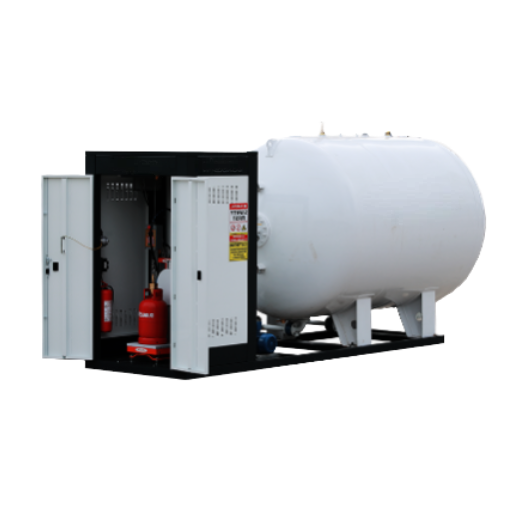
Fuel station permit requirements vary by market, so this table is a project checklist, not a legal opinion. Every row names the authority that leads and the trigger that brings a skid into the system. Requirements were checked in November 2026.
| Market | Who leads and with what | What triggers it | What catches skid buyers |
|---|---|---|---|
| United States | Local fire marshal or AHJ: IFC construction and operational permits; zoning; state tank registration | IFC operational permit; NFPA 30A limits of 12,000 gallons individual and 48,000 aggregate; SPCC above 1,320 gallons | Gasoline often needs UL 2080 or 2085, not UL 142 alone; some codes ban public skid dispensing; 90- or 180-day temporary limits |
| United Kingdom | Petroleum Enforcement Authority: petroleum storage certificate; local planning; DSEAR 2002 | Static tank, containment and pump dispensing petrol into a vehicle; apply 6 months to 28 days ahead; 28 days’ notice for works | A movable container can fall outside the certificate, but planning and DSEAR remain; fixing it in place brings the certificate back |
| European Union | Member-state installation permit; ATEX 1999/92/EC; EIA where listed | National permit and planning; Seveso III entry 34 starts at 2,500 tonnes | Seveso is not the issue at skid scale; the national permit and ATEX workplace assessment are |
| Kenya | , then retail licence; NEMA EIA; county fire clearance | 45 plus 30 days, no EPRA fee; 2025 spacing and staffing rules | NEMA and fire clearance are prerequisites; drawings need registered engineers to KS 1969:2013 and KS 2506:2014 |
| Nigeria | NMDPRA retail-outlet licence: site suitability, Approval to Construct, storage and retail licence; fire certificate | Pump 15 metres from the road; 400 metres between stations; maximum four per 2 kilometres | The retail checklist assumes a forecourt; confirm the private industrial category first |
| South Africa | DMRE site and retail licences; zoning; NEMA; SANRAL if a national road | DMRE decision in 90 days; NEMA Activity 14 at 80 to 500 m³ | A 20 to 30 m³ skid is below the 80 m³ EIA trigger, but zoning, fire and DMRE licences remain |
| India | PESO Form XIV retail pump, Form XVI storage; state fire NOC; local planning | Class C diesel no-licence limit 45,000 litres; Form XIV needs Rule 144 NOC, Rule 126 test and Rule 130 certificate | Under 45,000 litres may avoid the storage licence; a retail pump still needs Form XIV |
| UAE, Dubai | SCE approval under Resolution 85/2025; municipality; RTA; Civil Defence | No retail station without SCE approval; apply through a national petroleum company; approval lapses in one year | Own-use industrial fueling is a separate AED 4,000 permit; there is no direct application |
| Saudi Arabia | Ministry of Energy requirements; Civil Defence permit and technical study; SASO; SBC 801; municipality | Technical study before a municipal licence; 1 kilometre urban spacing; a mobile category exists | The technical study gates the municipality; a supplier fire report does not replace it |
| Philippines | DOE Certificate of Compliance; LGU zoning, building, and Mayor’s permits; DENR ECC; BFP fire certificate | DOE DC 2003-11-010 pre-construction and pre-operation document lists | DOE and LGU approvals are separate. |
Three rows change the decision most often. In the United States, the fire authority is local, and the gasoline tank usually needs a fire-rated listing.
In the United Kingdom, a movable container can sit outside the petroleum storage certificate, but planning and DSEAR still apply. Fixing it in place brings the certificate back. The sets out the scope.
In Dubai, the applicant can’t apply directly; own-use fueling is a separate permit, and the sets the route, fees, and one-year validity.
US skid station permit requirements are set locally, and review commonly runs 2 to 8 weeks. No national standard covers every authority.
The document pack that gets an application accepted
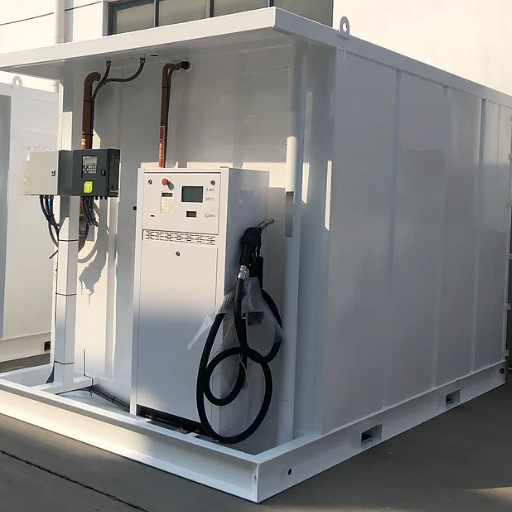
The lists the twelve documents a supplier sends. The regulator reads a different pack, grouped by stage. Missing documents are the most common reason a clock stops.
At enquiry or feasibility
- A scaled site plan with boundaries, roads, drains, tank and dispenser positions, and distances.
- A use description: public retail, private fleet, industrial own-use, temporary worksite, mining, marina or aviation.
- Fuel type, maximum stored volume, and compartments.
- A general arrangement drawing and a containment calculation with primary volume, secondary volume, and freeboard.
- Tank and dispenser datasheets, listings and Ex certificates.
- A preliminary fire separation and access plan.
At application
- Land title or lease, company registration, tax clearance and business permit.
- A zoning or conditional-use submission.
- Environmental screening, EIA or registration, or a discharge approval.
- A fire technical study signed by the qualified authority required.
- Emergency and spill response plans, and an operator training plan with a nominated responsible person.
At inspection or before operation
- Tank pressure and leak test reports, and a dispenser calibration certificate.
- Earthing, insulation resistance and Ex inspection records.
- As-built drawings, the O&M manual, commissioning records and a spare-parts list.
- Insurance and, where required, environmental liability cover.
Two documents fail more often than the rest. The first is the containment calculation. A stated “110% containment” without a volume, freeboard figure, and stormwater allowance is not a calculation. The authority wants the largest compartment volume plus freeboard, not a marketing percentage.
The second is the fire-rated listing for gasoline. A UL 142 tank certificate with no UL 2080 or UL 2085 listing, offered for a gasoline dispenser, is the most common equipment-side gap in this research.
Ask for a document pack structured for your application, not a folder of certificates. The should include that boundary, because a supplier can supply evidence but not approval.
Frequently asked questions
Do skid-mounted fuel stations need planning permission?
Usually yes, because skid station permit requirements depend on land use and zoning. A private diesel unit at an industrial site may need only a zoning clearance; a public retail site may need a conditional-use permit.
How long does a fuel station permit take?
Timelines vary by market and by how complete the application is. Only some markets publish one.
| Market | Published timeline | Source |
|---|---|---|
| Kenya | 45 days for the construction permit, plus 30 days for the retail licence | EPRA |
| South Africa | 90 days for a DMRE decision | DMRE |
| United Kingdom | Apply 6 months to 28 days ahead; 28 days’ notice for works | HSE / PEA |
| United States | 2 to 8 weeks for local review, varying by authority | Observation from this research |
Can a skid station be used for public retail?
A skid station can be used for public retail in some markets, but public retail is the hardest category. It usually adds a market licence, public-access fire requirements, and sometimes minimum spacing. Some codes prohibit public dispensing from a skid, so check the local amendment first.
What documents does a fire marshal ask for?
A fire marshal typically asks for:
- A scaled site plan with tank and dispenser positions and separation distances
- A containment calculation with volume and freeboard
- Tank and dispenser listings and Ex certificates
- An emergency and spill response plan
- Pressure and leak test reports
The list depends on the authority and the fuel; a certificate folder is not a substitute.
Is a CSC plate a permit?
No. A CSC plate is a safety approval for a freight container under the International Convention for Safe Containers. It confirms the frame is safe to lift and stack, not that the site is approved for planning, fire safety, environmental protection, or fuel licensing.
How long can a temporary fuel station stay on site?
Common limits are 90 days, 180 days, one year, or 24 months. Wisconsin allows up to 24 months, Bexar County permits 180 days, and Orange County limits streamlined review to 90 days. When the limit expires, the unit must move, be recertified, or be permitted as a fixed tank.
Next step
Skid station permit requirements are not answered by a certificate. Four approvals, a use case, and a calendar do. Start with the site, not the equipment.
Shandong Shengrui Intelligent Equipment Co., Ltd. manufactures skid-mounted fuel stations and supplies the drawings, datasheets, listings, and test reports that support an application. It cannot issue the approvals itself.
Send the site plan, intended use, fuel type, maximum volume, planned duration, and destination market. We will match the pack to those details and flag the items only the local authority can issue.
If the unit is still being specified, around the site you have in mind, not the other way round.
This guide summarizes published requirements for project planning as of November 2026. It isn’t legal advice. Confirm current rules with the named authority before you commit to a site or a purchase.