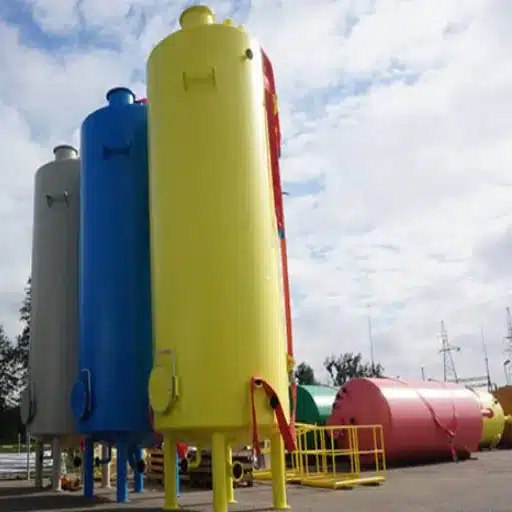
A fuel tank rarely explodes because of the liquid inside it. It explodes because of the space above the liquid — the vapor space where fuel and air mix into something ignitable. An explosion-proof fuel tank, also called a barrier fuel tank, is engineered to make that space incapable of exploding.
Here is the honest, plain-English version of how explosion-proof fuel tanks work: a conductive matrix fills the tank’s interior, dividing the vapor space into millions of tiny cells that quench flames, absorb heat, and slow pressure rise. It is not a magic shell, and it is not a substitute for venting, grounding, or flame arresters. In this guide, you will learn:
- Why the vapor space, not the fuel, is the real hazard
- The four physical mechanisms a barrier tank uses to stop an explosion
- What an explosion-proof tank can and cannot do
- The standards that prove the mechanism works
For comprehensive information, please read our article on explosion-proof tanks.
What Is an Explosion-Proof (Barrier) Fuel Tank?

An explosion-proof (barrier) fuel tank is a storage vessel whose interior is filled with a highly porous, conductive matrix — usually aluminum-alloy honeycomb or a spiral-wound barrier material. That fill divides the vapor space into millions of tiny cells that quench flames, absorb heat, and slow pressure rise before an internal explosion can develop.
Two clarifications keep the term honest:
- It is not an “Ex d” electrical enclosure. Explosion-proof equipment (motors, junction boxes, lighting) uses a different principle — containing an internal explosion so it cannot ignite the outside atmosphere. A barrier fuel tank suppresses an explosion inside the vessel.
- It is not a “fire-protected” tank. A UL 2085 fire-protected aboveground tank relies on an insulated or concrete-encased shell to survive external fire. A barrier tank stops an internal vapor-space event. A tank can be both — and often is — but they solve different problems.
In practice, two barrier implementations dominate the market. One uses an aluminum-alloy honeycomb mesh, and the other uses a HAN Barrier spiral-wound matrix. Both work on the same physics, which we explain below.
Why Fuel Tanks Explode: The Vapor-Space Problem
The liquid you can see is rarely the danger. Gasoline has a flash point of about −43 °C (−45 °F). That means it gives off ignitable vapor even on the coldest day. Above the liquid, inside the tank, sits that vapor. If the mixture falls within its flammable range and meets an ignition source, you have the ingredients for an explosion.
The Fire Triangle Inside a Tank
Every tank holds three things that can complete a fire triangle:
- Fuel vapor — always present above gasoline, and above diesel in warmer conditions.
- Oxygen — pulled in as the tank “breathes.” Day-to-night temperature swings push vapor out through the vent, then draw fresh air back in (called diurnal breathing). That air keeps the vapor space inside the flammable range.
- An ignition source — the one variable you can try to control.
The Three Ignition Scenarios
Ignition sources are more common than people assume:
- Static discharge — generated by fuel moving through pipes, splash filling, or even sludge settling. Documented refueling fires, such as a March 2002 static-ignition incident at a Tucson gas station, are almost always vapor igniting at a filler opening rather than liquid exploding.
- Lightning, hot work, or electrical faults — welding and grinding near a tank, or an electrical fault in a fitting, can ignite vapor.
- External fire — fire near the tank heats the shell and the liquid, raising pressure and weakening the steel.
Deflagration vs. BLEVE: Getting the Terms Right
When vapor ignites inside a tank, the flame front typically moves at subsonic speed. That is a deflagration, and it is the realistic internal event for gasoline and diesel stored in ordinary atmospheric tanks. As the flame spreads, pressure rises. If the pressure outruns what the vents can relieve, the shell can fail.
A BLEVE (Boiling Liquid Expanding Vapor Explosion) is different: it happens when a pressurized tank holding a liquid above its boiling point ruptures, and the liquid flashes to vapor almost instantly. That is the domain of LPG and propane cylinders, or vessels superheated by a fire. Atmospheric gasoline and diesel tanks are stored near ambient temperature, well below their boiling point, so a textbook BLEVE is not the dominant risk for them.
This distinction matters, and it is a red flag when you see vendors promise “100% BLEVE prevention” for a diesel tank. The barrier technology’s real, provable job is suppressing internal deflagration and slowing pressure rise — which we cover next.
How an Explosion-Proof Fuel Tank Works

The engineering insight is simple once stated: an explosion needs a continuous volume of flammable gas to build pressure. A barrier tank removes that continuous volume.
From One Big Volume to Millions of Small Cells
Fill a tank with expanded aluminum alloy or a spiral-wound matrix, and you replace one large open space with millions of narrow channels. Peer-reviewed work on expanded-aluminum suppression shows the matrix typically occupies only about 1–3% of tank volume.
Two specifications make the difference:
- Cell size must be small enough to quench the flame. For propane-like fuel vapors, standards require openings of roughly 2 mm or less — smaller than the “quenching distance” the flame needs to keep burning.
- Surface area must be high enough to cool the flame. National Fire Protection Association (NFPA) guidance points to a minimum surface-area-to-volume ratio around 0.25 mm⁻¹. Aluminum’s thermal conductivity, near 200 W/m·K, is what makes the heat transfer fast enough to matter.
The Four Suppression Mechanisms
When an ignition source appears inside a filled tank, four things work together to stop it:
- Flame quenching. The honeycomb or mesh cells split the flame front into segments too small and too cool to propagate. The flame literally runs out of room.
- Thermal sink. The metal matrix has enormous surface area. It absorbs heat from the flame faster than the flame generates it, so the gas never reaches sustained combustion temperature.
- Pressure-rise dampening. The matrix adds resistance to gas expansion. Instead of a fast pressure spike, you get a slower pressure rise that the tank’s emergency vents can actually handle.
- Free-radical interruption. Combustion is a chain reaction. When reactive molecules collide with the metal surface, the chain is broken — sometimes called the “wall effect.”
Corroborating studies on deflagration suppression with expanded metal mesh and polymer foams reach the same conclusion about cell size and surface area. For buyers, the practical takeaway is that this is tested, bounded physics — not an unverifiable claim.
These four mechanisms explain why barrier-filled tanks pass fire-engulfment tests that would rupture an empty tank.
What Actually Happens at Ignition
Walk through a single event: a static spark appears in the vapor space of a filled tank. The local gas flashes. But the flame front hits the nearest cell walls, loses heat, and dies. Pressure rises slightly, then the vents release it. No propagating flame, no runaway pressure, no rupture.
There is one honest caveat: suppression depends on near-complete fill of the vulnerable volume. NFPA 69, the U.S. standard for explosion prevention systems, validates suppression in vessels that are effectively full of matrix. A barrier that only covers part of the tank gives only partial protection — which is exactly why certified tanks are filled at the factory to a verified density.
Some accessories are necessary during use, you can read our article on explosion-proof tank safety accessories.
What Barrier Tanks Do and Don’t Do
Engineers distrust absolutes, and so should buyers. Here is the honest picture:
| A barrier fuel tank CAN | A barrier fuel tank CANNOT |
|---|---|
| Suppress an internal vapor-space explosion | Stop ignition of leaked vapor outside the tank |
| Slow the pressure rise so relief vents can act | Replace venting, flame arresters, or grounding |
| Absorb heat and buy time during an external fire | Prevent rupture from extreme impact or projectile damage |
| Dissipate static charge through the conductive matrix | Guarantee protection if only partially filled |
The last row is the most important to internalize. An explosion-proof barrier tank is one layer in a compliant storage system. It earns its keep by making the tank’s own interior non-explosive, which is exactly what enables siting decisions like placing storage closer to a property line. But it works alongside — never instead of — spill containment systems, overfill prevention devices, pressure/vacuum vents, and bonding and grounding.
“Is It Really 99.9% Explosion-Proof?” Reading Vendor Claims

You will see dramatic numbers online: “99.9% suppression,” “100% BLEVE prevention,” “0.8% volume displacement.” Read them with care.
A. M. Birk’s 2008 review of expanded-aluminum suppression put it plainly: in this field, it can be “difficult to separate the science from the marketing.” Independent, peer-reviewed work confirms the mechanisms above and documents the design rules (fill density, cell size, surface area). What it does not confirm is a single universal percentage, because suppression depends on the tank geometry, the fuel, and how completely the matrix fills the vessel.
Here is how we read claims at Shandong Shengrui:
- Supplier-reported figures are just that. A manufacturer’s “99.9%” comes from that manufacturer’s own test protocol. Ask for the protocol, the fill density, and the test vessel size.
- Independent standards are the stronger proof. A tank built and filled to NFPA 69 suppression requirements, with certified appurtenances, is a more trustworthy claim than any marketing percentage.
- Capacity-loss numbers deserve the same skepticism. Engineering literature puts matrix occupancy at roughly 1–3% of tank volume; the “<1.1%” you sometimes see is a vendor-specific figure, not a law of physics.
When you see honest numbers, honest limits, and a named standard, you are likely dealing with real engineering. That is the standard we hold ourselves to — which is why our certified explosion-proof barrier fuel tanks document the mechanism, the fill density, and the compliance path rather than a single dramatic percentage.
The Standards Behind the Mechanism
The barrier tank’s working principle is not folklore — it is codified in national and military standards.
- NFPA 69, Standard on Explosion Prevention Systems — the reference for expanded-metal explosion suppression. It specifies matrix density, surface-area-to-volume ratio, cell size, and the test methods used to validate suppression.
- Military lineage — expanded-aluminum suppression was first developed in the late 1970s (the Canadian “Explosafe” product) and evaluated by the U.S. Air Force for aircraft fuel tanks (report AFWAL-TR-80-2043). Aviation’s lesson from vapor-space events like the TWA 800 center-tank explosion drove the technology’s adoption and refinement.
- Tank construction — the vessel itself is built to storage-tank standards such as UL 142 for aboveground tanks and UL 58 for underground tanks. For export to China, AQ 3001–3002 and GB 50156 govern barrier-material and station compliance.
A note on scope: barrier suppression is an internal protection strategy, and it does not remove the tank’s venting and flame-arrester duties. Standards for venting (API 2000) and flame arresters (EN ISO 16852) still apply to the openings. For a broader comparison of certification schemes, see our ATEX vs. IECEx vs. UL certification guide.
Where Barrier Fuel Tanks Are Used

Because a barrier tank changes the risk profile of the vessel itself, it shows up where an explosion would be catastrophic or where siting rules are tight:
- Dense-urban aboveground storage — a barrier tank can support a reduced-setback argument that a conventional single-wall tank would fail.
- Containerized and skid-mounted stations — the compact, relocatable format pairs naturally with a tank that is safe by design, as in our explosion-proof container and skid station range.
- Fleet and generator day tanks — where fuel sits near people, equipment, and buildings.
- Mining, defense, and remote operations — where a fire truck may be hours away, and the tank must survive a worst-case on its own.
Consider an illustrative scenario: a distributor in a congested city needed aboveground diesel storage closer to the property line than local rules allowed for a single-wall tank. By specifying an internal-suppression barrier tank, the site’s risk assessment changed — the storage could be sited nearer the boundary, with less weight and less cost than a concrete-encased alternative. The physics was the same one described in this article; the barrier simply made the tank’s interior a non-event. For a detailed comparison, please read our explosion-proof barrier materials guide.
For a step-by-step maintenance procedure, please read our explosion-proof tank maintenance and inspection checklist.
Frequently Asked Questions
Can a fuel tank explode?
Yes, but rarely because the liquid ignites. The vapor space above the fuel ignites when it is in the flammable range and meets an ignition source. In an open or partially filled space that produces a flash; in a confined tank, it can produce a damaging pressure rise. Barrier fill prevents that internal event.
How much fuel capacity do I lose with barrier fill?
Typically about 1–3% of usable volume, based on peer-reviewed engineering literature. Some suppliers report lower figures for their specific material. The trade-off is small, and most operators consider it a worthwhile price for a tank whose interior cannot sustain a propagating flame.
Is an explosion-proof barrier tank the same as a double-wall tank?
No. A double-wall (or SF) tank provides secondary containment to catch leaks; a barrier tank provides internal explosion suppression. They solve different problems and are often combined — a barrier-filled double-wall tank offers both. Our SF double-wall tank guide explains the containment side.
Does the barrier material ever need replacing?
Under normal service, expanded-aluminum and HAN-type matrices are designed to last the life of the tank. What needs periodic attention is the system around them: vent and flame-arrester cleaning, grounding checks, and interstitial or leak monitoring. Fuel chemistry matters too — aggressive blends can affect the alloy, so match the material grade to your fuel.
Do I need a barrier tank for diesel?
Diesel has a higher flash point than gasoline, so its vapor is less eager to ignite at ambient temperature. But diesel storage is not risk-free, especially in warm climates, near ignition sources, or under external fire. Many operators choose barrier fill for peace of mind and for siting flexibility rather than because code demands it.
What standards prove an explosion-proof tank works?
Look for suppression validated to NFPA 69, a vessel built to UL 142 or UL 58 (or your local equivalent such as GB 50156 / AQ 3001), and certified appurtenances — vents, flame arresters, and intrinsically safe gauging. A manufacturer that names its standards and its fill density is easier to trust than one that quotes a percentage.
Conclusion
An explosion-proof (barrier) fuel tank works by making the vapor space incapable of supporting an explosion. It fills the tank with a conductive matrix that quenches flames, absorbs heat, slows pressure rise, and interrupts the combustion chain — grounded in peer-reviewed science and codified in NFPA 69.
The takeaways that matter for your decision:
- The vapor space is the hazard, not the liquid.
- Suppression is about cell size and surface area, not magic materials.
- Full fill is essential — partial protection is not protection.
- A barrier tank is one layer — vents, grounding, and flame arresters are still mandatory.
- Trust standards over percentages — “99.9%” is marketing; NFPA 69 is engineering.
If you are evaluating an explosion-proof fuel tank for a site, bring the questions from this guide to the conversation: What is the fill density? What standard validates suppression? What happens to the vents and gauging? Ask those, and you will separate real engineering from claims.
Need help specifying a certified barrier fuel tank for your project? Request a quote and our engineers will walk through the mechanism, the standards, and the configuration that fits your site.