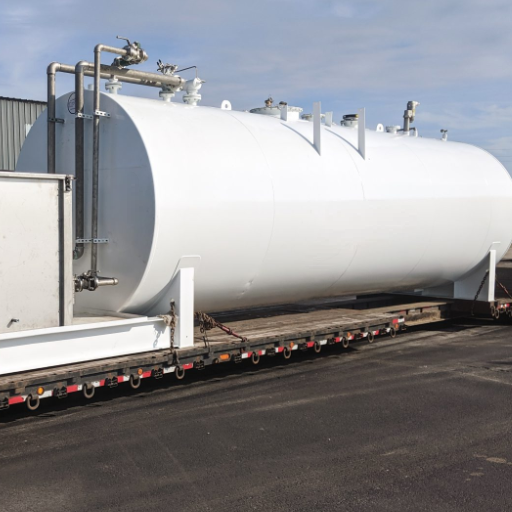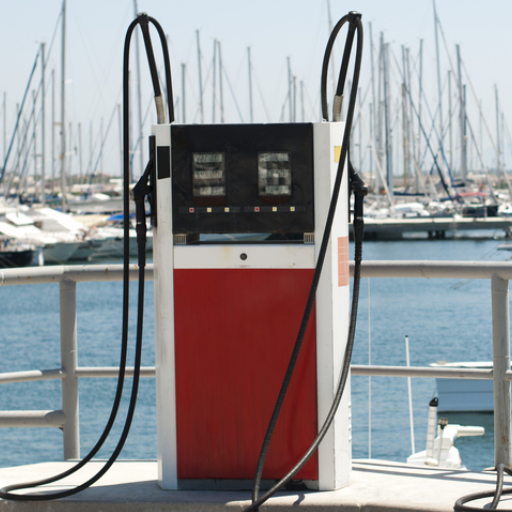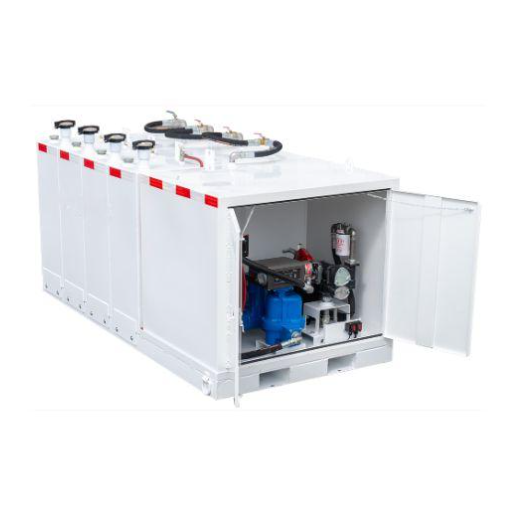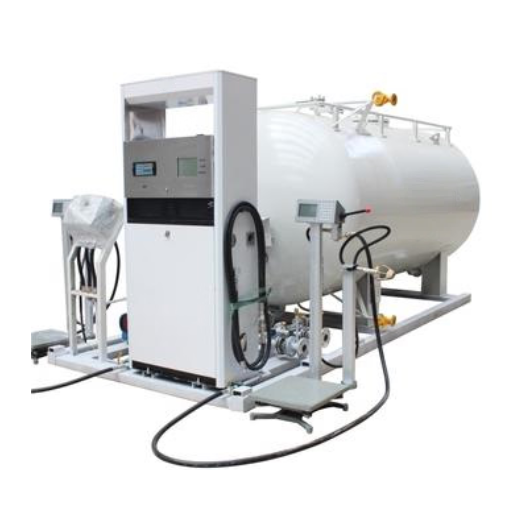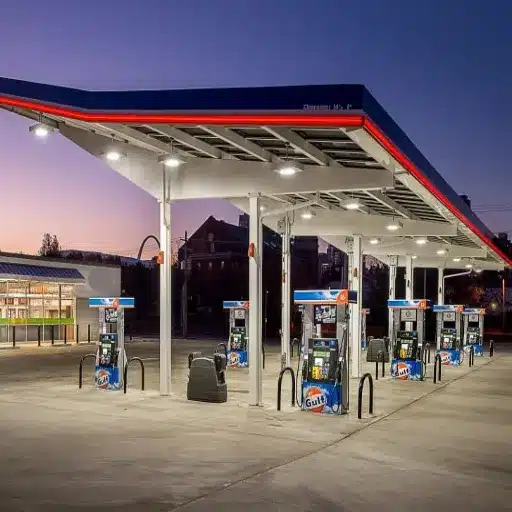
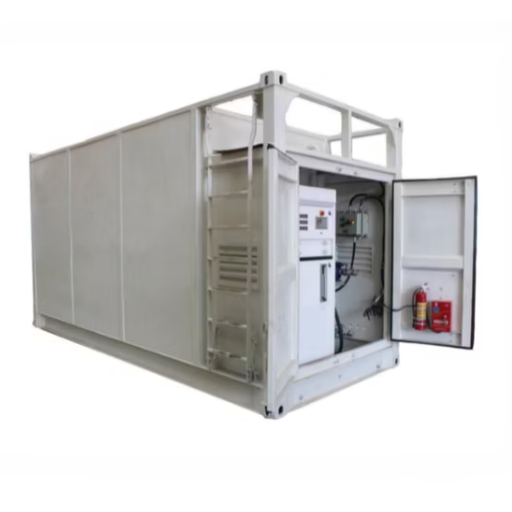
A 40ft skid station is a fuel storage and dispensing unit built into a 40ft ISO frame. Most units are rated between 60,000 and 68,000 liters nominal, carry one to three compartments, and put the pump set, dispenser, and controls on the same frame. The figure that decides whether the unit works at your site is not the nominal one. It is usable liters at 95% fill, gross mass when full, and the containment volume behind any bund claim.
Ask four suppliers what a 40ft skid station holds, and you can get five answers. One quotes 60,000 liters. One quotes 65,000. One quotes 68,000 and calls it high-cube. Another says “over 40,000”.
A fifth quotes cubic meters for the container and liters for the tank, and that is the only honest one of the group, because they are different measurements.
You already know capacity matters. What you need is a way to compare quotes that use one word for three quantities. This guide separates nominal, usable and deployable capacity, works the envelope arithmetic for standard and high-cube frames, then covers configuration, site architecture, ground loading and the specification points that decide whether the unit is safe and legal. If you are still choosing between footprints, start with the capacity selection method and come back.
Key Takeaways
- A 40ft standard frame holds 67.7 m³ of internal volume and a high-cube holds 76.4 m³. A 60,000 L tank uses 88.6% of the standard box before a pump, panel, or aisle goes in.
- Published nominal figures of 60,000 to 68,000 L become about 57,000 to 64,600 L usable at 95% fill, and less again once compartments are added.
- A true external bund at 110% caps a 40ft high-cube near 36,000 L. A 60,000 L claim therefore depends on a double-wall tank with a monitored interstice, not an external bund.
- A full unit weighs about 65 to 72 tonnes against a 30,480 kg plate on most 40ft containers. It ships empty and is filled on site.
- Each added compartment costs dead volume plus its own fill point, vent, meter, and overfill protection. Three products in one frame is a plumbing decision, not a checkbox.
What a 40ft skid station frame actually gives you
The envelope, standard versus high-cube
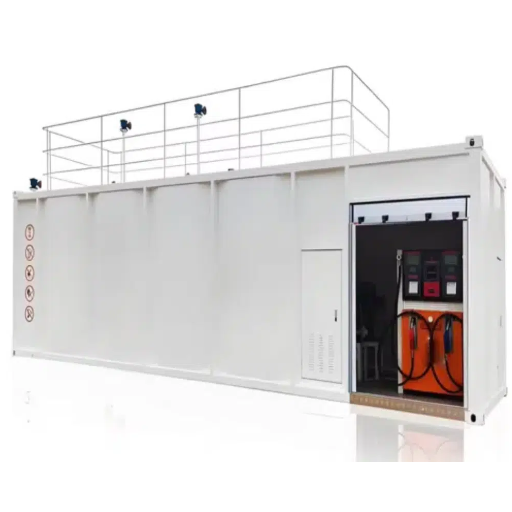
External dimensions are fixed by ISO 668: 12.192 m long, 2.438 m wide, and 2.591 m high for a standard 40ft frame. The high-cube raises the height to 2.896 m, an extra 305 mm. Our own shipping and logistics guide uses the same figures, and they match the specification table on the 40ft product page.
Internal volume is what the tank can use. Typical internal dimensions are 12.032 × 2.352 × 2.393 m for the standard box and 12.032 × 2.352 × 2.698 m for the high-cube. Multiply those out, and you get the two numbers everything else depends on:
| Parameter | 40ft standard | 40ft high-cube |
|---|---|---|
| External dimensions | 12.192 × 2.438 × 2.591 m | 12.192 × 2.438 × 2.896 m |
| Internal dimensions | 12.032 × 2.352 × 2.393 m | 12.032 × 2.352 × 2.698 m |
| Internal volume | 67.7 m³ | 76.4 m³ |
| Volume gain over standard | none | about 13% |
The high-cube adds nearly 9 m³, which is why capacity claims differ so much between the two frames, and it raises the center of gravity when full.
What the tank has to share the box with
A container is a box, not a tank. Turning it into a 40ft container fuel station means fitting a tank inside an envelope that already has corrugated walls, a floor structure, and a roof. The tank then shares the remaining volume with five things:
- Tank walls and stiffeners. The double-wall construction our product page describes uses 6 mm inner and outer plate on the standard model, and 8 mm inner and 6 mm outer on the high-cube.
- Bulkheads: one stiffened plate per compartment division.
- The pump bay, holding pumps, meters, filtration, hoses, and the electrical panel.
- Ullage, the vapor space the overfill protection needs.
- Access to fill points, gauge, valves, and leak detector.
A design that quotes a capacity without saying where those five things sit has skipped the only calculation that matters. The high-cube helps, because the extra height can become tank height without taking length from the pump bay.
How much fuel a 40ft skid station really holds
Nominal, usable, and deployable
Every capacity number is one of three measurements with the same word.
Nominal capacity is the geometric volume of the tank shell. When a datasheet says 60,000 L, this is almost always what it means. Usable capacity is about 95% of nominal, because the top 5% is ullage and overfill margin. Deployable capacity is what you can draw between deliveries at your site, after the heel, the unusable bottom, the compartment split, and any reserve.
| Check | 40ft standard | 40ft high-cube |
|---|---|---|
| Internal volume of the frame | 67.7 m³ | 76.4 m³ |
| Published nominal tank | 60,000 L | 65,000 to 68,000 L |
| Tank as a share of the envelope | 88.6% | 85.1% to 89.0% |
| Usable at 95% fill | 57,000 L | 61,750 to 64,600 L |
| Fuel mass at 95% fill (diesel at 0.835 kg/L) | 47.6 t | 51.6 to 54.0 t |
| Published gross mass when full | about 65 t | about 72 t |
Read the third row again. A 60,000 L tank fills nearly nine-tenths of a standard 40ft box, and a 68,000 L tank fills 89% of a high-cube. In those designs, the tank is not equipment inside the container. It’s the container, with a dispenser attached.
That’s a legitimate way to build one. It’s also why the pump bay, aisle, and fill points have to sit outside the tank envelope, and why a buyer should ask for the general arrangement drawing rather than a photograph.
The containment design that sets the ceiling
Containment is where 40ft capacity claims diverge most, because “secondary containment” describes two different constructions.
| Design | What it is | Volume it costs | Typical consequence |
|---|---|---|---|
| External bund at 110% | A separate containment volume sized at 1.1 times the tank | The bund plus the tank, so 2.1 times the tank volume in total | Caps a 40ft standard near 32,000 L and a high-cube near 36,000 L |
| Double-wall tank with a monitored interstice | A tank inside a tank, with a small gap monitored for leaks | A few percent of tank volume | Supports 60,000 L or more, but the interstice detects a leak; it doesn’t hold a full release |
Run the arithmetic on the first row. A 40ft high-cube offers 76.4 m³. Divide by 2.1, and you get 36.4 m³, or about 36,400 liters of primary tank.
That’s the true ceiling for an external 110% bund inside the frame, and it is why a page that advertises 65,000 L and a page that advertises 36,000 L can both describe a 40ft station honestly. They’re describing different containment designs.
The second row is where most high-capacity units live. A 60,000 L tank in a standard frame needs 60 m³ inside a 67.7 m³ box, leaving 7.7 m³ for the outer shell, the interstice, stiffeners, the pump bay, and the fill points. It can be done, but only if almost every cubic meter is allocated. Interstitial monitoring is what makes the design safe, because the gap is the leak detector.
Now test the top of the range. A 68,000 L tank in a 76.4 m³ high-cube is 89% of the envelope. Add a true external 110% bund, and you need 74.8 m³, or 98% of the box.
Nothing is left for a pump, a panel, an aisle, or a person. A 68,000 L 40ft high-cube fuel station can exist, but only as a double-wall tank that fills the frame, with dispensing equipment outside the tank envelope or in a small end bay.
That’s the question to put to any supplier, including us: what is the bund volume in cubic meters, and where does the pump bay sit? The answer tells you which design you are buying.
A quarry manager we will call Owen compared two quotes for a remote pit, one at 60,000 L and one at 45,000 L, and chose the larger because the price per liter was better. What he had not checked was the fill level behind the number. The 60,000 L unit held 57,000 L at its working fill, and his fleet burned about 55,000 L a month. The unit arrived with a refill interval of roughly a month, not the six weeks he had planned, and the tanker route added two hours each way.
The larger tank was still the right purchase. The refill schedule built on the nominal figure was not.
The weight check
Diesel runs about 0.835 kg per liter, within a 0.820 to 0.845 range depending on grade and temperature. At 95% fill, a 60,000 L tank carries 47.6 tonnes of product. Add tank, frame, pumps, and panel, and this fuel skid reaches the published gross mass when full: about 65 tonnes for the standard model and 72 tonnes for the high-cube.
The plate on a 40ft container is nowhere near that. Most plates in service read 30,480 kg maximum gross mass. ISO 668 Amendment 2, published in 2016, raised the permitted maximum to 36,000 kg for standard containers of all sizes except the 10ft, but a plate is what a port, haulier or crane operator reads, and many units still carry the older figure.
| Condition | Mass | Against a 30,480 kg plate |
|---|---|---|
| Empty unit, dry | about 13.4 t for a 60,000 L high-cube | within the plate |
| Full at 95% fill | 65 to 72 t | 2.1 to 2.4 times the plate |
| Static load on the pad | 65 to 72 t over about 29.7 m² | about 22 to 24 kN/m² average |
Two conclusions follow. A full 40ft skid station doesn’t travel by container ship, rail, or standard skeletal trailer: it ships empty and is filled on site. And the site has to carry the full mass, not the shipping mass, which changes the foundation.
Configurations: one tank, twin chamber, three-chamber, and AdBlue
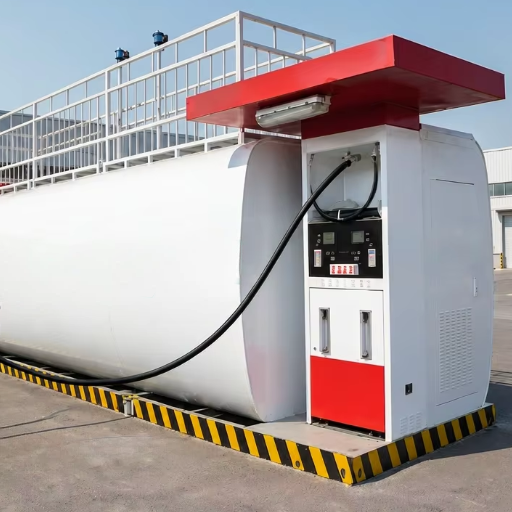
A 40ft skid-mounted fuel station can carry one product or several. The product page lists one to three chambers for diesel, petrol, and AdBlue. The engineering question is what each added chamber costs.
What each added chamber costs
A compartment isn’t a divider dropped into a tank. It is a stiffened bulkhead with its own fill point, vent, suction line, meter, and overfill protection. It also creates dead volume: the space between the bulkhead and the usable liquid, plus the heel you can’t draw.
Plan on 1% to 2% of total nominal capacity per added bulkhead, plus the loss from not being able to trim product between compartments. A 60,000 L two-chamber tank might hold 59,000 L across both. A three-chamber version might hold 58,000 L. Small compared to 60,000, but it compounds with the 95% fill rule and the containment design.
The higher cost is plumbing. Each product needs a dedicated line from tank to dispenser, a dedicated meter for stock reconciliation, and a dedicated overfill sensor. A three-product 40ft container fuel station has three times the fill connections, three vent paths, and three leak-detection zones. That is why multi-product units cost more per liter, and why the extra cost is mostly in the parts you cannot see.
Segregation and cross-contamination
Petrol and diesel can share a frame. They shouldn’t share a line, a meter, a hose, or a fill point. Petrol in diesel raises the flash point and can damage a common-rail engine; diesel in petrol smokes and knocks. The product page addresses this with independent venting, interstitial leak detection and dedicated fill points per chamber, which is the minimum.
If AdBlue is in scope, it needs its own tank, not a chamber shared with fuel. AdBlue is a urea solution that crystallizes, attacks mild steel and galvanized surfaces, and has a shelf life measured in months. It is stored in 304 or 316L stainless steel or a compatible plastic tank, and needs a dedicated dispenser or nozzle.
The 40ft product page describes dedicated stainless sub-tanks for AdBlue, which is the right construction. Don’t accept a mild-steel chamber with a liner as an equivalent.
A depot engineer we will call Priya priced this for a three-product site. The first quote put diesel, petrol, and AdBlue in one frame with three chambers. The second put diesel and petrol in the frame and AdBlue on a separate small skid.
The second was cheaper, easier to service, and removed the risk of a urea spill contaminating 40,000 liters of diesel. The single-frame layout was viable, but only with a stainless, independently monitored AdBlue sub-tank. Product count is a system decision, not a capacity decision.
One 40ft or two 20ft? The site architecture decision
Two 20ft containers can hold the same total volume as one 40ft unit. The choice is an architecture decision, and it changes redundancy, transport, permits, and site works.
| Criterion | One 40ft | Two 20ft |
|---|---|---|
| Nominal capacity | 60,000 to 68,000 L in one frame | 2 × 30,000 L, about 60,000 L total |
| Redundancy | One unit, one point of failure | One unit can stay in service while the other is serviced |
| Transport | One oversize or heavy lift, one delivery | Two standard lifts, easier routing |
| Site footprint | One pad, one bund, one perimeter | Two pads, more perimeter, more fencing |
| Permit surface | One approval package | Usually one package, two locations on the drawing |
| Dispensing | One dispenser cluster, up to four nozzles | Two clusters, more hose runs, more vehicle travel |
| Spare parts | One set | Common parts, two of some items |
| Cost per liter | Usually lower for tank and frame | Usually higher for steel, lower foundation risk |
The decision rule is simple enough to write down. Choose one 40ft skid station when the site has the access, the ground, and the throughput to keep a single large tank turning over. Choose two 20ft when delivery access is constrained, when downtime is unacceptable, or when the units serve different parts of the site.
Access is the criterion buyers underestimate. A 40ft unit arrives on a lowboy or flat-rack and needs a crane with enough reach at the required radius. The shipping guide puts the crane requirement at 50 to 100 tonnes for a 40ft or break-bulk unit, against about 25 tonnes for a 20ft. If the last kilometre is a mine haul road with a tight switchback, two 20ft units may be the only configuration that reaches the pad.
A project lead we will call Elena chose one 40ft for a logistics depot because the cost per liter was better. The site survey found the turning circle at the gate could not take the lowboy at the angle the delivery needed. The unit was offloaded a kilometre away and moved on a temporary road built for the purpose.
The road cost more than the savings on the tank. A 20-minute access check at the quotation stage would have caught it.
If you are comparing the footprints as products rather than as site architectures, the 20ft skid station specification guide covers the smaller frame in detail, and the 20ft containerized gas station page lists the standard model.
Ground loading and foundation for a 40ft skid station
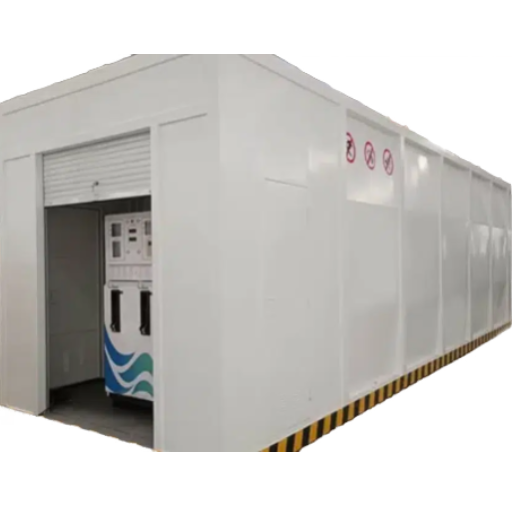
The foundation for a 40ft skid station has to carry about 22 to 24 kN/m² as an average over its footprint. That average isn’t what the slab sees. The load arrives through four skid beams or corner castings, and the pressure under a beam is several times the average.
Take a 72-tonne unit on four beams 11.8 m long. Each beam carries about 18 tonnes, or 1.5 tonnes per metre. If the beam flange is 200 mm wide, contact pressure is roughly 7.6 tonnes per square metre, or about 75 kN/m², before load spreading. A slab designed for a 20ft unit at 30 tonnes isn’t adequate.
The foundation options are the same as for any heavy aboveground tank, with larger numbers:
- Reinforced concrete slab on compacted subbase. The usual choice on competent ground. Thickness and reinforcement come from a structural engineer using the delivered mass, beam layout, and soil bearing capacity.
- Piled foundation with a transfer slab. Needed where the ground is soft, filled or variable, or where settlement would distort the frame.
- Reinforced hardstanding with a separate bund. Suitable for a unit that doesn’t rely on the pad for containment.
Anchoring matters as much as bearing. A 40ft unit is a sail when empty and a heavy box when full, so wind uplift and seismic loads have to transfer to the foundation through anchor points at the corners or along the beams. The product page lists seismic Zone 3 and Zone 4 compliance as available, which is a design option, not a foundation.
Drainage and bunding are the other half. A self-bunded unit contains a release inside its own shell. A civil bund contains it in a walled compound with a sump and a controlled outlet. The live foundation and bunding design guide covers the 20ft case in detail; the 40ft version adds mass, beam spacing, and delivery access to the same method.
Before the unit ships, send the supplier five things: a site plan with the pad location, the ground investigation or assumed bearing capacity, the delivery route and crane standing position, the finished floor level relative to the tanker fill point, and the drainage destination. Those five answers decide whether the foundation drawing is right the first time.
Transport, lifting and offloading
A 40ft skid station moves empty. The dry unit weighs about 13.4 tonnes for a 60,000 L high-cube, within a standard container’s payload. A full unit weighs 65 to 72 tonnes and isn’t a container load: it travels on a skeletal trailer, flat-rack or lowboy, lifts on certified lugs or corner castings, and needs a crane sized for the lift radius, not just the mass.
Road weight limits are governed by federal truck size and weight rules, and the transport credential is the CSC safety approval plate and its current examination date. The plate is a shipping document. It’s not a fire rating, not a tank certificate, and not evidence that the unit can dispense fuel legally. The shipping and logistics guide covers modes, road weight limits, dangerous-goods rules, crane selection, and the oversize route survey in full, and you should read it before booking freight.
Fuel quality at volume
A large tank changes fuel behavior, and not always for the better. The relevant number is turnover: how long a liter sits before it is drawn.
A 60,000 L tank serving a site that burns 60,000 L a month turns over once a month. The same tank at 20,000 L a month turns over every three months. The second site has three times the residence time, and that is where water bottoms, microbial growth, and oxidation start to matter. Diesel is most affected; petrol is more volatile and less prone to biological growth, but it still stratifies and picks up water.
The controls run from cheap to engineered:
- Settling and draining, with a drain point at the low point and a schedule.
- Filtration at the dispenser, which catches particulate and free water at the point of sale but does nothing for the tank.
- A polishing loop, a pump, filter, and water separator that circulates the tank on a schedule, the engineered answer for long residence times.
- Biocide and fill-point housekeeping where water ingress or microbial growth is established.
The best time to specify a polishing circuit is at build, not after the first contaminated load. A 40ft skid station has room for a polishing pump and filter skid in the frame if the layout allows. The diesel skid configuration guide covers fuel-side specification, and remote monitoring and telemetry is how you watch water and level between site visits.
Emissions and vapour recovery
Vapour recovery has two stages. Stage I captures vapour displaced from the tank when a tanker delivers fuel: the tanker’s vapor line connects to the tank’s vapor return, so vapour goes back into the truck instead of out of the vent. Stage II captures vapour displaced from the vehicle tank during refueling and returns it to the station tank through a coaxial hose or vacuum-assist system.
Diesel produces little vapour at ambient temperature, so vapour recovery is mostly a gasoline issue. For a 40ft skid station, the requirement follows the product and the throughput, not the tank size. A diesel-only mining unit usually has no Stage II obligation. A 40ft unit dispensing petrol at a depot or retail site may.
Specify vapour-tight fill connections, a vapor return line sized for the delivery rate, pressure and vacuum vents set for the tank design, a Stage II-ready dispenser if gasoline is in scope even where the local rule doesn’t require it yet, and clear labeling of which compartment carries which product. A vapour line connected to the wrong compartment is a real failure mode. The hazardous-area safety systems guide covers the explosion-protection side; vapour recovery is an emissions control, specified separately.
Permits, approvals and the certificate-versus-permit distinction
A 40ft skid station is not approved as a unit. It is approved as a site, and the unit is one input.
The common mistake is treating a CSC plate, a tank certificate, or a manufacturer’s declaration as permission to install. A certificate says a component was built or tested to a standard. A permit says the authority having jurisdiction allows it at this location, for this product, with these setbacks. Different documents, different bodies.
The live skid station permit requirements guide sets out the four approval tracks, covering land use, fire, environment, and transport. For a 40ft unit, the questions change in scale: fire separation is measured from a larger tank, containment volume is larger, and the delivery vehicle is heavier. The tracks are the same; the numbers inside them are not.
NFPA 30A is the usual starting point for motor fuel dispensing in US jurisdictions, and the NFPA 30A compliance guide covers its scope and tank limits. Aboveground storage with a discharge point may also bring the SPCC rule at 40 CFR 112 into play, which is about containment and inspection, not tank construction.
Total cost of ownership for a 40ft skid station
The purchase price is the smallest part of a ten-year cost model for a 40ft skid station, because the unit is the only line that doesn’t scale with the site.
| Cost line | What drives it | How a 40ft differs from a 20ft |
|---|---|---|
| Unit and options | Tank, compartments, dispenser, filtration, electrical | Higher steel and equipment cost, better cost per liter |
| Freight and lifting | Mass, dimensions, route, crane | Oversize or heavy lift more likely; crane 50 to 100 t |
| Foundation | Full mass, ground conditions, bund | Roughly twice the pad area and load |
| Installation and commissioning | Electrical, piping, testing, first fill | Similar scope, larger test volumes |
| Permits and approvals | Jurisdiction, product, throughput | Larger containment and separation numbers |
| Inspection and maintenance | Tank, dispensers, leak detection, polishing | More fuel to test and polish |
| Fuel quality | Turnover, water ingress, treatment | Longer residence time at the same throughput |
| Relocation or exit | Lift, transport, decommissioning | Heavier lift, larger route survey |
The live ten-year cost model is built on a 20ft unit and three site types. The structure carries over to 40ft, but the foundation, lifting, and residence-time lines grow. The right comparison metric is cost per liter delivered, not cost per unit.
How to specify and qualify a 40ft skid station supplier
A 40ft skid station datasheet should answer five questions before it quotes a capacity. If any answer is missing, the capacity figure is marketing.
| What to ask | Why it matters | Red flag |
|---|---|---|
| Nominal and usable capacity, per compartment | Separates shell volume from working volume | One total figure, no fill level |
| Bund volume in m³, and the containment type | Decides whether 60,000 L is physically possible | “110%” with no cubic meters |
| Measured tare weight | Without it, gross mass and plate compliance can’t be checked | “Approximate” with no tolerance |
| Maximum gross mass on the plate | Governs road legality, lifting and foundation | No plate reference |
| Flow rate at a stated pressure, per nozzle | A bare L/min figure says nothing about real throughput | Flow quoted with no pressure |
Then add the points a 40ft unit makes more important than a 20ft one: the general arrangement drawing showing the pump bay outside the tank envelope, the beam layout and lifting points, the compartment fill and vent diagram, the interstitial monitoring method and alarm setpoint, and the foundation load schedule.
A supplier who can’t produce those documents before the order will produce them after the first problem. The manufacturer evaluation criteria guide covers the wider due-diligence list, including the documentation and approvals boundary.
Want to compare a 40ft unit against the 20ft alternative before you shortlist? The 20ft skid station guide runs the same arithmetic on the smaller frame, so you can see what the extra 9 m³ of high-cube volume actually buys.
FAQ
How much fuel does a 40ft skid station hold?
Often searched as a 40 000 litre fuel station, a 40ft skid station typically holds 60,000 to 68,000 liters nominal, about 57,000 to 64,600 liters usable at 95% fill. The exact figure depends on the frame type, the containment design, and the number of compartments.
Can a 40ft high-cube really hold 68,000 liters?
It can, but only as a double-wall tank that fills about 89% of the 76.4 m³ internal envelope. A 68,000 L tank with a true external 110% bund would need 74.8 m³ of containment space, or 98% of the box, leaving nothing for pumps, panel, or access. Ask for the bund volume and the general arrangement drawing.
What does a 40ft skid station weigh when full?
About 65 tonnes for a 60,000 L standard unit and about 72 tonnes for a high-cube at full capacity, including the unit. That is roughly 2.1 to 2.4 times the 30,480 kg maximum gross mass on most 40ft container plates, so the unit ships empty and is filled on site.
How many compartments can a 40ft tank have?
One to three is the common range, covering diesel, petrol, and AdBlue. Each added bulkhead costs about 1% to 2% of nominal capacity in dead volume, plus its own fill point, vent, meter, and overfill protection.
Is one 40ft station better than two 20ft stations?
One 40ft station usually costs less per liter and needs one pad, but it needs access for a heavy lift and has no redundancy. Two 20ft stations are easier to deliver, allow one unit to stay in service during maintenance, and suit sites where the route cannot take a lowboy at the required turning radius.
Does a 40ft skid station need planning permission?
It usually needs more than one approval: land use or planning, fire authority approval, and often an environmental or spill-response sign-off. A CSC plate and a tank certificate are not permits. Check the four approval tracks in the permit requirements guide before committing to a site.
Next step
Start with the arithmetic, not the brochure. Decide the usable volume your site needs, check the mass against the ground and the route, and only then compare configurations. The 40ft containerized fuel station range lists the standard and high-cube models, the compartment options and the flow rates, and the full mobile fuel station range puts the 40ft unit beside the 20ft and mini formats.
If you send us your site plan, monthly throughput, and delivery access, we’ll run the capacity and mass check against your actual duty cycle and tell you whether a 40ft skid station, two 20ft skid stations, or a smaller unit is the better fit.