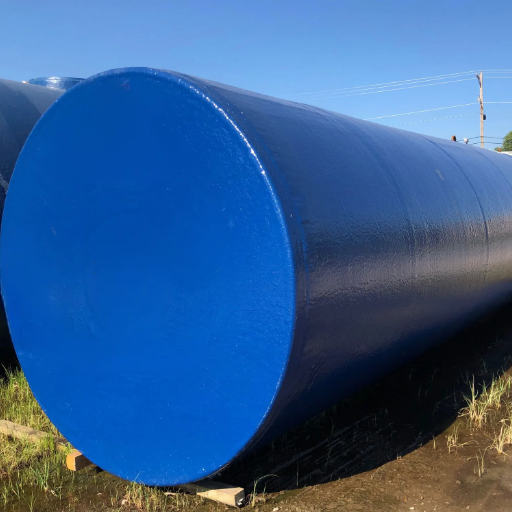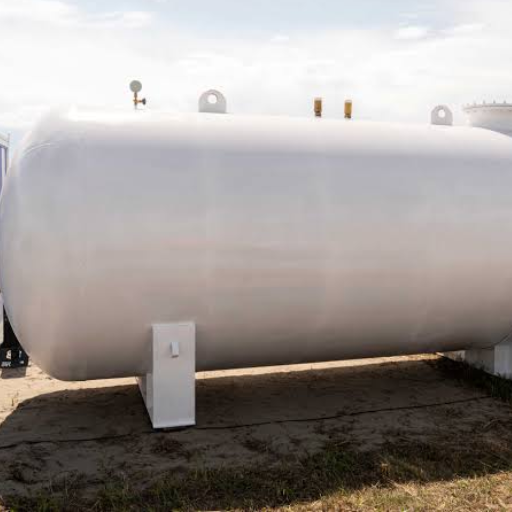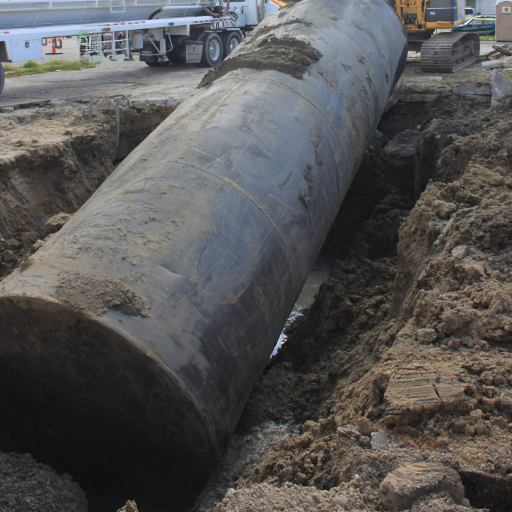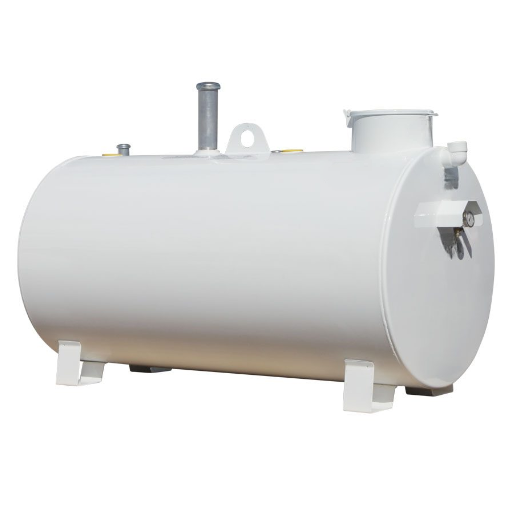
An empty tank in a wet hole is a boat.
That explains more failed installations than any other. A buried tank does not need a defect to rise. It needs to be empty, and it needs water around it. Soil that looked dry at excavation can saturate six months later, and the tank that sat level in February is off its bedding by July.
This guide covers underground storage tank anchoring as a design decision, from when it is required to the burial depth table, the calculation, and what to inspect before backfill.
If you need the full procurement procedure, how to specify an SF double-wall tank covers the submittal package and the rejection process.
What Tank Anti-Flotation Actually Means

Tank anti-flotation is the set of measures that hold a buried tank down against hydrostatic uplift. It combines burial depth, backfill weight, and mechanical anchorage so an empty tank cannot rise when groundwater returns.
Water weighs 62.4 pounds per cubic foot, or 8.34 pounds per gallon. A submerged tank displaces its own external volume, and the displaced water pushes back with the same weight. That is the whole mechanism.
The buoyancy force, in one number
An 8-foot-diameter tank, 28 feet long, displaces about 1,407 cubic feet. Multiply by 62.4, and the uplift comes to roughly 87,800 pounds, close to 40 tonnes pressing on an empty shell.
The tank’s own weight does not come close. A bare steel tank that size covers less than a sixth of the lift. The rest must come from the soil above it or from an anchor tied to something heavier.
Why the water table you see is not the water table that matters
Groundwater is seasonal. A construction schedule is not. An excavation in a dry month proves nothing about the water level in a wet one.
Four conditions put water around a tank even when the water table looks low: perched water above clay, runoff into an open excavation, clay backfill that traps water like a bathtub, and flood stage. The standards design for the worst case.
STI R011 and PEI RP100 both size the anchor for an empty tank with water to grade. Everything that follows rests on that assumption.
If the tank is not ordered yet, request its displacement, empty weight, and fitting layout with the quote. We supply those figures, so the anchor is sized once.
For the sensor side of that equation, our guide to interstitial monitoring methods for double wall tanks compares the available approaches.
When Underground Storage Tank Anchoring Is Required
Anchoring is required whenever water could enter the excavation and the soil above the tank cannot resist buoyancy on its own. In a flood hazard area, in high groundwater, or with a large-diameter tank, the cover is rarely enough.
The Steel Tank Institute’s anchoring practice for steel underground tanks, R011, gives the shortcut most projects use. Measure burial depth from the top of the tank to grade, then compare it with the table.
The burial-depth shortcut
| Tank diameter | Minimum cover, no slab | Minimum cover, 8 in concrete slab |
|---|---|---|
| 4 ft (1.22 m) | 26 in (0.66 m) | 24 in (0.61 m) |
| 6 ft (1.83 m) | 45 in (1.14 m) | 39 in (0.99 m) |
| 8 ft (2.44 m) | 63 in (1.60 m) | 58 in (1.47 m) |
| 10 ft (3.05 m) | 84 in (2.13 m) | 79 in (2.01 m) |
| 12 ft (3.66 m) | Anchoring required | Anchoring required |
At these depths, R011 states that the overburden outweighs the buoyancy of an empty tank with water to grade at a safety factor of 1.2. The 12-foot row has no depth because a tank that size is anchored regardless.
The figures are cover above the tank, not depth to the invert, and assume full backfill with suitable material. The table also assumes water can enter the hole; if it genuinely cannot, anchoring is a choice rather than a requirement.
When the table does not apply
Several conditions take a site past the table and into an engineered anchor:
- Tank diameter of 12 feet or larger
- Location inside a mapped flood hazard area
- A local code or manufacturer’s manual requiring anchors
- Manways, risers, or sumps that add displacement
The last point is easy to miss: buoyancy follows external geometry, so a fitting that adds volume below the water line adds lift.
What anchoring means in the code chain
In the United States, 40 CFR 280.20(d) does not prescribe an anchor type. It requires installation per a nationally recognized code of practice and the manufacturer’s instructions, naming API 1615, PEI RP100, and NFPA 30 and 30A.
The flotation requirement lives inside those documents, not the federal text. A claim that federal rules demand a particular anchor is wrong; they demand a code that does.
PEI describes the two classic methods plainly: strap the tank to a heavy concrete mass, and let the mass plus the fill above do the work. R011 supplies the dimensions, and the UST regulatory framework explains how state rules layer on top.
Sizing an Underground Storage Tank Anchoring System
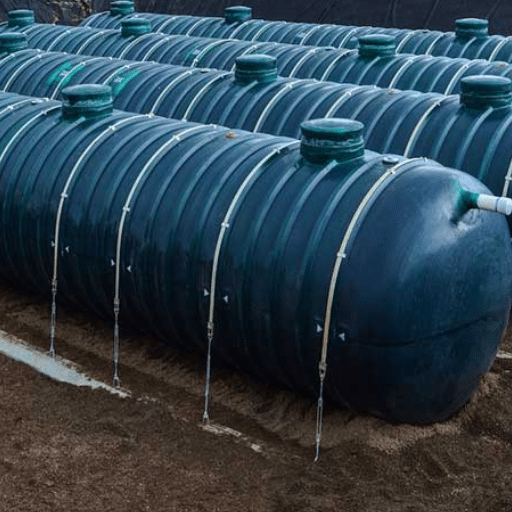
The uplift calculation
Uplift equals displaced volume times 62.4 pounds per cubic foot, using external dimensions that include manways, risers, and sumps. Nominal capacity is a product figure, not a displacement figure.
What counts as resistance
Three sources resist uplift, and two shrink once underwater. That is the part most first estimates get wrong.
Soil and concrete still weigh, but the water they displace pushes back: backfill at 120 pounds per cubic foot becomes 57.6 submerged, concrete at 150 becomes about 87.6. An anchor sized in a dry-site spreadsheet is usually undersized the moment the hole fills.
The factor of safety
R011’s burial-depth basis uses 1.2. A factor of 1.5 is the common target where the water table is uncertain, and vendor calculations for prefabricated systems often land between 1.2 and 1.3.
There is no universal number. The governing document sets it, and a specification quoting a factor without naming its source is not a specification.
The calculation has to match the hardware
The California State Water Resources Control Board made this point directly in its September 2025 UST program update. Proposed Title 23, chapter 16 regulations will require anchoring on every tank installed on or after January 1, 2027. They do not prescribe a method; the anchor must follow the manufacturer, an industry code, or a California-registered engineer’s specification.
The Board then described a failure it has already seen. An operator submits the tank manufacturer’s buoyancy calculations, then installs a different anchor system. The paperwork no longer describes the hole.
In the Board’s words: “Repairing a floated tank can be nearly as costly as installing a new tank.”
The lesson travels beyond California. When calculation and hardware disagree, the calculation gets filed, and the tank floats.
Anchoring Methods Compared
Deadman anchors
A deadman is a reinforced concrete beam along each side of the tank, with straps over the tank tied to anchor points in the concrete. Beam weight plus the soil above it resists uplift.
R011 sets minimums in a table rarely reproduced outside the standard:
| Tank diameter | Min. deadman height | Min. deadman width | Max. anchor spacing | Max. anchor point load | Min. anchor bolt |
|---|---|---|---|---|---|
| 4 ft | 6 in | 6 in | 96 in | 1,800 lb | 1/2 in |
| 6 ft | 6 in | 6 in | 96 in | 1,800 lb | 1/2 in |
| 8 ft | 12 in | 12 in | 96 in | 6,000 lb | 7/8 in |
| 10 ft | 12 in | 21 in | 72 in | 8,000 lb | 1 in |
| 12 ft | 12 in | 30 in | 45 in | 8,000 lb | 1 in |
Geometry matters as much as dimensions. The deadman runs the full tank length, its bottom sits at least as deep as the tank bottom, and its edge projects no more than 6 inches under the outer edge. Each section needs two anchor points or more, and no point may sit more than half the maximum spacing from either end.
The assumptions are 2,000 psi concrete at 150 pounds per cubic foot, backfill at 120, and A36 hardware. Different materials invalidate the table.
Concrete hold-down pad or slab
A pad works the same way in a different shape. It sits beneath the tank, tied with straps, 6 to 12 inches thick per PEI, with its weight plus the fill above doing the work.
R011 adds the geometry. The slab is at least 2 feet wider and longer than the tank, centered on it, with its top at least 6 inches below the tank bottom and suitable backfill between. The tank never rests on concrete. Rebar sits 3 inches in from the top and bottom faces, with two additional bars along each row of anchor bolts.
The slab is heavier, easier to inspect before backfill, and more expensive than deadmen.
Engineered, composite, and prefabricated systems
Suppliers offer alternatives to poured concrete: prefabricated deadmen, fiberglass and geocomposite frames that use soil weight, and helical anchors for deeper strata. They can solve real problems, but the calculation belongs to the supplier. If the submittal and the installed system diverge, the warranty and the permitting position both weaken.
Ballast, and why it is not a design
Water ballast keeps a tank on its bedding while it is set and backfilled. It is an installation tool, not an anti-flotation design, because a tank cannot stay full of water once the site stores fuel.
Hardware Rules by Tank Type

The physics is the same for every tank. The hardware is not, and the wrong pairing can void a warranty before the first wet season.
Steel tanks and cathodic isolation
A cathodically protected steel tank depends on electrical isolation to keep current flowing to the shell rather than to nearby steel. Anchor straps that touch the shell can become an anode.
The fix is dielectric padding between strap and tank, extending beyond the strap width so no steel edge contacts the coating. This is standard on STI-P3 style tanks and worth confirming on any coated steel installation.
Fiberglass tanks
Fiberglass tanks are lighter than steel for the same volume, which makes them more susceptible to uplift, not less. They also carry stricter hardware rules.
Manufacturer instructions for FRP tanks prohibit steel cable and round-bar straps against the shell. Straps are fiberglass or another non-marring material, placed only at marked locations over ribs, seated snug without deflecting the tank. Vertical diameter is measured before and after strapping so deflection can be checked against the limit in the manual.
For a prefabricated deadman, the Xerxes installation instructions specify three rules: top of deadman aligned to tank bottom, deadman outside the tank’s shadow, one strap per anchor point.
SF and composite double-wall tanks
Steel-fiberglass and composite construction changes weight and fitting count, not the physics. The submittal still needs external displacement and empty weight, and both differ from a single-wall tank of the same nominal capacity.
Manufacturers of fiberglass double-wall tanks and carbon steel underground storage tanks publish figures for their own models. Use those rather than a generic table, particularly above 10 feet in diameter.
For comprehensive information, please read our double-wall fuel tank specifications explained guide.
Straps, padding, and tensioning
Three details separate a working anchor from a damaged one: padding wider than the strap, even tension across every anchor point, and no strap against a sump or manway. An over-tensioned strap concentrates load; an under-tensioned one lets the tank move. Neither shows up until the hole fills.
Installation Sequence and Inspection Points
Underground storage tank anchoring is decided at design, built during installation, and verified before backfill. The wider sequence sits in our guide to underground fuel tank installation; this section covers only what protects against uplift.
Dewater before the tank goes in
Pumping down an excavation is normal practice with a limit. If water cannot be held below the tank bottom, the tank needs a completed anchor before it is set, or temporary ballast. An empty tank in a hole that can fill overnight is the dangerous condition, and a rainfall event between setting and strapping is enough.
Bedding, strapping, and backfill
The tank sits on bedding, never on concrete. Where a slab is used, backfill separates the slab from the tank bottom, and the bedding above the slab is compacted before the tank is lowered.
Straps go on before backfill, at marked locations, with padding in place. Tension is checked on every anchor point, not just the first two. For steel, the inspection point is coating damage; for FRP, it is the vertical diameter measurement.
Ballast stays until backfill reaches the height the manufacturer specifies. Removing it while the tank is half backfilled returns the tank to its lightest state at the moment it is least restrained.
The inspector’s checklist
Before backfill, an inspector should confirm:
- The anchor type matches the design submitted for the permit
- The buoyancy calculation uses the installed anchor, not a different one
- Deadman dimensions and spacing meet the standard or supplier table
- Straps are padded and seated at marked locations
- Tension is even, with no contact on fittings or sumps
- Bedding separates tank from concrete
- Ballast is at the specified level, or released only after the specified backfill height
If any item cannot be confirmed, backfill is the wrong next step.
Cost and the Five Ways Anchoring Fails

What drives the cost
Five variables set the price: method, tank diameter, water table height, engineering sign-off, and dewatering.
Deadmen generally cost less than a full pad, which is why they are the default on high-water sites. Containment Solutions states it plainly: deadmen “are just as effective at preventing tank flotation but cost less than a concrete pad under the tank.” Engineering sign-off is not optional where a permit requires it, and the overall underground tank cost picture is incomplete without it.
The five failure modes
- Anchoring skipped on a dry-day water table. The hole was dry at excavation, so no anchor was designed.
- Calculation and hardware do not match. The submittal describes the supplier’s deadmen; the contractor poured a pad.
- Strap damages the shell or coating. Unpadded steel on a coated or FRP tank.
- Tank placed in contact with concrete. No bedding layer, point loads on the shell.
- Ballast removed too early. Water drained before backfill reached the required height.
Every one is a process failure, not a product failure, and none is visible after backfill.
If you are comparing options across sites, the vertical tank foundation guide covers the aboveground equivalents, where wind and seismic uplift replace groundwater. The failure logic does not change.
Frequently Asked Questions
Do underground storage tanks need to be anchored?
Only where water can reach the tank and burial depth is insufficient. On a dry site with adequate cover, it is not required; with groundwater, flood risk, or a large diameter present, it is.
How deep must an underground tank be buried to avoid anchoring?
Using R011, an 8-foot tank needs 63 inches of cover without a slab and 58 inches with one. A 4-foot tank needs 26 or 24 inches. A 12-foot tank cannot avoid anchoring through depth.
Deadman anchors or a concrete pad- which is better?
Both satisfy the same calculation. Deadmen cost less and suit most sites. A pad gives a wider, more inspectable base and suits soft soil or a high water table.
Can water ballast replace anchors?
No. Ballast keeps the tank seated while backfill is placed. It cannot remain once the tank holds fuel, so it cannot resist flotation over the tank’s life.
Can a fiberglass tank float?
Yes, more easily than a steel tank of the same volume. Lower shell weight means less resistance for the same displacement, which is why FRP tanks carry stricter anchoring rules.
What happens if an underground tank floats?
The tank lifts off its bedding. Piping, fill lines, and sumps take the strain, and the usual result is a sheared fitting and a release. Repairs approach the cost of replacement.
Who designs the anchor, the manufacturer or the engineer?
Either can, but the calculation has to describe the hardware installed. Where a permit requires a stamped design, a registered engineer takes responsibility.
Conclusion
Underground storage tank anchoring is a subtraction problem with real consequences. An empty tank displaces water, the water pushes back at 62.4 pounds per cubic foot, and the anchor plus the soil must exceed that number with a margin.
Four things decide whether it works. The burial depth table sets the threshold, the calculation sizes the anchor against the installed hardware, the tank material sets the harness, and the installation sequence keeps the tank down until the soil takes over.
Before signing an installation contract, ask three questions. What displacement figure did you use? What factor of safety, and from which document? Does the anchor in your quote match the calculation you submitted?
If the answers do not match the paperwork, the site is not protected, whatever the price list says.
Planning a high-water-table installation? Contact our engineering team for tank dimensions, empty weight, and a buoyancy calculation package.